Scarred. What the Pandemic means for inequality.

SeeSaw

The numbers amaze. Economies stopped and now as we get new data coming off such a pulverised base, the percentage growth numbers can dazzle on the upside. This can take forecasters by surprise – recent jobs numbers in the US are a good example, as are UK retail sales.

Economic growth is a good thing – very good. But hard as it might be, the focus needs to be on the quality of that growth as much as the quantity.

On issues such as sustainability or climate change, this does seem to be taken on board. There is a clear green tinge to many public investment initiatives. Governments have been made aware of the demands of the public, especially the younger cohort, for a clear green agenda in practically all sectors. The Swedish government’s attached conditions, regarding carbon emissions, in a recent financial injection into the airline SAS, are an example of how the emergence from the pandemic will have a greater sustainability imprint.

However there is another aspect where we need to be vigilant and that is the issue of income inequality.
Inequality in income distribution in countries and across countries already was a severe and growing problem. There are clear social consequences from the trend. But the other aspect of this is that quite simply it slows economic growth, leaving permanent scars.

Every pandemic in the twentieth century has led to increased income inequality.

Covid-19 has disproportionately hurt disadvantaged groups. While many people have been adversely hit by the health emergency and government mitigation measures, those with a lack of savings or insurance are impacted the most by a sudden loss of income. Workers in the informal economy with weaker job attachment or those in low skilled service sector occupations also bear brunt of the lockdown. In the developing world employment numbers for those with only basic skills fall by 5% over a 5 year period after a pandemic according to the IMF. Higher skilled workers and those with advanced education fare much better.

Educational prospects are severely impacted by the global lock down. The United Nations estimates that more than half a billion children have lost their access to education through this period. Lack of internet access and lack of appropriate devices is a significant factor in this, and according to the UN, Primary school children have been most impacted. While a concern globally, with potential long term consequences, it is especially a problem for emerging economies who face higher levels of “learning poverty” – an inability to read or understand a simple text by age 10.

Another feature of income inequality is that many people and indeed small companies don’t have full access to financial services and technology. Limited access to credit increases vulnerability both at individual and company level when cash flow simply stops. This leads to job losses and business closures which turns further widens the gap.
History shows that the greater the pre-existing inequalities, the more uneven is the impact of the pandemic. Income equality will hold back the strength and durability of growth.
In some countries the early experience isn’t great. In the US many of the financial measures aimed at lower income groups are set to expire in August – with little appetite from Republican politicians to extend. On the other hand a lot of tax breaks and provisions favour the already wealthy – according to a Congress Committee, 82% of those who stand to benefit earn at least $1m. annually.

We need a more inclusive recovery.

It is good that governments around the world have deployed extraordinary measures swiftly and will continue to do so, but the shape of that investment matters if we’re to prevent long term scarring of the global economy.
Healthcare and social protection need to be high on the agenda if we are to prevent the mistakes of history. Education needs investment with a view to ensuring wider access to the digital classroom. Failure here may cast the longest shadow. Access to high quality childcare must expand, which in some cases may boost female participation in the labour force and ultimately long term growth. It will be important to harness the power of technology in other areas as well as education. Financial inclusion can matter. If we broaden the access of low income households and small businesses to finance, it may be possible to smooth the experience during a cash flow shock. The IMF estimate that there can be a 2 to 3 percentage point difference in GDP growth over the long term between financially inclusive countries and their less inclusive peers.

Education, health-care, social protection, and technology should all be points on the compass as we navigate a path out of the down-turn. It would be important that there is co-operation and cohesion within and between regions. Policy measures, where they can, should be concerted and consistent.

That could be the challenge in a world where borders and minds may be closing.


Note: This article first appeared in the Sunday Business Post.

Beyond GDP. Using other measures to fine tune our exit from economic lock-down.


Toll Picture

At this point in the pandemic, what becomes very important is measuring the extent of economic revival as economies across the globe look to reopen and map any impact on the spread of the virus.

Being able to measure economies is tough at the best of times but given the size of the shock and the wide extent of the dislocation, it is now especially challenging. Most economic numbers, like GDP or unemployment ,are backward looking or lagging and tend to tell us how things were rather than how they are. And indeed most of the headline grabbing economic figures are subject to subsequent material revisions.
Survey data from both businesses and individuals, such as PMIs and consumer sentiment , can be more timely, but can be heavily influenced by the psychological shock of this epidemic. For example, looking at survey data in Europe last week, it has come out materially different from market expectations in both positive and negative directions. While we are this close to the outbreak, it is likely to remain “noisy”.

Now more than ever, we need to have robust and timely measures of how we are doing.

The IMF has recognised this and highlighted how useful other indicators may be in framing a view. These can be more frequent, more timely and more robust than say GDP calculations, if perhaps a bit unconventional. Included in these indicators could be electricity consumption, traffic count, HGV journeys, metro footfalls, weekly retail sales data etc. While they do require care in interpretation, they can also provide a good picture of underlying real economic momentum – and in a timely manner.

So how are we doing?

Some indicators don’t surprise. Air travel in Europe, as we know, has basically stopped. But it has been on an upward trend in China since the beginning of April and in the US from about two weeks after that, reflecting easing of conditions. The pace in the US has especially picked up in more recent weeks.

More generally in Europe we have seen a gradual pick up in mobility, road traffic, car registrations and retail sales albeit from very depressed levels.
This higher frequency data also highlights the gap between different European countries, with a relatively more robust north and a trailing south. Traffic through toll roads in Italy and Spain, at its low point in late March, was down 80% on a year on year basis, but has recovered to being “only” 50% down. By contrast truck traffic in Germany is much stronger at just 5% below its level at the start of the year.
Electricity usage is comfortably past its low in most countries but with Italy showing the greater pace of pick up in recent weeks.

Car registrations in some countries have improved quite dramatically in recent weeks. In Spain from a level of zero at the start of April, daily car registrations are now running at a daily rate of about 4000. The average through 2019 was about 6000 on a daily basis. France also has seen some momentum here with the most recent weeks running at about 80% of last year’s level. Clearly, there is a replacement cycle and pent up demand issue, but it still represents big ticket spending by the consumer.

One of the more unusual items now being focussed on is global maritime data from the Automatic Identification System (AIS) – basically ships’ radio signals – to show how international trade is being affected by the pandemic. Analysts can see if activity is picking up, is it finished products or commodities and what are the destinations? This trade data is available daily and in real time while official statistics can be delayed by weeks.

One encouraging sign has come from looking at internet data – and this has been pretty similar across the major European countries. Since the start of May we have seen a significant uptick in the level of internet enquiries into holidays and holiday accommodation. The level is still way off what we would have seen at the start of the year but perhaps a sign of improving confidence.

This non-traditional higher frequency data can, in the view of bodies such as the IMF, complement the official statistics especially at a time when we may see disruptions to the data. In many examples the focus is on level rather than growth rate which is important because we are still so far off normal levels that percentage changes can be misleading.
The verdict on this recovery so far – it’s started but uneven across regions and sectors and certainly not V-shaped.

This article first appeared in the Sunday Business Post

What’s going on? Forget the numbers What are CEOs saying?

Business Numbers


So Q1 was a write-off and there is zero visibility on business outlook.

But I believe there is value in looking at what CEOs, the people who actually run companies, are saying, to get a better sense of any unique or emerging trends within the downturn, and whether these trends may persist.

As of this week, we’re about 25% through the S&P 500 in terms of earnings reports. Normally this is a highly choreographed process with most companies beating the analysts’ forecasts, which the companies themselves have already had a strong hand in guiding. For the record, according to Factset, earnings to date are in aggregate about 5% below what had been forecast.

But the numbers don’t matter and guidance is cancelled.

In the face of the pandemic and the downturn, that’s the only honest response.

But we can look at the currents beneath this overall bleak picture. What are CEOs telling us?

Front line sectors, such as Airlines, are getting hardest hit. Oscar Munoz, CEO of United Airlines said that travel demand into 2021 was ‘essentially zero’. They flew 200,000 people in the last two weeks. The corresponding number for 2019 was 6 million – a decline of 97%. The company has cut its capacity to 10% of what it had previously planned. United see demand depressed into 2021, with one of the longer term impacts from the pandemic being less flying with more use of remote sessions and less business travel overall for what Munoz describes as “hand-shake” meetings. Cost cutting at companies will probably drive this also.

Coke is another consumer stock that saw its sales knocked but James Quincey the CEO sets a more positive tone believing that the back half of 2020 will see an improvement. The company has seen a 25% decline in global volumes this month alone – fully driven by the measures adopted by governments to tackle the pandemic. What Coke calls “away from home” sales – cinemas, sports venues etc. represent half the company’s revenue and have clearly disappeared. Home buying and “pantry building” (as Coke describe it) did not make up the gap and really it’s not that clear that it will in the near term.
It has been a similar picture for the management team at Heineken. Jan Francois van Boxmeer highlighted the 14% decline in their volumes in March and sees recovery being wholly dependent upon lifting of restrictions. Heineken’s response is to double up efforts on the retail side as they believe pubs aren’t coming back soon. So look for a bigger presence and profile from the likes of Heineken in your local supermarket!

Some company chiefs while not complacent, took more comfort from the resilience of their business model and less substantial exposure to discretionary spending. Arvind Krishna, CEO at IBM, while not giving guidance stressed the resilience of their customer base – 70% of their customers would come from healthcare and telecommunications – so perhaps less affected by the lock-downs and lack of travel. IBM focus on stress testing their business model and driving their cloud business. If business budgets were to be severely reined in, it would no doubt impact, but the message from IBM is; we’re not there yet.

Even companies whose products have been flying off the shelves look to strike a cautious tone in their comments. Mike Hsu, CEO at Kimberly Clark, maker of Andrex toilet rolls, spoke mainly about health and safety of staff and security of supply chain while acknowledging that their cash flow in the quarter more than double to over $700M. A degree of stock piling saw their global sales of toilet tissue up by 17% outside the US. Hard to imagine that was in their corporate planning assumptions!

Some company results highlighted the difference between the US experience and the more stark picture earlier in the year in China and Europe. Hershey,the chocolate manufacturer, pointed out how they had a solid start to the year, and in fact for the quarter as a whole saw reasonable demand in the US. However, chocolate demand in China declined by 8%. The company are alive to how consumer behaviour and social distancing protocols in the US may impact on their bottom line as the pandemic has spread. But as CEO Michele Buck pointed out, as a chocolate maker, their key “ability is to be able to make moments of goodness during this time when physical connection is limited.”(!)

One of the high profile names who has a better experience in this first quarter and gained a lot of attention was Netflix. They added nearly 16m subscribers, well over double what had been forecast. However there was little triumphalist in their letter to shareholders though, as they rightly acknowledged how tough the environment is for jobs and activity in the overall entertainment industry. The company notes how it is in a fortunate position and has contributed funds to support many of those who will find themselves out of work. Netflix also see a time, as home confinement ends, that their stellar subscription growth rate falls back – and they look forward to it!

It is very much a mixed tapestry of experiences for companies in the current situation and some are clearly more exposed than others. There is also a clear tone of corporate responsibility underlying a lot of what CEOs are saying. The speed and severity of the virus has impacted on all, but as many of the comments reveal – it may have taught humility but not helplessness.

What markets and managers are looking at now.

Turmoil

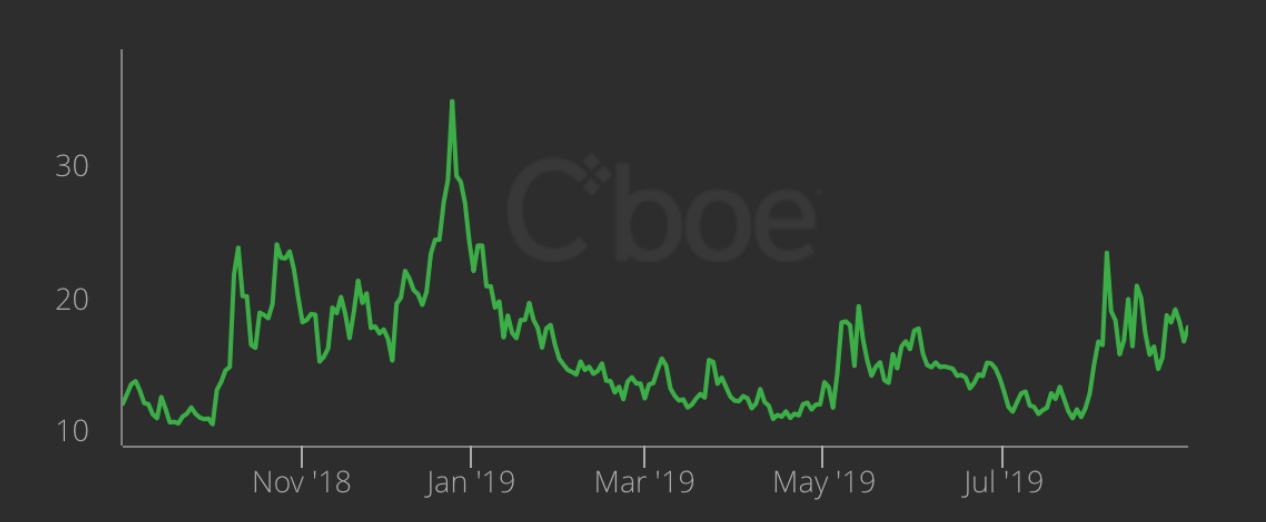
In recent days, the tone in stock markets seems to have changed from the panic tumbles on high volumes that we saw in mid-March. Volatility as measured by the VIX index has also reduced though still at elevated levels, but generally we have seen less of the 5-6% moves upwards and downwards on a daily basis.
A general read across what investment managers are thinking also suggests a degree of caution, though many are painting out what their exit strategy from the crisis will be, and how they will position portfolios accordingly for the ‘next new normal.’

The speed of the spiral downwards in markets is what many managers remark upon most, as well as the sheer scale of the monetary and fiscal action activated and proposed, that was required to stabilise markets at lower levels. Market moves reflected the ebb and flow of confidence that policy makers were alive to the seriousness of the issue. But now, governments and central banks have set their stalls out; and medical facts such as mortality and new cases have played a greater role in the past week. Political interpretations about those medical facts have played some role in market moves in the US.

Markets may scour the data for direction on a very short term basis, as we saw early this week, and we may see high frequency traders or hedge funds look to play. Given that the medical facts won’t move in a straight line, this means continued volatility, albeit at lower levels.

But large long-term investors are likely to look for clear, sustained, and meaningful improvements in the numbers to change their asset allocations to being more positive.

For investors, there are several features on the landscape that pose difficulties in framing or timing an appropriate investment strategy.

The actual degree of uncertainty in the current environment is unparalleled.
There is absolutely no clarity on economies or companies. For example, how bad will the US jobs market get? There is a very wide range of forecasts, with Goldman Sachs, for example, expecting US unemployment to peak in the third quarter at 15%. However at the same time, the Federal Reserve in St. Louis suggests a 30% unemployment rate is possible. It hit 25% during the Great Depression.

Forecasting company profits is even more problematic.
We simply don’t know.
Many companies have ceased making forecasts or giving guidance to analysts. Without such guidance, many analysts struggle to arrive at a meaningful number. Analysts have also in the past been slow to catch up to reality. At the start of the year, the average estimate from all analysts for company profits growth in the US this year was about 8% positive. Last week that estimate was -3%. But the final outcome, given falls in revenue and in margins, is likely to be an earnings hit closer to -30%. The sectors being hit the most include consumer discretionary and energy with consumer staples and healthcare holding up well.

It is clear that there is plenty room for shocks on both the macro and the individual company level.

Markets may also hold different challenges for different types of investors. Take the case of income investors – those funds that especially value the importance of dividend income in their investment process. This is a very significant group of funds in the UK for example. In an environment where many corporates will be starved of cash flow, paying cash out as dividends may put the overall enterprise at risk. So we will see certainly a reduction in dividends and in some cases cancelation. Regulators in the UK and Europe have urged banks and insurance companies to pause dividend pay-outs. Overall UK dividends are expected to be down by 50% and US by 25% in 2020.
Share buy-backs (which have been seen as a strong support for stock market levels) will go the same way. Many companies in the US have already suspended buy-back programmes and the expectations are that for the full year we could see a reduction of 50%.

Some investment managers fear a more inflationary environment in the future, as we may have supply constraints at the same time as fiscal and monetary policies stoke demand. While it could be an issue in the very short term, it is difficult to see inflation being top of the agenda. We know how long it takes for policy (especially monetary policy) to drive demand – the last six years of QE haven’t seen economies really take off. Also supply chains can be rebuilt. The experience from Avian Flu and SARS supports the view of little inflationary impact.

Given the overall and unparalleled level of uncertainty, it is not surprising that there is a range of views among fund managers. Some managers, such as hedge funds, may have very different time horizons and look to capitalise on shorter term market moves. Others may adopt very non – consensus views. One-UK based manager is using the Black Death of 1348 as their template for the timing and severity of the down turn. Most are somewhat less stark in their assumptions.

Broadly, investment managers at this point see the pandemic as a serious but temporary shock. They remain diversified and vigilant. A sustained improvement in the medical facts (fewer new cases), and some degree of visibility around corporate health, are what long term investors will look to, to frame the next stage of their strategy.

The investment risk is the same as the universal risk – as one fund manager put it: “a second wave of infections within countries that successfully controlled the first wave”. That would mean more drawn out economic contraction, more serious market impact and more overall uncertainty.


This originally appeared as an article in The Sunday Business Post on April 12 2020

Investing and Covid-19

MKT Graph

Financial markets fully reflect the current and future uncertainty that society is facing.
While this is first and foremost a humanitarian tragedy, it is having daily and dramatic impacts on markets, and will leave a lasting footprint on our global economy.
We see violent swings in stock markets on a daily basis. Circuit breakers (which suspend trading for a period) are triggered regularly and the idea of closing markets for more sustained periods has been mooted. Robust monetary and fiscal measures aimed at restoring confidence are having little sustained impact. There may be greater success with full on globally coordinated and clearly communicated measures. The IMF notes that while quarantining and social distancing is the right prescription to fight the virus, a healthier global economy requires the opposite policy action – constant contact and close coordination.

What has been the investor experience?
We have seen historic falls in stock markets. From its high in February, the US S&P 500 is down (at time of writing) by about 30%. To give this some context, since WW2 in S&P bear markets, the maximum drawdown has been 34.5% on average wiping out 65 months of prior gains.
Selling is broadly indiscriminate, but with front line sectors such as airlines, consumer discretionary, hospitality, etc. bearing the brunt. Geographically it’s red ink everywhere but Europe has been getting hit the most, reflecting it’s COVID 19 experience. Sectors like healthcare and technology have to date been performing better though still substantially down. Volatility remains extreme and this argues against taking any dramatic portfolio action on a day to day basis.
As for “safe havens” like bonds or Gold, performance is mixed. Gold went nowhere for about 5 years until 2019 when it began to perform and has been reasonable in the current crisis though it has given up a lot of ground since late February. This may be because there is a “dash for cash” from investors generally, or that Gold may be a crowded trade, as recent falls have been significant.
Government bonds had held up well. Lower rates and bond buying are clear positives and these low rates are here for some time. But even here the prospect of ballooning government deficits has weighed against the asset class in recent weeks.
And there has been some stress in the Corporate Bond market, principally in the US. Even within “investment grade” bonds, we have seen a deterioration in quality as many US companies had seized the opportunity to load up on cheap debt. Looking at both the blow out in the yields, as well as the costs of insuring against default, we are likely to see some company failures as result of drastic trading conditions over the next three/six months. An oil price that has declined by 50% in the last 12 months is a further hit to Energy companies, who have been to the forefront in raising capital.

Many people see the impact of these overall asset moves most directly in their pensions or investment savings. Of course, not all pension funds are the same and indeed the mix of a typical fund has changed significantly in recent years, with greater exposure to so-called “alternative” assets. Based on the average asset mix for standard pension funds here in Ireland, stocks are still the largest single investment category at over 60%. Stocks are an excellent long term asset class for achieving growth, but in the short term, can have a negative impact.
So far this year, the average pension managed fund in Ireland has lost about 20% in value.

What can investors expect?
We are in an economic recession. The only question is how long and how deep.
We are going to see a wave of downgrades to economic growth, domestically and globally, as forecasters refresh their numbers.
There will soon be massive downgrades to company profit forecasts, with, critically, almost zero confidence in those new forecasts, until there is greater visibility in the profile of the virus.
We will see downgrades and defaults in company debt and not all companies will make it through.
Volatility is likely to continue.
We should expect to see some fund closures or suspensions, as illiquid assets can’t be sold in the face of redemptions. We have seen this in some funds in the UK already.
All in all a very difficult background for investors.

What should investors do?
Firstly, some of this bad news is already reflected in the seismic moves we have seen already.
But we are likely to see further tough days. Reassuringly, policy priorities from governments are appropriate – get as much resources (human and financial) into our health systems, intervene and alleviate cash flow problems for individuals and companies, ensure that the “financial plumbing” (access to credit) doesn’t gum up. Government deficits will widen dramatically – as they should.

Investors need to stay truly diversified in terms of risk. In times of financial stress, assets don’t always perform as history dictates, and what may appear as a safe haven may not perform like one. Assets that should be uncorrelated may move together. And importantly what may look like a liquid asset or fund may not turn out to be so. At times like this it is important to examine an investment portfolio under these headings of risk, correlation and liquidity.

Advice is important but investors should also be careful in the advice they listen to. This is a crisis unlike any others in recent times for financial markets and indeed society overall. Normal metrics of what constitutes cheap or dear, opportunity or threat may not apply. Rather than price to book or price to earnings , net new cases may be a more important metric to focus on. Reacting dramatically to siren calls from commentators or analysts about whether to buy or sell is not appropriate. It is a time to be measured in response and action, and not to overreact.

Deliberate calm is how investors should frame their strategy – try and detach from a very fraught and frightening situation and think clearly about navigating through it to the other side, guided by long term goals amidst short term volatility.
As investors, Covid-19 may teach us humility, that does not mean helplessness.

This originally appeared as an article in The Sunday Business Post March 22nd 2020

What’s all this Diversity carry-on…..?

Diversity Image


Prove it.

That seems to be a mantra among those who struggle a bit with the seismic shift we are seeing today in the role of Environmental Social and Governance factors (ESG) in asset management.
For issues such as climate change or global warming which may not be observable, up close and personal, in our day to day experience, I can maybe see how a debate could form. But there are other aspects of ESG which quite simply stare us in the face.

Diversity is one of these. Greater diversity in organizations, and in decision making, is seen as a mark of good governance and is promoted and sought after by lobby groups, regulators and governments alike.
Not only is it the right thing to do but it leads to better overall outcomes both in terms of risk or reward.

And does it?

There has been huge research in this subject with gender diversity being especially studied. While there is a wide body of evidence, McKinsey and Mercer have been among those to the fore.

The conclusions I’ve seen on greater diversity, are all unambiguously positive and powerful.

Just to give a flavour:
Peterson Institute: increasing female participation at corporate leadership level up to 30% associated with 15% boost to profitability.
Gallup: Gender diversity strengthens company financial performance through greater engagement levels.
McKinsey: Companies with the greatest gender diversity shown to have 15% superior financial returns.
Harvard Business Review: Positive correlation between diversity and financial performance both in terms of risk and reward.

There is a growing body of research that draws similar conclusions – that diversity (gender and other wise) is a positive contributor to outcomes.

 
We have seen enough evidence, especially within the asset management industry, where features like dominant individuals, unchallenged practises, groupthink, etc.(all the opposite of diversity!) have led to disasterous outcomes for clients.

So while diversity may seem like one of the softer factors within the ESG family, it has been shown to have quite powerful outcomes and certainly worthy of inclusion in the investment process.

But it’s a two way street.

For some, the fact that the asset management industry, now with its new found drive and passion to manage funds on an ESG basis, is highlighting and championing issues like diversity is sadly ironic. Asset management companies themselves also need to be held to account for their own performance on diversity metrics. Mark Carney has described the levels of gender diversity in UK financial services as “shocking”.

This suggest that there needs to be a conversation between the likes of pension trustees and their investment managers, to view the ESG debate in the round and ensure that both are making meaningful progress.

Is it time to fire your fund manager?

Sugar

It may be the most important decision faced by all investors be they pension trustees, family offices, multi-managers or individuals – and it’s a lot riskier than you might think.

There are a range of scenarios where the trigger will need to be pulled and some are quite straight-forward.

Trust: This is a key feature of a healthy relationship between fund manager and investor and if for any reason this is compromised it’s a strong reason to move. This could be a breach of data or confidentiality and while it may not impact on current performance, it does not augur well. Surveys show that this is actually the top reason for getting investment managers fired. A CFA study showed that 30% of institutional investors do not trust the asset management industry!

Reputation: Do any changes/statements/decisions at or impacting on the fund management company impact on your reputation or your relationship with customers, peers, sponsors etc. Increasingly this can be prompted by the industry regulator. Again I think this is relatively clear cut.

Manager moves: What if a great manager moves on elsewhere? Do you follow? Do you stick with the current management company? My experience has been that there is no single answer. I’ve seen managers move and carry on with excellent numbers without skipping a beat . I’ve also seen “moving managers” crash and burn. Best option is refresh your primary due diligence on both original and destination set up.

Performance: This is the tricky one and the one where I suspect most trustees or groups spend time on. How long do you accept under-performance? 6 months?, 2 years? Many will feel some form of “emotional” investment with the manager choice and hope for a turnaround. It becomes an issue at each and every meeting. It’s natural just to want to be rid of the “problem child”. In the end it can often be just capitulation leading to the firing.
However the performance numbers suggest it can turn out to be a bad decision. Investors often buy into a manager who has already been doing well and sell out just before the old manager begins to recover.
TABLE Perf
You can see how high turnover of managers based on performance can eat into long term returns.
Performance is the riskiest set of issues around which to change a fund manager.

Style Drift: This can be like the US Navy SEAL of factors – silent and deadly. Basically if the manager changes what they are doing from what they said they would do, it’s time for a change. This can happen over time and performance may continue to be delivered but failure to identify such trends can have a major negative impact on fund returns and indeed investment capital itself. For example if a manager had a long term profile and history of investing in liquid large cap income-producing stocks, but begins to move into illiquid technology and bio-science smaller companies, alarm bells should ring. There is currently a high profile example of this.
Red flags here can appear early, and close monitoring of portfolio holdings is the key to taking prompt action.

The toughest thing can be leaving a manager who is performing well. A tough thing as well can be allocating new capital to a manager whose performance is slipping. Both should be considered in the overall portfolio management

House!

Hibs

Are we looking at the wrong things in our financial market outlooks?

If you’ve ever had the misfortune to play soccer at really, really low levels, say pub soccer or summer league, there may have been occasions when just as you’re setting up and steadying yourself to take that elegantly curved shot that will skim over the oncoming full-back and nestle in the top corner of the net, you’ll hear a cry of “House!” from one of your teammates.
It translates as Watch your house! or Mind your house!

What it means is that while your focussing on your shot, wind speed, and the players in front of you, there’s a six-foot muck-spreader, bombing towards you from behind, whose only shred of thought in his Neanderthal brain is to break your legs.

Last week, the Federal Reserve Bank of New York shouted “House!”

The FRBNY is one of the 12 districts that make up the US Federal Reserve or Central Bank, and while most market commentators look at GDP and earnings and interest rates, in this call the New York Bank is highlighting financial risk – serious risk.

And the source of this risk is the corporate bond market.

US companies rely much more on the bond market for raising money than their European counterparts. The size of the US Corporate Bond market is currently over $9.2 trillion! We know that US companies have been on a borrowing binge and that a lot of this debt has been used for share buy-backs rather than “real” capital investment.

The risk to financial stability comes from how this corporate bond landscape has changed.

Basically investment grade bonds ,that is those of better quality than High Yield (or Junk as it used to be called) ) have seen a significant deterioration in their characteristics. This work echoes research by the Federal Reserve itself showing that the most rapid increases in debt have been among the riskiest firms!

Within Investment Grade the number of higher rated firms has reduced – today there are only two firms rated AAA, the top of the pile; Johnson & Johnson and Microsoft. And it’s in the lower rated sector within Investment Grade where the bulk of the borrowing since 2016 has taken place – even more than in High Yield. And this increased amount of debt has been at longer maturities – around 4 years as opposed to 1 year at start of decade.
This increased borrowing has had an impact on the quality of these bonds. Leverage, – that is debt compared to assets- has increased. According to the New York Fed, investment grade debt (because of higher leverage) is now as risky, if not riskier, as the supposedly poorer quality high yield sector.

In sum, a large component of the corporate bond market is now riskier – poorer quality and longer term- than many might have assumed, but is still getting a reasonable rating.

This is manageable if rates stay low, which is probably reasonable.

The real risk is if we do see an economic downturn with its impact on revenues and ability to pay, the consequent outcome of poorer returns, higher default rates and ratings downgrades constitute a serious threat to financial stability. Ratings downgrades could lead to some degree of forced selling.

This level of debt does not imply a recession but says that if there is one it may be scarier and more severe than some think.
And remember, corporate bond markets have often played a role as an early warning signals for assets overall

Investment Management – the Next Ten Years

Astro

Asset Management – the next 10 years

What will asset management look like in 10 years-time?

Well despite the headlines you may read, what it won’t look like is –

One global player using an Artificial Intelligence driven algorithm to invest passively on a rigorous ESG basis and doing it all for nothing.

Change in investment management is incremental . Think back 10 years ago and compare today to see how nuanced changes can be in asset management. Neither the past nor the future is a thoroughly different country.
But there will be change.
And there have been a number of very solid forward looking thought pieces recently notably from PWC and McKinsey which look at this.
Where are we most likely to see changes?

The Firm
Fewer names? Probably. It’s hard not to see consolidation continue and mainly due to, on one side, the cost of the regulatory infrastructure necessary, coupled with pressure on fees. In asset management it’s not just large acquiring small, but industry leaders are also very open to corporate activity – viz Standard Life and Aberdeen. Regulators globally are very focussed on the systemic risk of asset management. And the industry hasn’t been doing itself any favours recently with high profile cases around issues such as liquidity and closet indexation.
But the reason for the “probably” above is that we may also see a wave of pure investment-
only firms emerge. The “hub and spoke” model with the centre providing finance and compliance functions to a wide number of stand-alone boutiques has much to recommend it. Where investment firms do look to outsource functions such as compliance or governance it will be very important that roles are clearly demarcated and responsibilities fully carried out.

Income
Fund management fees have come down – and will continue to do so. In the US as an example, headline fees charged dropped by 25% in the past 5 years. There are two seismic forces driving this. Firstly the increasing availability of, and choices within the whole area of indexed funds, ETF’s etc. As volumes and competition grow we will see further price pressure.
And on the other side we have the increasing role of financial regulators who are rightly demanding transparency, value for money, and clarity around fees. Both the Central Bank of Ireland and the FCA in the UK have expressed concerns here – specifically on performance fees. Today there is still too wide a range of fees being charged especially at the retail level and we should expect average fees to fall further. However we shouldn’t confuse price with volumes. The asset gathering industry will see significant growth over the next 10 years, and for the winners this will offset any pricing pressure.

The Product
Will investment managers be manufacturing the same product in 10 years-time. Based on the trade press you would be forgiven for thinking all the demand and attention will be on alternatives, passives and ESG strategies. Certainly the clamour around ESG is deafening and practically every manager seems to have an offering. New government directives on ESG for pension funds will support the market’s attention span. I believe this is more than a passing phase, and we will see more investment following the ESG theme. However there needs to be a winnowing out amongst all the current offerings, greater consistency in what actually determines an ESG process, and greater scrutiny of performance amongst providers.
Does this imply the end of what has been a core asset class of many funds – active equities? Recall the BusinessWeek cover from 1979 entitled ‘The Death of Equities”. Well once again any obituaries might be premature. McKinsey estimate that in 5 years-time, active equities will still represent the second largest component of investment management revenue. Active will have to be active, with no hint of closet indexing. And be demonstrated through high active share, concentrated portfolios and……..performance.

So where will the change be….?
So definitely we will see incremental change across most aspects of investment management, but where are we likely to see the greatest dynamism? The PwC study, which looks at the alignment between what managers deliver and what customers want, provides clear direction. Where managers fall short of investor expectations is in the retail side, rather than the institutional arena. The large institutional investors typically have partly designed the offering, negotiated fees and are focussed on operational issues. Retail investors would like managers to go further – more focus on advice, greater ease of transacting, aligning fees with performance and greater transparency. Technology can help with some of these issues but will require investment.
The role and importance of platforms in the selling and distribution of product will grow. As recent events in the UK have shown the nature of a platform whether promoting funds or simply facilitating sales may need clarity.

All of this has implications for the skills needed in the industry. It will also lead to the continued “rise of the financial planner”, model portfolios and independent advice.

It is perhaps this retail arena that will have the greatest “look” of change in coming years. Elsewhere change will unrelenting but familiar.

Five Questions NOT to ask a fund manager

Paxman

Are you personally invested in the fund?
This is usually to get some sense of “skin in the game”, but it’s too easy, and really not that important. The fund manager can answer yes; even if it’s just a small part of a company-wide incentive scheme , that invests in the fund, with a 2 year lock-in. In the words of investment guru, Shania Twain – that don’t impress me much.
Especially if that amounts to just 0.4% of the manager’s total wealth including the London house, the apartment in Antibes and the 3 Bentleys.
Also how important is it really? We had a recent example of a “rock star” UK fund manager who had significant exposure to his fund, and indeed the overall investment company. This did little to protect the investors from underperformance and indeed severe capital losses.

Do you visit companies ?
Well, it seems a reasonable thing to do. But at least in the Large Cap world with no end to the availability of data and contact through conferences, video links, media outlets, broker and independent research etc. it’s difficult to see how much value is really being added for the time spent. Companies are also very aware of what can and cannot be said from a regulatory standpoint.
I think there may be some merit in the Small Cap space, but does travelling to Seattle to meet the Number 4 person in Investor Relations department of Microsoft really give you a competitive edge?

What keeps you awake at night?
Never, ever ask this. Even if you’re wondering what is the deepest, darkest fear the manager may hold for the portfolio. First of all you’ll get an answer like –“my 12 month old kid!” or such-like to get a laugh. Or something that none of us can control such as the fall-out from the Kurd conflict in Northern Syria. But more importantly don’t ask this question because it says more about you, than the fund manager. It basically says “ I didn’t know we had this meeting this morning!”

Are you passionate about investing?
Really – do you want someone who is passionate about investing? Passion should be for your lover, your kids or if you’re lucky the football team in your home town. For investing. I think you’re better off with a manager who is disciplined, informed, intelligent, has conviction etc. As Adam Smith pointed out in “The Money Game” in the 1970’s “The stock doesn’t know you own it” and “It won’t love you back” The portfolio is not the place for passion.

What has been your biggest mistake?
You might think you should ask this question to get a sense of how the manager reacts to adversity. But managers see this coming, and typically give an example that paints them in a favourable light.
Answers are often along the lines of “We held XYZ which fell 40% on the trading update, which hurt – but then we added to our holding before the stock went up by 60%!” or “XYZ slumped by 40% and, disappointed, we sold out. It subsequently fell another 60%!”
But life is messier than that and things do go wrong and don’t end well. I think a confident, assured fund manager recognises this.
Some years back I met a highly regarded Emerging Markets manager in London who had invested in an Indian software company . Because of fraudulent accounting the company went bankrupt. The investment management company prided itself on the rigour of its research. The manager’s answer was simple “We got it wrong.” Adding that fraud can be very difficult to anticipate.
He immediately soared in my estimation!

When that Investment Long Term becomes just a little bit more Short Term….


Boris & TrumpInvestors need to find a balance between short term and long term factors in making decisions.
Focusing purely on short term factors will likely lead to over-trading, higher costs and leave fundamental investors at the mercy of high frequency strategies. All of which will ultimately haemorrhage returns.
At the same time, investors do need to be dynamic and aware of current market conditions and not simply invest on the basis of what may be extremely long term factors.

One of those key long term calls is that economic growth in the future will not match the run rate we have seen over the past 30 years or so. Irrespective of fiscal and monetary policy interventions around the globe, the trend rate of global economy will shift down a gear.
The drivers of this are well established and include demographics, high debt levels, lower productivity and growing income inequality.

But we know these long term factors aren’t going to impact on the investment case tomorrow any more than they did today. Allowing factors such as the above to dominate a dynamic investment strategy doesn’t make sense. It’s the well established challenge of getting the balance between long term and short term right.
For instance, concerns about record global sovereign debts levels shouldn’t really have a huge bearing on the correct valuation for IBM. Similarly growing global income inequality won’t feature in the medium term investment thesis for Ryanair.

So can we just park these long term factors like income inequality in coming to a market view?
In fact, it may well be that this very factor – growing income inequality (and one particular aspect of it) – has been influencing financial markets more directly in the past 2-3 years.

Growing global income inequality features a lot in the “Key Risks” sections of investment presentations. We’re all familiar with the “elephant curve” chart which shows how the top 1% in income terms have captured 27% of income growth in the past 35 years. It’s usually associated with the risks from rising populism etc.
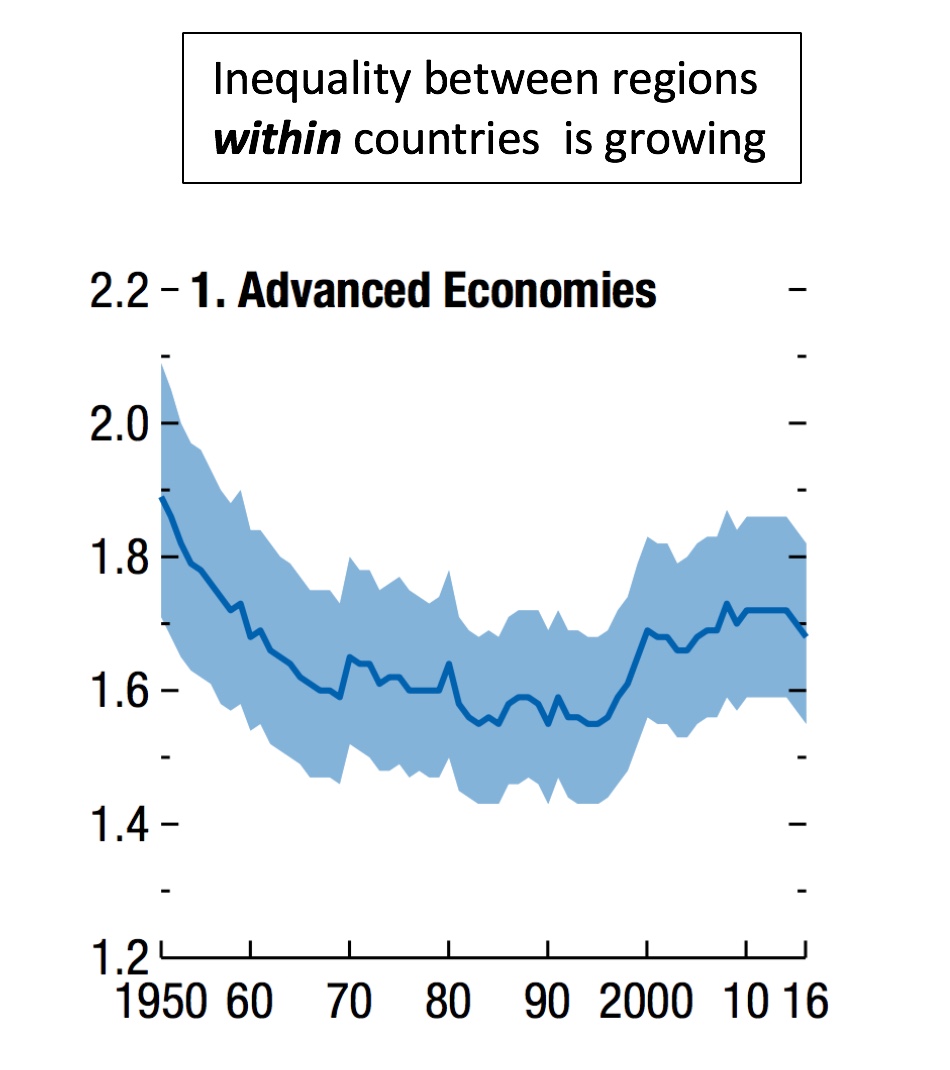
However there’s another interesting aspect to this and it is one that was deemed sufficiently important to be given a full chapter in the IMF’s Global Outlook in October, and this is the rapid growth in inequality between regions within an individual state.

The picture below shows how the gap between regions within advanced economies has been growing since before 2000. The characteristics of these “lagging” regions include poorer health outcomes, lower labour productivity and reduced resilience in the face of economic shocks.

INEQUAL BLOG GRAPH
Just how wide is the gap in terms of GDP per capita? Typically in Advanced Economies, those regions in the top 10% are about 70% better off than the regions in the bottom 10%.

In the words of the IMF, this “can fuel discontent and political polarisation, erode social trust and threaten national cohesion”. Somehow sums up the environment today?

Why might this regional disparity matter more than the global aggregates usually quoted?

I think partly because it transposes so directly on to the political map. Many of the key political outcomes in recent years have been driven by clusters of people believing that they were being left behind or losing control. Brexit and Trump grew partly out of this disparity – with all the consequences for financial markets and currencies that we have seen.

For investors, Income inequality and its impact on growth, does fit into that longer term concerns bucket, but also can directly impact financial markets now.

And it’s a trend that’s not reversing anytime soon.

Just a minute: China

October 18th 2019
China – This morning’s numbers

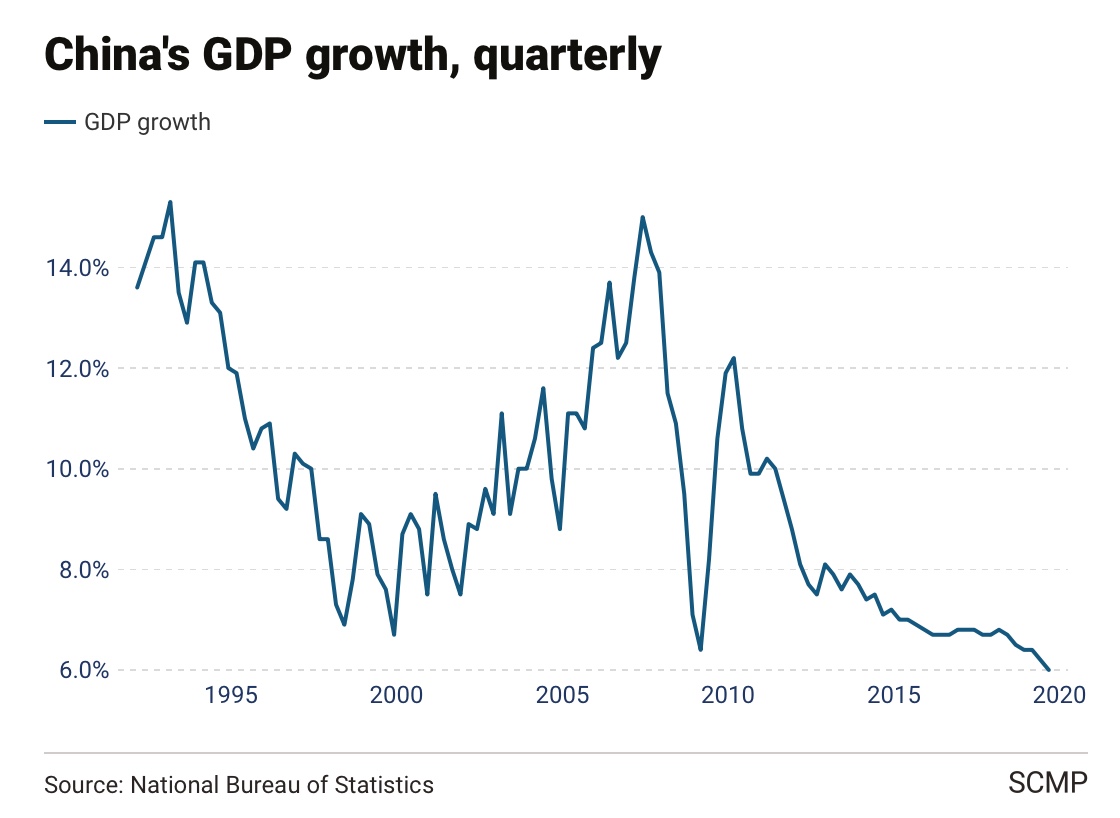
This morning we got more key indicators on the health of the Chinese economy. The economy grew by 6% in the third quarter, which while marginally weaker than the previous quarter, was reasonably expected by markets.
This was the lowest in 26 years.
There was better news from retail sales which grew by almost 8% in the third quarter .

China Growth


Trade war concerns are holding back some investment plans, while weaker demand is impacting on Chinese exports generally

This follows on from Tuesday’s downgrade of China’s growth by the IMF, who now look for 6.1% this year, and an even lower 5.8% for 2020. The IMF also estimate that a trade war would knock Chinese growth by about 1% in the long term with a corresponding 0.6% hit to US growth.

While growth may slip further, Chinese policy makers are reluctant to act too aggressively, as tackling financial risk in the system remains the priority.

Contagion

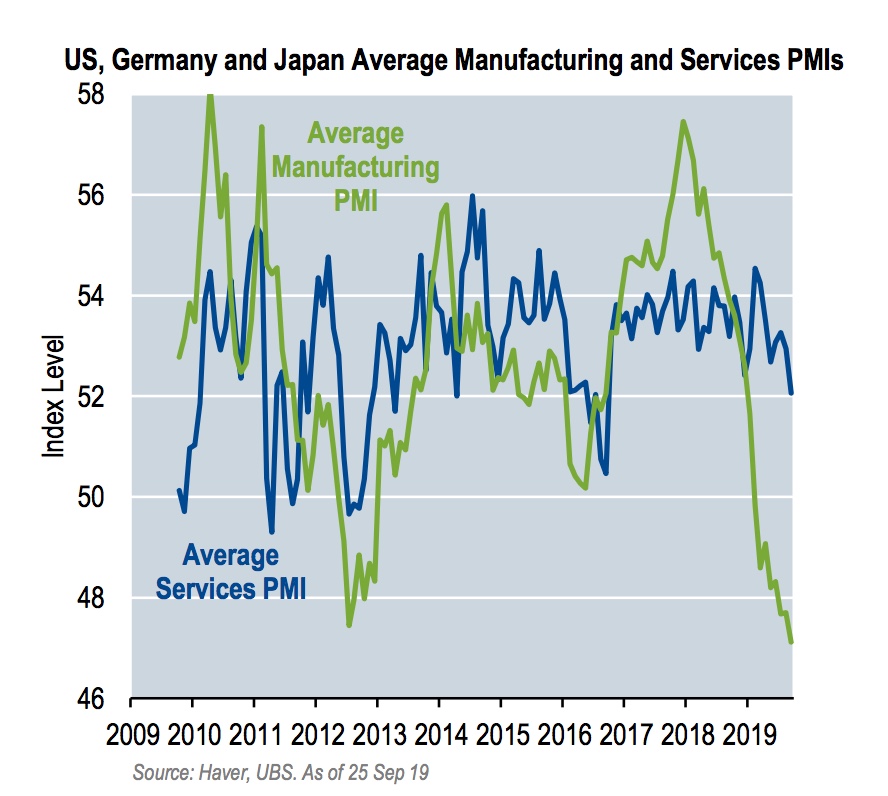
Today , October 1st, we saw a battery of weak numbers from the manufacturing sectors from the US and Europe. These were the PMI’s (Purchasing Managers’ Indices) – which should give a timely and forward looking indication of the underlying health of the manufacturing base. For the US, we saw the weakest number for a decade. In Europe, while there is universal slippage, Germany is especially hurt, with the steepest downturn for nearly 7 years.

3 country pmi's

What has been interesting to date, is how services and the consumer have held up despite the manufacturing malaise – as the graph above shows:

It’s hard to see how this gap can persist if we get continued poor news from manufacturing sector.

And the most likely transmission mechanism is jobs.

In Europe, according to the PMI Survey, jobs are now being cut at the fastest rate since 2013.

The risk then would be that a deteriorating jobs market hits households and the service sector.

In this Friday’s US jobs data, attention should be paid as much to measures such as overtime or hours worked, as to the overall unemployment rate.

Culture in Asset Management – the “Must Haves” and the “Great to Haves”!

Cello

Culture is now a Red Button issue in Irish financial services, from banking to insurance through to asset management.
Recently, we have seen the setting up of the Irish Banking Culture Board to remedy cultural shortfalls in the banking sector. The Central Bank of Ireland has raised the issue of culture for asset managers repeatedly, while in the UK some of the recent failings in the fund sector (such as funds being closed for liquidity reasons) stem from the culture and practise within fund management companies and have been noted by both the UK regulator (the FCA) and the Bank of England.
To some it seems soft and ethereal, but make no mistake – culture is going to stay on the agenda for the financial services industry, and increasingly so for asset management.

What do we mean by culture? While there is a range of potential descriptions, I think at its core, at least for asset management, it is:
“how and why we do things around here”
Why does it matter? Ultimately because culture has a profound impact on the quality and sustainability of investment outcomes.

Why are regulators concerned about culture – and why should asset managers be?
Regulators rightly focus on culture as they see it as a way of mitigating the risk of poor conduct. They look for leaders to set the right tone and minimize the risk of such misconduct.
Why should asset managers care? Well of course if the regulator cares, that should be reason enough! But even more importantly, by developing good cultural traits, investment managers have the opportunity to move their business to a new level of excellence and success.
Regulators look for a healthy consumer centric culture at the heart of every investment firm, but are also clear to point out that culture is a matter for each individual entity. There is no “one size fits all” but the regulator does have a role to monitor, assess and influence. Key cultural values such as fairness, respect, integrity and honesty however would certainly feature in the Regulator’s wish-list.
In practical terms (as highlighted by the Irish and other regulators) this emerges as guidance on issues like:

Keeping fees as simple and transparent as possible
Making sure the fee is right for the product (not charging active fees for index management)
Communicating in clear non-jargon language
Clear attribution on performance and explaining benchmarks where used
Ensuring liquidity and ability to deal.
Realistic performance objectives.
Need for fund boards to challenge

It is possible to see recent issues in the UK asset management industry, where funds were forced to suspend dealing due to outflows and illiquid assets, as a cultural failure. Getting illiquid unlisted securities (which were the core of the problem) listed in lighter touch domiciles to technically continue, doesn’t seem aligned with a “consumer centric culture”. The chief of the FCA in the UK, Andrew Bailey, accused such firms of not following the “spirit” of the rules. Bailey said: “Any organisation that prioritises being within the rules rather than doing the right thing will not stand up to scrutiny”

Culture will continue to be an issue of the highest importance for regulators. How should asset managers respond?

This is in fact a great opportunity for asset managers to consider culture not just from the regulatory aspect but more for how it could drive sustainable business success, and result in a true defining competitive advantage.

A healthy culture is seen by many in the asset management industry, practitioners and observers, as a vital ingredient on long term business and outcome success. Many of the “gatekeepers” to immense amounts of pension assets globally (i.e. consultants), now explicitly downgrade asset managers who display poor cultural traits.
In fact in the UK and US, we have seen clear evidence where negative cultural characteristics such as in-fighting, bullying, dominant personalities etc. have led to poor outcomes for both firms and investors.
What does a good culture within an asset management company look like? While there will be many aspects, we should expect to see some of the following:

Honesty and transparency in customer fees – no “creaming off”
Diversity through the company and in decision-making
Reasonable and fair compensation
Good internal challenge (psychological safety)
Ability to learn from poor outcomes
Clear commitment to culture from top team

If strategy matters, then culture matters; as a poor culture will undermine and drag on a good strategy.
Asset managers should see this heightened focus on culture, not as regulatory headwinds, but as a spring-board to make that move from good to great.

When the Dust settles….

Just a Minute series: September 3rd 2019

2019 so far seems to have been a year when financial markets were driven by tweets and fantasy phone calls on Sino-US trade deals.

Real economic data has been mixed with manufacturing numbers weaker (especially forward looking ones) but consumers and jobs holding up better. Those clamouring for imminent recession are having to pay a lot of attention to unusual patterns in bond markets where at times we have seen longer dated bonds yielding less that shorter ones.

It would be convenient to think that absent the tweet chatter, financial markets would behave a lot better. There are two problems with this. The tweets (and the policy vacillations) aren’t likely to go away anytime soon. And even if the dust were to settle, investors need to take account of a number of issues in coming to a market view. To be considered are:

The global economy is shifting down a gear. While there is collateral damage from the escalation in trade tariffs and uncertainty, there is also a fundamentally driven slow-down in the global economy. Demographics, debt overhang and low productivity are among the sources of this.

Corporate profit expectations have been dragged down. Consensus global forecasts for 2019 are now basically flat, having started the year at 7%+. The worry is that analysts have yet to take a red pencil to their 2020 numbers, where consensus growth forecasts are still in double figures.

And yet despite sluggish economic and profits growth, market valuations are reasonably extended. The US stock market for example is on 16 times 2020 earnings – by no means cheap.

Markets can muddle through – they often do. But as the factors above point to – even if the current particular type of dust were to settle – there’s still a heap of dust around.

VIX Uncertainty Index

VIX PIC


ESG: Stop! Look Listen

ESG Image

ESG investing (i.e. incorporating environmental, social and governance factors in investment decision making)  seems to be everywhere. FTfm every week is guaranteed to have at least two pieces on it! Most asset managers will include an ESG option in their product range. Most investment conferences have an almost obligatory ESG session. There is largescale lobbying by government and non-government agencies to promote the subject.


People who can talk in big numbers tell me that ESG style investing is worth about $30 Trillion globally. And it’s growing rapidly.


The concept clearly has appeal – earning investment returns and “doing good”. What’s not to like?


Interest has broadened out from initially endowment and charity sectors to a wider general audience, including the much sought after millennials. This level of interest will expand even further into institutional pension plans as new European pension directives mean that trustees of pension schemes will at least have to consider ESG factors in their investment decisions (whether they actually allocate or not). Such discussion and consideration will need to be evidenced, noted in their statement of investment principles, and made publicly available.


One big question always looms. Does it negatively affect investment performance? Well every fund management group will probably tell you no; or that any effect is actually positive. But really, it’s probably too soon to see the full impact of ESG considerations on investment performance given the data to hand.  It certainly hasn’t been through a proper investment cycle in its current scale. As assets grow in the sector it will also have a greater influence on share prices.

In terms of performance, much depends as well on what specific factors are included in any definition of ESG for investment purposes. What’s the policy on fossil fuels for example? Do we exclude everything or just the “nastier” end of the carbon spectrum? Going for full fossil fuel exclusion there will definitely be a relative performance impact, given the weighting of energy (and its volatility) in global benchmarks. There is a wide range of views around this specific point.


Don’t underestimate the task of moving into an ESG framework and be aware that it’s an evolving space. Fixed income, for example, is likely to see a wider range of options into the future as Blue bonds join Green bonds and other credit instruments come into the space.

Despite the seemingly frenetic pace of growth of interest and assets in ESG strategies, the increasing availability of investment options, and the appeal of the message, this is not something investors should rush headlong into.

There a number of key steps well worth considering.


mCanvass views. What do people want? Not everyone feels the same passion on these issues and there a wide range of product on offer from asset managers, from quite specific to a very broad church of ESG issues. While in the DC world it can be straight forward to offer an ESG choice. – it’s more complicated in the DB world and trustee responsibility as defined by deed is typically to deliver a purely financial return.


mResearch the asset manager thoroughly. There isn’t enough standardisation, transparency or consistency in how different entities score companies on ESG factors. This applies to both active and indexed offerings. Inconsistency can lead to surprise – for example some sustainability indices can include tobacco companies, which seems out of place.


mFully understand and quantify the performance impact of employing any ESG considerations. This will allow for informed review of the bottom line impact of the strategy and the potential, if necessary, to re-shape it. Investment managers need to understand the priority of ESG in the totality of what they deliver to clients and scale it accordingly.


If it’s worth doing – it’s worth doing well.


Half Time!

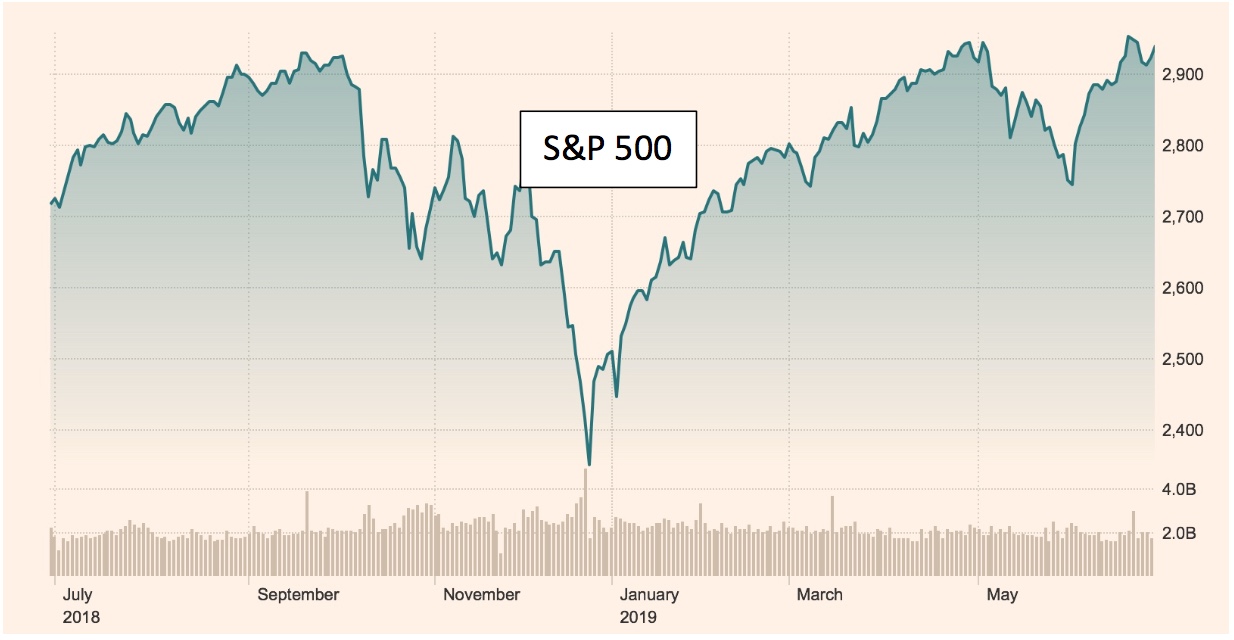
The first half of 2019 has been very rewarding for investors. The world’s stock markets, as measured by the FTSE World index, are up 16%! Among major markets the US is a clear winner, up 18% while other developed markets are up 13%. For the US, it’s been the best first half since 1997.

These numbers are flattered by the fact that we ended 2018 with very weak markets, so there is a strong element of catch-up in the data. Looking at the S&P 500 index in the picture below we can see that we are not that far away from where we were last September. The lack of a major negative in US-China trade talks also helped. The final support for stock markets has been the line-up in recent weeks by a flock of increasingly dovish central banks which coaxed markets over the line.

Economic data overall has been mixed and not a catalyst for market moves so far in 2019. I suspect trade and interest rates will remain key factors for the rest of the year. As well as divergence in returns at overall market level, there has also been meaningful divergence in sector performance. For example looking at global sectors; Technology is up 22%, Banks 11% and Food Retailers 1%.

It will be interesting to see active manager performances, for the first half of the year, against this background.

S&P


The Boys are back in Town!

Dateline: September 23rd 2019

The Boys are Back in Town

Last week’s batch of data from the US and Eurozone economies did little to clear the fog around near-term direction. Business confidence remains especially low.
One thing is clear though – Central Banks are centre stage – again.

Members of the US Federal Reserve said they would take whatever action was appropriate to sustain the economic expansion. This probably means interest rate cuts during the year with some members, such as James Bullard, wanting cuts immediately.
Mario Draghi, ECB president was equally “dovish” promising rate cuts, more bond buying and strong pledges on how long rates would remain low, if economic conditions fail to improve. All eyes on Central banks then!
In further evidence of their critical role, President Trump has managed to complain about both central banks in the past week!

Of course a successful life-enhancing Brexit or an outbreak of sweetness and light in Sino-US relations at the G20 could change the picture.
(Still something worrying at the back of the mind, when policy makers say they are concerned about growth and stock markets go up!)


People to avoid at Parties No. 86 Someone who actually knows what an inverted yield curve is

Swiss Tony

Yup – it doesn’t rank as the most enthralling of topics, but there are some folks who are obsessed by it. Now if they work in the investment/economic milieu there may be an excuse for that, but if they are in the real world, it may be time to seek help.


Why does it matter and what is it?

The inverted yield curve is regarded by many as the best single predictor of an economic recession around the corner.

The yield on government bonds (that is the interest rate that the market demands for holding them) should get higher as those bonds get longer. For example, the yield on a 10 year bond should be higher than on a 2 year bond and that for a 30 year bond higher than the 10 and so on. Investors typically demand higher returns for locking their money up for longer periods. This is to compensate them for higher economic risk such as an outburst of inflation or a payment risk.

When that is not the case – when yields are turned around (or inverted) it sets alarm bells ringing for many commentators. It has a good track record. In the US, whenever the yield curve has inverted, in the last 60 years – with one exception in the late 1960’s – a recession has followed.

What’s the rationale for this. The shorter end of the bond spectrum is likely to reflect the Central Bank’s policy on interest rates, so rising rates to choke of inflation or growth has a knock on effect on them. This naturally can lead to lower growth.


We have recently moved into that territory. Today in the US, 10 year bond yields are about 2.08% while shorter 3 month rates are 2.2%. Is a recession imminent?


The US economy looks OK at the moment though everyone acknowledges this has been a very long expansion. The New York Fed see the probability of a recession in 2020 at 30% currently. This is probably a bit lower than the followers of the inverted yield curve society would be thinking.

NYF Recession IndicSo, despite its pedigree the inverted yield curve may not be getting the universal acceptance it thinks it should merit. Why might it have lost some of its power?


We are at extremely low bond yields already after the greatest monetary experiment ever and  unprecedented bond buying by the world’s Central Banks. That has to play some role.


Also longer dated bonds typically have built in this premium because of inflation risk etc. Inflation has not been on the agenda for a number of years, is not an issue currently and market forecasts, 5 and 10 years out, see it as being very benign.


What does this mean in the short term?

Many board members of the US Central Bank keep track of the yield curve and would, if there was an overwhelming signal of an imminent recession, look to cut rates. Others will take a more balanced view of the economy and weigh up the pockets of strength against the weaker areas, as well as signals from the bond market. Some talk of an “insurance cut” i.e. to smooth market behaviour in case of any further tariff escalations.

All in all this could push us into a “wait and see” stance.

“Neeeaaaoorgheee!”

Tommy

Tommy Tiernan has a brilliant piece where he discusses the global debt situation. It’s not a typical topic in stand-up comedy and well worth a look on YouTube.


https://youtu.be/E8DfCzOS1lE


He says we all owe – Germany owes billions of gazzillions, while England owes trillions of willions of billions and as for the US it owes so much it’s not even a word; it’s a primordial screaming deafening noise.

(Tiernan also has a solution to this debt problem)

It’s not clear how much Tiernan based his views on the 2012 work by Reinhart and Rogoff noting that countries with high debt levels face massive losses of output often lasting more than a decade.


What are the numbers? Global debt last year was $243 trillion. That’s just over 3 times the size of the global economy!   This is actually higher than it was in 2008 – and that was when all the trouble started.

The debt is held by corporates and governments and mainly in China and the US.


It’s a topic that we are always being warned about from the likes of the IMF, OECD, World Bank, Institute for International Finance as well as the rating agencies and the media. Talk of debt sky-rocketing and words like impending crisis, financial time bomb and catastrophe mark the debate.

The IMF says that our financial vulnerability remains elevated – which I think means

*We have too much debt

*It’s growing too fast

*The quality of the debt is getting worse


The IMF is concerned that these debt levels are handicapping governments’ ability to increase spending or cut taxes to offset any weakening economic growth.

And at the company level we are seeing shareholders in some cases pushing for balance sheets to be restored to some degree. This certainly emerged in investor calls with companies like Verizon, AT&T and AB InBev in recent months.


But apart from the constant warnings and the company promises to reduce bloated balance sheets, financial and market life seems to roll on. Whenever markets have a few bad days, global debt gets rolled out as an excuse and then quietly slips into the background again.


So is it a thing?


I think it is something, which if we are entering tougher times, will make it more difficult to respond effectively, and this weaker policy response may exacerbate any slowdown. It’s like the road directions you get in Ireland “Well if I was you, I wouldn’t start from here.”


The fact that a lot of the corporate debt is poorer quality (lent to companies with weaker balance sheets etc.) is also important. In the US we have seen the weaker type of corporate debt, such as what has labelled BBB go from 30% of all debt in 2008 to 55% in 2018. This probably means that if things do go pear-shaped we could potentially see higher default rates than in previous cycles.


But……….. today, this week, this month it’s hard to think this monster debt level should have a huge impact or indeed on its own prompt a downturn and the picture below holds the key. It looks not at the level of debt but at the interest costs of that debt.


Debt levels are at extreme highs but the cost of that debt is at extreme lows. The graph is from a recent report from Moodys and they note that the 5 recessions since 1979 were prompted by a surge in interest expense, whereas wehave seen interest costs at very low levels and declining. As you can see, the current position of the green line is way below previous stress levels.

Debt graph3


The key here is that interest rates remain low. This clearly depends on things such as inflation and if you want comfort on that, Lawrence Summers said in a speech in April that in his view current levels of inflation and interest rates are here for the next 10-15 years!