The Central Bankers’ Christmas Party

‘Twas the night before Christmas
And all the markets were closed.
Dealers all snuggled up in their beds
No asset positions left exposed.

But soft in the distance, the bells rang out
And cherubs sang hale and hearty
Coz after another year of decision making
This was the night of the Central Bankers’ Christmas Party.

The biggest night for governors past and present
A break from all that rate hiking or cutting
After a year of constant communication
That’s 12 months of trying to say nothing

This was the night all central bankers longed for
Festive fun and craic without any limits
And perhaps the best thing of all
There would be no one publishing the minutes.

A night of music and food and dancing
No standing on ceremony or being aloof
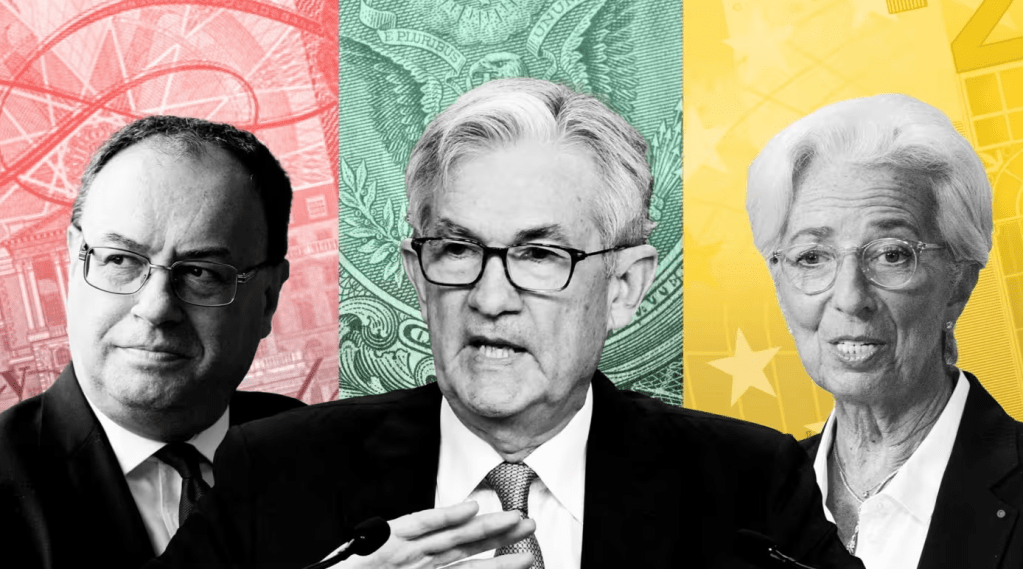
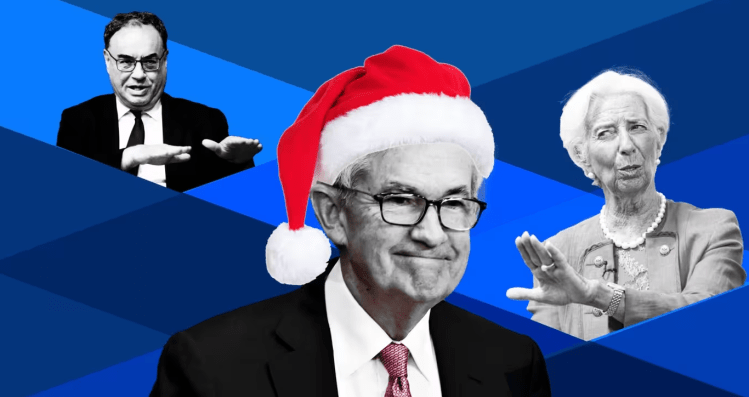
Here’s Lagarde, Powell, Ueda and Bailey
And of course our very own Gabriel Makhlouf

Well the liquidity taps were fully on
And I don’t mean M1 or M2
There was Stella, Heineken Asahi and Watneys
Not to mention Carlsberg Special Brew.

There was the finest food from around the world
Every governor brought the best of their nation
As they all tucked in, the next issue was
A severe bout of gastric inflation

There were vol au vents, sliders and oysters
Trays so heavy the waiters would waddle
Smoked salmon, and pigs in blankets
Oh and somebody brought some coddle.

Christine brought sumptuous escargot
Ueda-san brought sushi and sole
Andrew Bailey felt a bit out of things
With his spotted dick and his toad in the hole.

Pernod, schnapps, sake and sangria
It was not a night for the squeamish
Jay Powell sophisticatedly sipping a martini
Makhlouf piling into the Beamish

Then the music started and the dancing followed
Guaranteed to ease any tension
All the governors out dancing to Simply Red
Singing “Money’s too tight to mention”

Now the dancing was getting to fever pitch
Madam Lagarde, like a ballerina, did float
While Philip Lane, now wearing his tie on his head
Was on the floor doing “Rock the Boat”

Andrew Bailey now swinging from the Chandelier
Unusual for a man of his standing
Then the chandelier broke and the governor flew off
Desperately hoping he’d get a soft-landing

Now they were all going on about their policies
And the innovative things they might do
Pretty soon all their yield curves were twisted
And most of the Governors too.

Soon it’ll be back to work at the desk
Back to forecasts and market calling
But perhaps, interest rates in 2024,
Like the snow, will be gently falling

Why is the US economy in better shape than Europe?

Today the European Central Bank described Europe as being fragile and vulnerable. In contrast, the US Central bank spoke of broad based strength  across all categories. 

What are the facts? Compared to the US, Europe has higher inflation, higher unemployment, weaker stock-markets and significantly  lower economic growth.

And the gaps aren’t marginal – unemployment in Europe is 6.5%. In the US it’s 3.9%. And looking at basic measures like retail  sales, the most recent reading in the US was a positive 4%; here sales slumped by 3%.

It seems to be a question for investors every year – which will do better – Europe or US? 

As a fund manager I would wait for those January strategy pieces from experts telling me it was going to be Europe’s year! It was also (usually) going to be the year when stock selection would be key and Japan would re-emerge as an investment power-house!

As well as economic superiority, so far this year, US stocks are up nearly 20% while European averages are closer to 10%.

Why?

There are a number of reasons – some short term; others have longer to play out. 

This has to date been a crisis-laden millennium. And it seems that with each crisis, the Eurozone permanently loses a few points of growth to the United States. French economist Francois Geerouf notes “For the past fifteen years, Europe has been falling further and further behind, shock after shock: the eurozone crisis, the Covid-19 pandemic, the war in Ukraine, the Great Financial Crisis have all followed quickly. GDP is only one measure of economic well-being but since 2007, per capita growth on the other side of the Atlantic has been 19.2%, compared with 7.6% in the eurozone”. In 2010 US GDP per capita was 47 percent larger than the EU while in 2021 this gap increased to 82 percent.

Take the response to the Pandemic. The US was prepared to run a deficit of twice what Europe was prepared to do to restore growth. The run of blockbuster numbers on the jobs front in the US is testament to this. This also under-pinned the consumer surge. US consumers remain resilient and have bettered many forecasts. The fact that the lowest paid Americans have experienced the strongest pay growth has played a role here.  In Europe in contrast, the latest reading on consumer confidence is the lowest in 7 months.

Geography is also playing a role here and being physically closer to the Ukraine war is no doubt  impacting on European confidence. Issues such as the supply and price of energy  and the arrival of Ukrainian refugees keeps the war front of mind, much more so than in the US. This impacts on consumer confidence and spending.

If the US stock market didn’t have a stellar technology sector it would be closer to, or indeed lag, many European bourses. Technology stocks, with their run-away growth potential, account for about 30% of the US market while are practically non-existent in Europe. This year alone US technology stocks are up 50%. The US financial system itself also appears deeper, broader and more fluid, with a greater appetite for risk than a bank-heavy Europe. For example investment in the field of AI in the US has exceeded $450bn in the past decade, 10 times what we have seen in Europe.

So policy, geography and structure of capital markets are a big influence. Of course, this current situation can change and factors favouring Europe could dominate, but there are some factors which are not up for change.

Perhaps the greater source of the gap will be the fact that Europe is getting older and our workforce smaller. The workforce in the US  (those aged 15-64) is still showing some growth whereas here it is contracting and will continue to do so. The total number of European has risen by 1.6% since 2012. The corresponding number for the US is over 6%. This ultimately is a key driver of economic growth. Unless Europe had a seismic shift in attitude to immigration. As John Train said “Demography is destiny”.

Of course there will be quarters, years perhaps, when European growth will edge out the US. But as Mohnish Pabrai noted in his book “The Dhandho Investor” successful investing is all about the odds and seeking to get them even slightly in your favour. Favouring the US over Europe strategically would seem to achieve this.

Understanding China

Last week, two of the world’s most powerful leaders met in San Francisco. One representing a resilient economy with continuing impressive growth in numbers of people working. The other heading up an underperforming economy with huge issues in key sectors such as property – but China still matters.

For many investors, China is just a number.

Markets wait on the quarterly GDP number to assess whether the Chinese economy is back to its former glory when growth rates of around 12% were commonplace, or whether the more recent pedestrian figures of 5% prevail.

For what it’s worth, the most recent GDP reading was +4.9% for the third quarter this year – broadly in line with expectations but well below the 6.3% for the previous quarter and the IMF is forecasting a sluggish 4 % for 2024 and little improvement thereafter. Recent manufacturing data also pointed to continued contraction.

By historic standards these are disappointing numbers and there’s been a disappointing feel, a sense of drifting, in much of what’s gone on in the People’s Republic this year. From the start of the year there was a view that finally coming out of Covid would see an economic rebound with some degree of “revenge spending” – much as we saw in the US and elsewhere. Western economists expected a full-throated economic revival. 

It didn’t happen.

And the lack of real policy response also unnerved commentators. In previous downturns, the investment burners were turned on, and China (and many global sectors) surged. Instead we got marginal reductions in interest rates and small tax changes in stock market transactions. Coupled with a cumbersome exit from Covid, it made many doubt the degree of policy cohesiveness. 

There didn’t seem to be a Plan B.

Problems in the Property sector  haven’t helped. And to date this has been more a slow moving train wreck than a bust. More than half of China’s former top 50 developers have gone into default. Country Garden has defaulted on overseas bonds. Evergrande continues a tortuous path to restructuring. HSBC CFO Georges Elhedery believes we may have seen the worst in the China property saga, but it will be a multi-year recovery story. The scale of the problem supports the view that it will take time. Central Government is becoming much more interventionist in the housing market and it remains to be seen whether this will crowd out private initiatives. The entire property investment and shadow banking system are also going to be part of the remit of the newly formed Central Financial Commission (headed up by a Xi  Jinping loyalist) – another example of party control.

Where is China’s focus then? The President recently hosted many world leaders to celebrate the 10th anniversary of China’s global investment effort – the Belt and Road initiative (BRI). Although investment performance has fallen well short of expectations and many developing countries are mired in debt as a result, Xi Jinping was keen to sing its praises and potential. This partly reflects the fact that the success or otherwise  of the BRI is not purely short term financial but its aims are wider, reaching into areas such as national security, sustainable supply chains and Chinese jobs. With 1$ trillion lent over 100 countries it has dwarfed Western spending in many developing nations. However China must tread carefully here to avoid the perception of “debt trap diplomacy” and risk squandering its influence in the developing world.

But what about investment into China? This has in fact gone in the opposite direction. 

Foreign Direct Investment has fallen 34% in the past year – the biggest decline since figures became available in 2014. The fall partly reflects the steady stream of lacklustre economic news as well as increasing political tensions. Many global companies now look to “near-shore” many of their activities as they focus on supply chain issues. One very telling datapoint is that Private Equity firms that invest in China raised over $5 billion this year. Two years ago, that number  was $48 billion! This investment collapse isn’t going unnoticed in China and indeed at the recent BRI event, Xi Jinping announced some removal of restrictions on foreign investment. But really this  needs the same level of effort as was applied to the BRI, as there are potentially big wins to be had in sectors such as batteries, electric vehicles and renewable energy.

It’s clear Chinese policy makers are not measuring success in GDP points. National security and Common Prosperity play an equal if not greater role. This is not the China of Deng Xiaoping. Government policy in clearly more intrusive in many sectors including Property and Finance – the Central Financial Commission is one example of this.

Some worry about what they term as the “Great Walling-Off of China”.

Ian Johnson, a Pulitzer prize-winning journalist, speaks of a turning inwards, political ossification and ideological hardening. When the economy was at its most dynamic, there was a social contract or implicit understanding – the government would allow (and promote) economic opportunity for the people in return for a give-up of some political freedoms. The slump in earnings and growth questions whether the contract is being upheld.

China does have structural issues to contend with such as demographics, but by definition there is no short term solution here. A highly entrepreneurial people seem to lack optimism. The slump in foreign investment and the poor performance of Chinese stock-markets (down 40% from 2021 highs) are reasonably objective red flags pointing to a need for a different response –  or at least some response. 

In this regard, it may be that the biggest issue for the Chinese economy is Chinese Politics.

Understanding Christine Lagarde

Central Bankers: Financial markets hang on their every word. 

Speeches are parsed and pored over to gain the smallest clue as to where policy may be headed. 

And if we’re close to a peak in interest rates, with an extended period of little change ahead of us, what Central Bankers say may matter more, than what they do.

Now to be fair, many Central Bankers are not best known for their outstanding communication skills.

It was Alan Greenspan who, when running the US Federal Reserve, famously said “I know you think you understand what you thought I said, but I’m not sure you realize that what you heard is not what I meant”

So the standard has been set.

Now how do we in Ireland and Europe fare as regards Central Bankers’ clarity of communication. 

Christine Lagarde obviously has to be careful and cautious in the language she uses as she is dealing in an uncertain world with issues that investors, consumers, savers, borrowers and many more are desperate for certainty.

And she is. 

It is clear from looking through Lagarde’s speeches, that you’ll gain significant insight into monetary policy – 

– but by Jesus you’ll get an education as well!

Not for Christine is the arid Central Bank language of yield curves and liquidity traps . 

Her landscape of monetary policy is a rich tapestry of, amongst others, European philosophers, acclaimed novelists, Greek explorers – oh and the Head of the Catholic Church.

Take the annual meeting of the world’s central bankers in Wyoming this year. While the head of the US Central Bank was enthralling his audience with PCE and GDP; Christine Lagarde was introducing her audience to the works of Soren Kierkegaard, the Danish philosopher. She explained that one of the key problems for Central Bankers was summed up by Kierkegaard – “life can only be understood backwards but must be lived forward” – perhaps his version of data dependent!

European philosophy seems to loom large in the Lagarde lexicon.

In her September speech, up pops Ludwig Wittgenstein, Austrian born philosopher, who no doubt referring to Central Bankers, said “the limits of my language mean the limits of my world”. Hard to imagine Greenspan admitting to such shortcomings.

And it’s not only philosophers, Christine Lagarde expects us to be well and widely read. Earlier in the Summer she pointed us to acclaimed novelist Graham Greene, as a guide to the hard work that goes into interest rate decisions, when he said “a feat of daring can alter the whole conception of what is possible.”  Echoes of Mario Draghi’s “Big Bazooka”?

American author Helen Keller also was promoted by Lagarde this Summer. She offered Keller’s words of “our worst foes are not belligerent circumstances, but wavering spirits”. I think this was aimed at preparing her audience for “higher for longer interest rates” and the need to be patient and strong. At least I think that’s what she meant!

But it’s clear we have a Central Bank leader with interests in more than just supply side constraints. In fact, Lagarde’s ambit extends beyond the philosophical giants and great literature, she also cares for our spiritual welfare . Pope Francis and his encyclical, Laudato Si, feature in her most recent speech. 

The true measure of her influence will perhaps only be seen if Christine Lagarde features in a papal encyclical!

The next crisis will start with empty office buildings

The above headline ran in the Atlantic magazine last week in the US.

Also, the Financial Times speaks of a “financial storm” bearing down on the US commercial property market. Many analysts are talking of commercial property as the biggest systemic risk in the US today and being the next shoe to drop.

Is there a read across to the Irish Property market?

Firstly how dire is the situation in America? There are a lot of factors prompting the property panic. In New York and other “super-cities”, buildings are selling for less than the value of the land they sit on. Many valuations are less in absolute terms than they were 20 years ago. Office vacancy rate is over 20%. With a third of all office leases expiring by 2026, this vacancy rate could rise. The refinancing occurs at a time when costs of doing so are at a 20 year high.

So, it’s definitely challenging.

And the issue about property in the US is how critical it is to many other sectors. Property in the US is highly inter-linked in the system and seems to be Hydra-like in its impacts elsewhere in the economy. 

Property taxes underpin municipal city budgets. In New York, commercial real estate provides 16% of city’s total tax revenue. Many pension funds, public and private have been adding to commercial real estate. Some funds now have over 15% exposure. And as we know from the recent crisis, many regional banks have lending exposure to property. About 70% of all commercial property bank loans are with regional banks.

How should investors in Irish commercial property respond?

The sector has already been under pressure here, and in many of our European neighbours. A typical fund of listed European real estate is off about 18% in the past 12 months.  As with the US, we all face many of the well-rehearsed challenges – struggles through Covid, disruption with hybrid work practices and rising interest rates.

It is worthwhile to take pulse of Irish commercial property.

A typical institutional property portfolio will consist of, in ascending importance, logistics, retail and office.

Logistics typically means warehouses and transport hubs. Today this sector is characterised by solid demand, long term leases, low vacancy rates and good visibility. We have seen rents move up as retail, aided somewhat by the pandemic, has seen the trends to on-line continue.   

Retail itself, has seen the highest share of investor activity so far this year. Volumes and footfall are up and we are beyond pre-pandemic levels. Those parts of the retail market that need that “face to face” option are doing well. Vacancy rates are still high at around 13% for Dublin city centre. Some locations on Henry Street have seen a 14% increase in rent! But a lot of café-type retail, dependent on office occupancy, is challenged.

The bulk of commercial property investment is in offices. Today this is the sector of maximum change, maximum risk and maybe maximum opportunity. The office sector is intensely impacted by one of the major consequences of the pandemic – WFH (working from home).

While rising interest rates or economic growth are typical issues to consider in analysing property trends, WFH is new, unique and revolutionary. 

And we don’t know how it ends.

For some it’s a matter of time, and like the Nike “swoosh”, after the sharp fall, over time we see a pick up in office attendees. Many companies are now looking to limit WFH absences or issue return to work mandates.

Others, such as the consultants McKinsey, say hybrid working is here to stay and that office attendances are stabilising at 30% below pre-pandemic norms. It is hard to see the genie going fully back into the bottle.

But it’s clear Office Property has not caught up with this change in behaviour.

New York city has lost 5% of its urban core residents in the past two years. Footfall in many CBDs in US and Europe is down 20%. McKinsey estimate on modest assumptions that demand for office space in 2030 will be 13% lower than today.

Already Dublin is seeing changes. There are examples of massive remodelling within existing structures, changing how space is used. We have also seem companies simply relocate to smaller spaces. Buildings may need to be aligned more specifically with the culture of the occupier company, and indeed with the local community. The good news on this front is that we clearly have the skills as evidenced by IPUT’s award winning Tropical Fruit Warehouse project where art, culture, and sustainability all shine through an office space.

It’s hard to see a clear picture as activity has been subdued so far. Vacancy rates across all offices is about 14%. 

Is it a US level risk?  We are probably less exposed to knock on effects such as bank exposure, tax dependence and pension fund allocation. A consensus pension fund here has under 4% exposure to property compared to that 15% exposure in the US.

But of the sectors within a property portfolio, Office looks the most uncertain – and probably with the greatest distance to travel. 

Are Investment Funds getting too Big?

One trend that has been persistent, protracted and powerful in the Asset Management industry is consolidation.

And it’s not just the mega deals. Mergers, acquisitions and restructurings have been an ever present feature, on both buy-side and sell-side, at all points on the size spectrum. Recent names in the headlines include Franklin Templeton, Liontrust, Crux, Generali, Invesco, Rathbones, GAM, Brewin Dolphin, Numis and many more.

It is driven by a number of factors – increasing lower cost competition from ETFs and passive, ever increasing compliance burdens, strategic synergies, or just looking to “fill the gap” in the investment offering.

And consolidation means concentration – the big getting bigger. 

As an example, BlackRock in the UK, have doubled their market share since 2013 going from 8% to 16% of total net assets in the market.

This corporate activity is “super-charging” the growth in some funds way ahead of market moves or routine asset gathering. This has implications for what the fund managers may hold in their portfolios. 

Consolidation in the Asset Management industry typically leads to mergers of funds. It can also mean that what had been hitherto different funds, now being managed to the same common single model portfolio. The net result is a greater amount of assets targeting a smaller number of stocks. 

Regulators and risk managers place huge emphasis on fund liquidity. This involves looking at issues such how much exposure there may be to any one stock, whether any of the holdings are particularly illiquid or how long it might take to sell the whole fund.

These are all important issues as they can provide “red flags” to any potential risks in the fund for the investors.

But it also has implications for the contents of the fund. Basically as funds grow, the size of stock they can consider, and the  minimum size of any deal they can trade also grow. Depending on the size of the funds, perhaps only larger, more liquid stocks can be considered. 

Does this matter for investor choice? Probably.

In the UK for example fund managers were often significant investors in Investment Trusts, but as fund size has grown, their ability to invest in trusts and not break their liquidity rules (such as not owning more than 10% of any entity) has diminished. As a result fund ownership of investment trusts has fallen dramatically and many trusts now sit at multi-year discounts reflecting the absence of a significant buyer. 

This can apply to stocks and sectors in the same way.

For the investor a risk from this frantic fund activity is that diversity in fund contents declines, and that there is a “sameness” about what’s available. 

Even today we can see a huge overlap in fund holdings which means that investor choice is compromised. The table below shows three of the major active funds investing in Eurozone equities being sold here in Ireland, – note the very high level of common positions.

Fund AFund BFund C
LVMHASMLASML
ASMLLVMHLVMH
TotalSAPTotal
SanofiSchneiderSiemens
Deutsche TelL’OrealAllianz
SAPBMWSanofi
Air LiquideDassaultSAP
L’OrealAllianzL’Oreal
AllianzInfineonBNP
AXAEssilorSchneider

And these are all active funds, with individual managers making their own “calls” and stressing their ability to take off-benchmark positions. Yet the outcome doesn’t seem to offer much choice to the investor.

This matters because consolidation in Asset Management looks to continue at pace. 

According to the highly regarded PWC industry survey, nearly three-quarters of all asset managers are considering consolidation of some kind. 

One in six of all asset and wealth managers globally are expected to be swallowed up by 2027!

And as regards concentration, today the top ten asset managers control around 42% of mutual fund assets. By 2027, this moves to over 50%!

It’s not that clear that all this industry consolidation will be in investors’ interests.

Beyond the Taverna

Just over 10 years ago, it’s major cities were on fire. 

Bank buildings were burnt and foreign owned stores set alight and looted. Mass demonstrations were violent and fatal and met with riot police and tear gas. The political system was on the verge of collapse.

Today, Greece is one of the fastest growing economies in the Euro bloc. This year over 30 million tourists will flock to Greece’s beaches and temples. Irish tourists will again be to the fore of this wave, as Greece and its islands continue to top the travel surveys here. Greek tourism agencies are planning on how they can grow this vital source of revenue even further. 

The coffee shops in Heraklion are busy from early morning with this renewed tourism influx.

The improvement is not just visible in the bars and restaurants. Financial traders’ screens show a much improved picture than even 8 years ago. Today Greek 10 year bond yields are around the 3.4% rate, lower than many other Euro members, reflecting a willingness from investors to lend money to Greece. In the past investors have demanded yields as high as 15%!

The  international rating agencies such as S&P and Fitch are also on the brink of upgrading Greek debt. In June, Fitch affirmed its stable outlook for Greece, while S&P has a positive outlook on the country.

The Greek economy made one of the strongest recoveries from Covid with GDP up 8.4% in 2021, 5.9% in 2022 and looking like 3% this year and next.

Greece is still burdened by a high debt level – about 160% of GDP. But it has been falling, is set fall further, and is relatively long term – on average about 17 years.

Drilling into the economically crucial banking sector, we see further evidence of improvement as non-performing loans which made up over 50% of bank balance sheets in 2016, today account for just 7%. Unemployment which in the darkest of days accounted for over one quarter of the workforce, today just nudges over 10%.

To be clear though, the economy and its people  have suffered pain, as a result of the enforced austerity measures. 

This economy  is still a shadow of its former self. The Greek economy today is smaller than it was before its financial crisis by about 24%. And while unemployment levels have improved, they are still too high amongst younger age groups and females overall

For those in work, it is still very challenging. Average wages today are 25% lower in real terms than before the crisis. 30% of the Greek population is at risk of extreme poverty or social exclusion according to Eurostat. This is the third worst reading in the EU.

Greece is set to continue to receive European fiscal support – in excess of 3% of GDP per year until 2026. Such support buys the economy more time to deal with its chronic problems such as a long standing investment gap of about 7% of GDP on a yearly basis. 

There is still a need to move more of the economy out of the shadows and become more tax compliant.

Interestingly, Covid which saw an increase in on-line activity helped somewhat in this regard. But the country still ranks too unfavourably in global corruption indices and political leadership is required. 

Tax evasion in Greece exceeds 60 billion euros annually, according to Bank of Greece governor Yannis Stournaras. 

“We are considered European champions” in tax evasion despite the progress made, Stournaras said. About 2/3rds of tax raised comes from just 1/10 of the workforce.

The Greek economy is showing good top-line numbers and Greek bonds may soon regain an “Investment Grade” rating. But so many of the issues that signposted the way to the financial crisis still exist today. It looks like a financial recovery rather than a broad-based economic one.

So for the thousands of Irish holiday makers who flock to the beaches in Greece this summer, it will look like “business as usual” – and that may be part of the problem.

Globalisation – is it over? Does it matter?

Talk of the end of Globalisation seems everywhere.

Tanaiste Michael Martin and Ursula Von der Leyen, European Commission President, have both spoken recently about “de-risking” our trade flows. 

More extreme views believe that current global trade trends point to the end of Globalisation. The Peterson Institute sees Globalisation in retreat, and in its place they talk of “slowbalisation”

This matters because such an outcome could mean a major negative headwind to Global Economic growth over the next 5, 10, 20 years. 

Much of this pessimism comes from looking at trade flows – aggregate world trade data relative to world GDP. 

It’s true this trade data did soften around 2020 – which is exactly what you would expect in a world of pandemic and locked-down economies. The last two years have seen much talk of broken supply chains and massive trade disruptions due to the Pandemic and then various conflicts. 

However improvement has been swift. If we look at more timely and dynamic surveys, we can see this. The New York Federal Reserve index, which tracks global supply chain pressure, now points to a largely  normalised global trade picture. This clear improvement in physical trade is backed up by the noted Kiel Institute trade data.

Perhaps we’re not back at the pace of the growth in the “Golden Era” of global trade between 1970 and 2008, when corporates rushed to set up new supply chains.

But trade alone seems like a narrow enough gauge to capture the connectivity of the Global Economy. 

Given the importance of capital flows in the world economy and the ever increasing feature of human flows, a more holistic gauge of “Globalisation” would be in order.

The DHL Global Connectedness Index considers trade, capital, human and information flows.  This much more comprehensive measure of Globalisation continues to push to new highs, and is well above its pre-pandemic level. Trade did take a bit of a knock in 2020 but has been on an upward trajectory since. In mid 2022, the volume of world trade in goods was 10% above its pre-pandemic level. The biggest blow (no real surprise) was to the movement of people, as the world closed in.

But it’s not business as usual. There is evidence of decoupling  between the US and China, reflecting heightened geo-political tension between the two blocs.

Another key trend is what looks like a pick-up in trade within regions. Today roughly half of all international flows happens within regions, and this has been on an upward trend over the last 10 years. In a world of “near-shoring”, there is scope for this to grow.

Global trade will continue; even in what may appear a less benign world.

Michael Martin and Ursula Von der Leyen talk of de-risking –  not decoupling. 

And there is a sensible need to reduce risk in strategic sectors such as semi-conductors or critical minerals. G7 Finance Ministers have also spoken of the need for supply chain “diversity” where they may focus more on emerging economies to supply components and materials.

As regards capital flows, foreign direct investors will also continue to have a global perspective on their potential locations. But it may be a more risk aware perspective which some have described as a “China plus one” strategy, where they keep making things in China, but also have a back-up, for example Malaysia. 

But trying to move production takes longer than we might think.  A US Chamber of Commerce survey showed that 70% of US companies who manufacture in China have no plans to move in the next three years.

Undoubtedly, the shape of, and patterns within, global flows are changing. While western leaders look to de-risk and unbundle their trade with China, others like Bangladesh and Thailand are pivoting their economic future towards China. Indeed the World Bank sees this as the natural outcome of increased US/China tensions.

Globalisation has survived through wars and periods of protectionism. Now in the face of war and pandemic it continues to move ahead, though pace and patterns may have changed.

Heightened geo-political uncertainty serves to reveal the fragility of Globalisation.

Rumours of the demise of Globalisation have to date been unfounded. 

The World Bank has rightly warned about the risk of fragmentation. 

The greatest threat to globalisation, which we know has a beneficial economic outcome, may be complacency. 

Do Investment Models Work?

Yes  – until they don’t.

What I’m talking about here are the models, processes, frameworks that some investment managers may use when they are allocating across the various asset classes such as stocks, bonds, property, cash, alternatives etc.

The usual building blocks of such models may include factors such as valuation, economic growth, interest rates, currencies, bond yields, momentum, geo-political risk etc. These factors are often given a weight and scored to come to a ranking of assets and final portfolio.

Do all of these factors matter to markets? 

Absolutely.

The problem is not all at the same time; their impact and importance wax and wane through time.

There will be periods of substance and periods of irrelevance. For example there are times when currency moves can appear to be the key focus of markets.  At times in the 1980’s, for example, Yen/Dollar and Japanese trade data were the touch paper for the World’s equity markets. 

Economic growth has also been important at different times. But even if you can correctly forecast the shape and direction of the economy (no mean feat in itself) , forecasting the asset market response is a different matter. We could well be in a “bad news is good news” environment, as the market reaction can be based more on how  a Central Bank might react rather than the level of underlying activity.

Long term performance of such models has been poor. Research suggests little real value-add on average after costs. In the hedge fund world so called “Global Macro” funds which are a transparent way of gauging how effective these strategies are, shows them to be among the worst categories. In fact, over the last five years to date performance has been negative – in a period when the S&P 500 stock index was up over 50%.

There is a risk that if a sophisticated investment process has been constructed, there is a temptation to slavishly follow the turn in every outcome, and to “tinker”. The literature on this subject points to making the right strategic decision, doing so in a meaningful manner and then doing as little as possible. The legendary Charlie Munger has said:

“The wise ones invest heavily when the world offers them the opportunity.

And the rest of the time they don’t”

If there’s nothing to do, do it.

It can be useful to think of the investment universe in broad terms of “regimes” as these may have a longer life span and be easier delineated than many themes.

For example, are we in a rising interest rate regime or a falling one? This then determines an asset bias and may also point to what style might be prevalent within stock portfolios.

Is it a regime of falling or rising valuation multiples? Again this can be reasonably well defined and help us in deciding whether to be aggressive or cautious in portfolio construction. The particular strength here is as an aid to avoiding downside. Protecting against downside risk is one the most powerful portfolio management tools there is.

Even if an investment process appears to be delivering, that’s when real vigilance is called for. In renowned fund manager Anthony Bolton’s view, that’s “the period of maximum risk”

David Swenson, the fund manager’s fund manager, stresses the quality, integrity and discipline of the manager, rather than the sophisticated models shown in the power-point slide.  He does want to be as diversified as practical to ensure the best risk adjusted returns.

In short – the message from proven market experts seems to be not to slavishly follow investment models, but to be diversified, disciplined and decisive.

Could there be a Chinese Credit Suisse?

The Great Wall of China dates from the 7th century BC and is over 20,000 km in length.

It has had a profound military, economic and political impact on China. But at times of global financial crisis, China also seems to have had a financial “great wall” protecting it from contagion. China’s economy in the 80’s. 90’s and the start of this century was posting growth rates in the 10% region despite regular global wobbles. Admittedly these rates have come down and currently the economy is operating at a run rate of about 5%.

So as we deal with our latest banking crisis it seems fair to ask: Is China immune? Is the financial Great Wall working?

Well, the people who watch these banking issues closely – the rating agencies –  don’t really help us differentiate. Moody’s have a negative rating on Chinese Banks. But they rate US, UK and European banks equally negative. 

We know there is plenty of debt.

Using a broad definition that adds official government borrowing along with debt run up by so-called local government financing vehicles and state policy banks, Goldman Sachs analysts estimate  that the public burden has surged 10-fold over a decade. It reached $23 trillion last year, or 126% of GDP.

Property, where perhaps we have seen most stress and focus in the past 12 months, continues to require attention and Goldman expect increased default rates in property high yield bonds in 2023. The Evergrande saga appears to have reached some satisfactory conclusion. The property market experienced its “worst-ever slump” last year, with sales down 24 percent. The property sector, which along with construction accounts for about a quarter of China’s GDP, is a key pillar of the country’s growth. 

Prices of new homes in China rose at the fastest pace in 21 months in March, in the latest sign of green shoots for the world’s second-biggest economy as it recovers from three years of pandemic restrictions. No one is forecasting or indeed looking for a return to exuberance but we may be entering a more steady cycle.

The recent banking concerns in the US originated in the smaller banks, and indeed regional banks as a sector are still 20-30% down so far this year. Is there comfort for investors in China’s large State owned Banks?

Small local banks actually account for a sizeable share of China’s banking assets.

The smallest of banks account for nearly $15 trillion in assets. This is more than half the size of the large Commercial Banks. These smaller banks are laden with non-performing loans and face difficulties attracting stable deposits.

But won’t the Central Bank step in, in any of difficulty?

Pre-pandemic, the authorities allowed Baoshang Bank be the first Chinese bank to go  bankrupt in nearly two decades, wiping out bond holders and forcing a hair-cut on depositors. However we may take some comfort from Beijing’s more recent focus on financial stability.

Perhaps the financial threat could come from this side of the Great Wall.

China has been investing in roads, railways, ports and other infrastructure projects across 150 countries in Asia, Africa elsewhere over the past 10 years in it’s widely touted “Belt and Road” initiative (BRI).

There is no official figure for the scale of this spending but some analysts put it at around $1 trillion. However in the past three years, estimates are that about $80 billion has been written off or renegotiated, and the pace has been growing. China has also lent another $100 billion or so to prevent sovereign defaults. Estimates are that before the roll-out of BRI only 5% of Chinese overseas lending portfolio supported borrowers in financial distress; today that figures stands at 60%.

Given how closely BRI is associated with Xi Jinping, and its role in China’s international policy, it is difficult to see it being halted, but it may get fewer resources. In a world of higher interest rates, slow economic growth and record debt levels in the developing world, further write-offs are possible.

The risk of a banking crisis is top of mind with Chinese policy makers. This was clear at the recent party forum. The last ten years have seen greater power being accumulated by the centre. This applies to Banking and Financial Services as much as anything else. Xi’s view is that the financial sector should better serve the real economy, and has deepened structural reform to ensure this. Bank fraud in Henan Province last year was a strong catalyst for action. 

A new all-encompassing financial regulator, the State Bureau of Financial Supervision and Administration, has just been set up to oversee the sector. Allies of Xi Jinping have been appointed to key regulatory roles. One of the key targets is to prevent domestic funds moving overseas. 

In sum, China does have many of the ingredients that lead to our recent banking stress – large number of small banks, growing non-performing loans, singular focus on one asset – in China’s case, property. 

Western Central Banks chose to ensure liquidity and force mergers in the recent crisis. This was reacting to the crises, rather than having the appropriate regulation in force. The US Federal Reserve in a report this week blamed SVB’s collapse on Trump-era rule changes that meant regulatory standards were too low and supervision lacked force. 

China’s policy seems to be to “turbo-charge” their Regulator. It’s an ultra-cautious approach (similar to full lock down in the face of Covid 19) and remains to be seen how well this approach may work in a crisis.

US Economy 2023: The Consumer Conundrum

The US consumer seems to be on a solid footing today. 

Spending volumes increased in both January and February and look to be on course for a positive year overall in 2023. 

Spending is clearly helped by a red hot jobs market. January saw half a million new jobs created and while that pace will not be maintained, unemployment could well hold onto a low 3% handle for the rest of the year, an amazing result so late in the economic cycle. 

Wages are increasing at about 4% p.a. based on the most recent employment report, and job openings are at record levels.

This positive macro message stands behind the very significant jump we saw in the  consumer confidence survey from Michigan University up 7% in a year.

So the income picture is very supportive. But what about the other side of the equation – the household balance sheet? Here again we see a very constructive picture.  Covid saw a jump in saving and an improvement in household net wealth. 

Excess savings still remain impressive post Covid, but now they are in a downward arc. Savings are now being depleted. About 40% of excess savings have probably been spent so far – by end 2023 that will be closer to 70%. So, while still a factor, most of the wealth effect on spending is probably behind us. 

Consumers seem to be in a comfortable credit position today with little sign of stress so far, as delinquency rates on credit cards remain low. But as interest rates move higher and higher, this is likely to change. 

So the 2023 US consumer outlook is somewhat of a tug of war between the two key forces of income and wealth.

Can we add any clarity by moving from Wall Street to Main Street, and investigate what’s actually happening on the ground? Are these trends being played out at the check-out or being discussed in the boardroom?

We are just coming through the Q4 2022 earnings season in the US, where CEOs and CFOs try to guide investor expectations for 2023. Looking at the retail sector, if there was one word that permeates what CEOs have been saying in the past few weeks it is uncertainty. Many retailers are coming off resilient sales figures since pandemic but now feel that some of those trends are played out and the future, especially in the second half of 2023, may see some moderation.

Walmart, the retail giant, is a good barometer of what’s happening on Main Street. They do see some gains in 2023 in the face of what they see as stubborn inflation that’s depleting consumer wallets. However they see a risk of sales moderating in the second half of the year. Walmart specifically mentions a weaker household balance sheet and declining savings as a concern. 

Home Depot, the world’s biggest home improvement company, echoes this weaker 2023 view but for them the deceleration has already started. Roofing and flooring products have been especially weak suggesting a lot of the pent-up home  improvement is behind us.

The lack of visibility into 2023, is repeated across many widely diverse retail CEO comments from American Eagle  to Dollar Tree.

Retail CEOs do see a potential weakening at some point in 2023. This may also be in the US Central Bank’s playbook as they look for some of the heat to be taken out of the economy. A pull-back would also be in line with a recent PWC survey which shows 96% of global consumers intend to adopt cost saving measures over the next 6 months.

Consumption matters. It accounts for close to 70% of US GDP, and today near-term prospects seem very finely balanced. 

Target Corporation for example, with nearly 2000 stores across the US, probably sums it up best. The company said last week that the retail landscape is unpredictable and that they have seen a cutback on discretionary items as consumers make room for the higher prices in necessities. Brian Cornell, Target CEO, feels certain aspects of the retail environment have changed forever. 

The clearest indication of the unpredictability is that while Target expect their 2023  sales to move in low single digits 

– they’re just not sure if that’s up or down!

Can Investment Managers Manage?

At times of stress, investment managers’ actions may not be in investors’ best interests.

Even before the trade press headlines spoke of record fund outflows and weak financial markets combining to create a winter for the investment management industry, fund managers, both big and small were falling over themselves to cut jobs.
They still are.

The biggest garnered most headlines. BlackRock, the world’s largest asset manager, told employees in January that cutting around 2.5% of its total staff was necessary for it to “stay ahead of changes in the market and focus on delivering for our clients”.
Goldman Sachs has also begun to cut over 3000 jobs in what has been described as a brutal process. Alliance Bernstein is cutting jobs – directly linking it to a 17% fall in assets under management. Jupiter, JP Morgan – it’s a growing list. Fund analysts and commentators see more to come.

2022 was certainly a tough year as far as fund flows were concerned – and (with the exception of some ESG mandates) outflows were across the board, sizeable and persistent. UK funds for example saw record outflows every month of the year. US funds had their first year of outflows since 2016. Passive funds had their first ever year of outflows.

So combined with 15-20% decline in the value of many asset classes, it’s easy to see the knock-on revenue impact on asset managers.

And managers have acted quickly to cut costs. Salaries in a typical asset manager account for over half total variable cost, so it may seem like a logical place to bear the brunt.

But does it make sense? Was 2022 a typical year?

No – to both.

Fund outflows on such a broad protracted and massive scale are an exception. Especially for large asset managers, who may have both a retail and institutional profile, actual negative annual numbers are rare. Morningstar data points to persistent positive inflows in the industry. In 2021, fund inflows smashed records.
On top of record fund outflows, 2022 was notable for the sheer fall in markets – not only the depth but also the breadth of negative asset class returns.

Asset management is often said to be a “people business.” Before making the choice, selectors and investors will spend a huge amount of time looking at, and analysing the fund managers, the analysts, the risk managers, the compliance team and many more. They will consider how the culture of the firm depends on key individuals. It can aften be a sensitive “eco-system” of relationships, experiences and dependencies between people that ultimately deliver good performance.

Why put all of that at risk with swingeing job cuts in the face of what we know are infrequent or unusual market conditions?
Investment managers should manage their business through the cycle and not find themselves forced to cut numbers in response to market wobbles – and at a time when, they need experienced resources the most.

Another oft-used arrow in the quiver of cost cutting is fund amalgamation – where two funds with broadly similar mandates may be merged into one. Often cited as being to unlock cost synergies – these are synergies to the firm, not to you as investor as your management costs will not change.

How firmly held are these cataclysmic views and outlooks from those investment firms embarking on job cuts?

Interestingly, I looked at the example of a large company who recently announced very significant cut-backs, in the face of what they described (and here I paraphrase) as once in a life-time perilous market conditions. Into this abyss of doom, what was their investment advice to clients? ‘Stick with stocks, good half two coming’!

Bottom line: If a firm cannot manage their own finances, why should you be content for them to manage yours?

Irish Fund Managers 2022 – What Worked; What Didn’t

It was a shocker!

Red numbers across all significant stock markets, global bonds and most investment styles, made for very negative outcomes for most Irish investment funds in 2022.
Fear of inflation followed by fear of recession, coinciding with huge geo-political risk (Russia/China) and Central Bank catch-up, made it a year of living dangerously for many assets.

Developed market stocks are the mainstay of many multi-asset funds. Despite many mini-rallies, that were among the biggest we’ve seen since 1981, stocks never achieved escape velocity and in aggregate delivered negative returns in the region of 12% in Euro terms. Emerging Market equities followed in the slip-stream losing about 15% for the year.
Central Banks really called the tune for stock markets as rate hikes increased in frequency and lot-size. This interest rate uncertainty naturally flowed through to bond markets where yields spiked up. Global bonds saw losses in excess of 20% in 2022.

Commodities provided little comfort. Gold, the favoured safe-haven asset underwhelmed. Granted it didn’t fall but I expect more from my safe haven assets if apocalypse seems to be beckoning! The price peaked in March after the invasion at about 2050$ and finished the year at 1850$

Reasonably slim pickings elsewhere in the commodity space – using Copper as an example. A slowing global economy weighed heavily on Copper, the only metal with a PHD in economics. Similarly peaking in March at 4.9$, a downward summer shift meant it finished the year at about 3.9$.

So as investment reports start to arrive on peoples’ desks, how did Irish fund managers cope with miserable markets? Looking at the major surveys of Irish Multi-asset managers, most multi-asset funds experienced negative outcomes in the 10 to 15% range – and there was a strong degree of clustering around this average. Choices around style or risk bucket made little difference although Value did hold up best out of the major factors.

In the UK, a typical balanced fund had its worst year since 1937.

It was interesting to see how some funds performed in this dismal landscape. Many of 2021’s winners (those who performed significantly above average) brought up the rear in 2022, (performing way below average). The figures below show 2021 outperformance being given up in 2022. Delving into some funds shows that a high exposure to US technology names was the driver of returns, both to the upside and downside.

What about Absolute Return funds – funds that were intended to give reasonable returns and be less dependent on overall market conditions? Well they provided little safe haven for Irish investors in 2022. Of the three main absolute return funds marketed locally, two delivered negative returns in excess of 10%, while the third just edged into positive territory.

Clearly it was a tough year for investors globally. Was there any relief to be had anywhere in the funds space?
We did see very positive returns from so-called Global Macro Hedge funds as they benefitted from the widely signalled seismic upward-shifts in global interest rates. Many high profile Macro funds delivered returns in the 30 – 40% range. This was their best year since 2007. But it wasn’t across the board in the Hedge fund space as equity hedge funds were on average negative.

And indeed there was relative success closer to home. Within Irish Multi-asset funds we saw some that came close to a positive return. One outstanding fund delivered a return just about 1% negative – which in 2022 was a very fine outcome.

2022 proved difficult because so many market friendly trends were reversing – interest rates, earnings growth, bond buying etc. Near term, these 2022 trends will continue but it is possible, over the course of 2023, to see – if not a reversal – certainly a relaxation in pace.

The Central Bankers’ Christmas Party

It was the night before Christmas
And all the markets were closed
All the experts and analysts
Were safely home and hosed

No more forecasts for the year
Ni more unprecedented events
No more comments from Central Banks
And wondering what the Hell they meant

But all wasn’t peaceful and quiet
As the snow now began to fall hard
For oft in the distance, a disco light shone
It was the house of Christine Lagarde

“Free to say whatever I want”
She shouted out hale and hearty
“Forget your policies, rates and targets
It’s time for the Central Bankers Christmas Party!”

So the word went round to Governors all
No more speeches or blah, blah, blah
Just get yourself down to Christine’s house
And grab some ooh lah lah !

There was Yellen and Draghi and Carney
Governors, past and present, filing through the door
Alan Greenspan turned up with his punchbowl
Saying “I don’t really use this anymore”

Soon the governors were all mingling
Lagarde all stylish and sharp
Jerome Powell drinking trays of martinis
Philip Lane with a six pack of Harp

Formal protocol was soon abandoned
Even Kuroda was no longer aloof
Last seen standing one-legged on the bar
Doing shots with Gabriel Machlouf

Jay Powell, shirtless and swinging from the Chandelier
Shouting out “it’s just like an Irish Ceili!”
The UK governor replies at the top of his voice
“Does anyone fancy a Baileys?”

Some governors came in Pantomine dress
As usual there was Ben Bernanke
Who stole the show 3 year in a row
With his version of the Widow Twankey

Well the Liquidity was ample and flowing
“I think I’m drunk”, Kuroda blurted
You can forget all about your yield curves
It’s the governors who were now fully inverted

All the governors had brought food from home
And Christine says “This cooking’s a doddle.
We’ve French bread, British beef and noodles
But what the hell do I do with this Coddle?”

But the fun-filled night went on and on
Now it was really really quite late
The Central bankers were all exhausted
From lowering pints and raising rates

“Let’s call it a night” Christine declared
I think I’ve a meeting with Santa Clause
All the governors agreed and for 2023
Said maybe ….. we might just Pause.

Sustainability Faces Headwinds

Last week, European Fund Managers down-graded nearly €50 billion worth of investment funds on grounds of sustainability.

In total, nearly 10% of the premium rated sustainable funds have moved their rating down a notch since early November. And these are not peripheral players. Among the fund management groups to make these moves have been Amundi, Blackrock, UBS and HSBC

Regulators now require investment funds to be ranked on how well they adhere to environmental, social and governance factors. The fund managers who down-graded felt that a wide range of their funds which had previously held to the higher sustainability regime (so-called Article 9) didn’t meet the required criteria.

This is fund managers reassessing their own funds to see if they measure up. It is part of a broader reclassification drive in the European asset management industry ahead of the implementation of new measures at the start of next year. We may well see more downgrades

Just to recap: At a very high level, European regulation requires that funds classified as Article 9 funds in the new legislation are those funds, which can invest in a wide range of assets across equities, bonds and real assets ,that specifically have sustainable goals as their objective. The next category would be Article 8 funds which are somewhat more “relaxed” i.e. those funds that promote ESG characteristics but do not have them as the overarching objective.

Fund managers clearly don’t want to risk the ire of the regulator and “over promise” on the sustainability of their funds. The Central Bank in Ireland has affirmed that standards must be high. This is leading to a deliberately cautious approach from some fund managers.

Other fund management groups who had declared their funds as Article 9, on reflection feel that a more restricted universe of sustainable investments would lead to holding less stocks, meaning poorer diversification in the final portfolio – adding to greater investor risk.

As the Central Bank points out, the criteria used, and the rankings applied, need to be constantly assessed. Looking through an ESG lens can have significant impact on company evaluation. Moodys estimate that the credit impact of ESG considerations is highly negative for about 20% of a 6000 company universe they analysed. So transitioning from one level to another is not straightforward.

There is also a need for investors and agencies to drill down into how companies are assessing themselves. Cop27 jumped on this issue and demanded a stop to “dishonest climate accounting” where companies relied too much on buying questionable carbon credits rather than cutting their own emissions.

This is a new area and likely to be fluid for some time. There can often be lack of consistency in terms of how individual companies are rated by third party providers, and indeed managers may apply their own interpretations as to how “sustainable” companies may be.

This inconsistency and lack of common language is also apparent in the drive to Net Zero. We learned at Cop27 nearly one third of the largest companies now have a Net Zero vow. While this is higher than the 20% figure we saw at Cop26, it is totally undermined by a lack of robust rules.

According to UN Secretary General Antonio Guterres, this lack of rules and consistency has left “loop-holes big enough to drive a diesel truck through.”

We are at the beginning of this process. As at July 2022, the Central Bank estimated about 2% of Irish funds are at the elevated Article 9 level with about 25% at Article 8.

There seems no end to the wave of marketing material from fund management groups currently. They display very detailed schematics showing how investment management and sustainability factors seamlessly blend into a proven process – often under a Head of Sustainability recently appointed! All fund management groups strive to emphasise their difference.

We will see more changes in this funds sector and the amount of assets invested along these lines will grow. It is right that fund management groups should ensure their funds are “in the right sustainability box”. The Central Bank has insisted that all fund names and literature are consistent, clear and constantly under review.

This is how it should be.

Pension Funds and the Big Question

Three Facts

This year, 830 million people will go hungry.

We waste 40% of food globally.

Pension Funds can help.

After steadily declining for a decade, world hunger is on the rise, affecting nearly 10% of people globally. Of the 830 million going hungry, 50 million are facing absolute famine. This set-back is driven largely by conflict, climate change, and Covid. 45% of child deaths every year are driven by hunger. These figures compiled by Concern make for grim reading. The sad thing is that after 10 years of making progress, in the last three years the numbers are moving up again – by about 150 million in last three years. We are failing and falling far short on what is required. Only 7% of appeals for urgent hunger-related funding through the UN humanitarian system are filled. 

Hunger has a woman’s face. Gender bias is clearly visible in the numbers. Two thirds of all those impacted by food insecurity are women. 

Not only are we moving backward in trying to tackle this, but climate change foreshadows a future with even deadlier, more frequent humanitarian emergencies than we know today.

It’s a grotesque number  — 40% of global food production is being wasted. 

That’s about 2.5 billion tons of food produce that goes uneaten annually. This data emerges in this year’s Capgemini Research Institute’s report. The financial cost of food waste is estimated at $1 trillion. 

Where does it happen? Food waste occurs across the food chain. 

Almost 1.2 billion tons of food is lost on farms during pre-and-post-harvest/slaughter operations. Nearly 930 million tons of food is wasted in retail and final consumption levels, with the bulk of that occurring at the consumer end. 

While it’s a depressing number, the good news is everyone wants to change.

We know this. 72% of consumers have become more aware of this wastage post-pandemic, compared to 33% before. On line searches on “shelf life” are up 80%! Consumers feel guilty and want something done. Today, 61% of consumers feel brands, stores, and supermarkets should do more to help reduce waste. Producers share the view but have a way to go to match consumer demands. The survey suggests only 28% of food producers and retailers are focussing on waste reduction today.

This points to opportunity and increased benefits for all.

How would producers and retailers benefit? There are clear bottom line benefits – the costs associated with food waste account for 5.6% of total sales. And an organisation aware of food waster should also grow that revenue. 91% of consumers say they would prefer to purchase food from organisations that are taking steps to curb food waster. So for the organisation with deliverable plans on food waste it mean higher revenues and profitability.

OK so where do Pension funds come in? We know environmental, social and issues around governance (ESG) are now front of mind for pension funds and investment funds generally. European regulations mean that pension scheme trustees must at least consider such issues in arriving at decisions. Retail investment funds also must now be clearly classified in terms of environmental impact. So it’s on the agenda – but is it working?

In terms of food production many pension funds are looking at (and investing in) new approaches to agriculture which can deliver both improved outcomes and better environmental impact. The aim of this “regenerative agriculture” is to protect soil, make it more resilient and productive, and act as a storage sink for carbons. This seems much like a “win – win” proposition, but today only 15% of the world’s cropland is cultivated along these principles.

A Dutch pension fund is working with local agencies to restore 16,000 hectares of degraded land just north of Sydney Australia to build bio-diversity and critically increase its value. This is being repeated in many other locations, although often has to navigate local political issues. This type of investment by Pension funds is, by itself, not going to feed the world, but is an important building block.

Of course not all pension funds can act as directly as the above but through active engagement and clearly outlined ESG principles they can change corporate behaviour. 

Not all ESG factors are created equally.

Arguably some have greater and more timely impact than others. 

If we take food waste, where consumers want action, firms want action and the outcomes can be both beneficial and profitable, it would appear to be very powerful as a lever. It is a priority area – the United Nation’s Sustainable Development Goals (which many pensions associate with) have at number 2 –  Zero Hunger. Rather than a broad brush approach over an array of ESG factors, a dynamic, targeted and smart approach to this factor might be able to achieve results quicker. 

There is no ambiguity in terms of its importance.

Will the US economy avoid a recession?

The “R” word continues to haunt our Global Economy. 

Europe is facing recession in 2023 as energy costs, and indeed energy availability, are threatened by the war in Ukraine. Rishi Sunak is facing a deep recession as a £40 billion gap in the UK balance sheet needs closing. Xi Jinping’s renewed commitment this week to  a zero covid policy means Chinese economic growth totally compromised. 

And in the giant US economy, despite a better third quarter number, talk of a 2023 recession abounds. According to nearly 65% of US economists, as polled by the Wall Street Journal, the US economy is on the verge of recession..

Or is it?

Typical narrative in the US involves a very aggressive Central Bank which will continue to raise rates, engineer a dramatic economic slowdown, and in its own words bring the economy “more pain”. 

Is it widely forecast? Yes

Is it inevitable? No.

One of the risks in economic forecasting is that the data we rely on is out of date. 

GNP itself is a lagging indicator by the time we get it, and subject to a lot of revision. Labour market statistics are notoriously lagging.

However there is a way around this.

Recently, many economists have started looking at more short term ‘real-time’ data. Such data  might include restaurant bookings, electricity usage, rail traffic data or Google mentions. It may not have the same quality as government sourced GDP data but neither does it have the unwelcome time-lag. This became especially useful during Covid as this so called ‘higher frequency’ data informed the debate over when best to re-open economies.

Policy makers who pay heed to high frequency may have an edge in judging the real underlying strength of an economy.

The US economy is slowing – that’s not the question. 

In 2021, it grew close to 6%. The OECD have it at 1.5% this year and 0.5% next year 2023. 

But what does higher frequency data tell us? The Atlanta Fed produce a survey of where they see the economy in the past week. It is based upon about thirteen different factors. This measure actually picked up in October and is suggesting a substantially more positive direction than blue chip economists are. Another new short term indicator – the OECD weekly tracker of economic activity through October – is also holding up better than conventional forecasts.

The consumer holds the key to the US economy, accounting for close to 70% of all activity and while we are seeing record inflation which impacts on disposable incomes, recessionary cutbacks don’t appear imminent. October’s retail sales data was basically flat on the month and up close to 8% on the year. If we move away from the official data, we still get a picture of resilience. Based on the OpenTable reservation service, which manages booking at restaurants, people are back eating out at pre-pandemic levels. People are also confident enough to spend money on travel. The numbers flying and traveling generally are also holding up based on TSA data.

Can we drill into the jobs market to look at more unconventional measures to gain perspective? Looking at job site postings, demand may be slowing somewhat but still remains very strong by historic records. Some analysts have also been looking at Google data which shows that searches for items such as “unemployment benefits” are at lows in the US. Bottom line is there is little sign of stress in the jobs market.

Some captains of industry, such as Amazon’s Jeff Bezos, are warning of a severe recession in the next six months, while Jamie Dimon of JP Morgan sees a downturn that will spark panic in credit markets and lead to a stock bear market. It is worth noting that Dimon has been of this view for some time. 

So can the US economy sidestep this recession risk despite the odds? Brian Deese, President Biden’s top economic advisor, believes that the US has the strength and resistance to shield it from recession. A strong jobs market and a sold household balance sheet are key in his view.

Even if a recession is not avoided, much of the higher frequency data suggest it may be shallower than many expect. 

Irish Pension Funds and Property: Where to next?

The ultimate “Safe Haven”? 

It’s how many see Property as an investment – it’s not true of course, but it does give us a sense of where it stands on the risk spectrum.   

Certainly in 2022, for Irish pension funds and investors generally, Irish commercial property has played this role in what has been an abysmal financial market environment. 

Most, though not all, Irish property funds are showing small positive returns in 2022 – while stocks are in a bear market and bond yields have surged. Other investments such as so-called Absolute Return funds available in Ireland are also deeply in the red.

Typically an Irish pension fund might hold 5% in commercial property – it’s been higher in the past. Some would hold higher – some none at all. This is in turn allocated to the Office, Retail and Logistics (Industrial) sectors. 

Today a confluence of factors sees all three sectors are in the midst of seismic shifts.

Office has always dominated commercial property portfolios and probably accounts for about 60% in a typical fund. Rents today point to the city centre still being sought after with rent levels over twice what’s being charged in any of the suburbs. We continue to see substantial activity here. And while issues such as global and domestic growth always play a role here, we are also facing the impact of new factors such as hybrid working and an institutional drive to sustainability. 

Some potential office occupiers are understandably delaying expansion and relocation decisions until we can see greater clarity on what the week  in the office will look like.

In other words –  do we need the space?

It’s simply too soon to say where the endgame is on hybrid working. There is a lot of flux between employee surveys, corporate intentions and the health environment. Throw the energy crisis into this and any forward looking view on the extent of hybrid working is unsure. Perhaps the most that can be said is that in Ireland today  about 31% of the workforce are not in the office five days a week. That number has come down and in all likelihood will fall further even if we’re not sure to where.

Return to office plans have been making headlines since mid 2020. Ultimately the issue will not just be about space. McKinsey say that executives should focus on making the workplace matter and measuring that success. There is a need to design and activate offices that truly foster human connection. It’s a complex issue; McKinsey highlight research which shows that work experience accounts for at least half of the average person’s human capital. That cannot be squandered in remote working.

Owned space can also be repurposed for other activity that can still meet corporate goals. A US insurance company has donated some space to third level education – creating a “triple bottom line” for the company, the local community and society. 

The other watchwords sweeping through the Irish office market are sustainability and resilience. Property is pivotal in the race to net zero.

The OECD recently noted  that buildings and construction account for nearly 40% of global energy-related CO2 emissions and, in larger cities, sometimes as much as 70%. 

Many occupiers and investors have made bold and public commitments around decarbonisation with goals of 2030 or sooner. 

This trend is irreversible. 

JLL estimate that zero carbon commitments are expected to double over the next two years from 43% to over 80%.

The good news is that huge strides have been made by builders and developers in pursuing this agenda.

IPUT, for example, which is the largest office owner in Dublin, has had ESG factors embedded in its DNA for decades now and its practice and processes reflect standards many still aspire to. Through new builds and refurbs to science-based targets and occupier engagement, a truly holistic approach has been shown to work. It is now working on its first net zero carbon build.

So there will be a supply of best in class office space but also a stock of secondary buildings with poor ESG metrics. The investor will need to choose wisely.

While office dominates portfolios and grabs headlines, other sectors are also undergoing fundamental and unprecedented change. 

As regards Industrial, the post covid obsession on supply chains, puts emphasis on “near shoring” and probably higher local inventory levels. Strong demand with little supply has seen rents rise and under-pins further advances. Corporates with a clear ESG mission will insist upon sustainability levels through the supply chain. Investors should do like-wise.

The Pandemic had a huge impact on trends in retail. During lockdowns, on-line sales in Ireland naturally rose to 15-20% of all retail sales based on CSO data. These levels, not surprisingly, fell back on re-opening, but settled at higher than pre-pandemic levels. The issue for investors looking at the Retail property sector is that some, such as consultants Oliver Wyman, see the on-line proportion moving to 25% over the next 5 years. Even for those who don’t avail of on-line, frequency of trips may have reduced. 

Transaction activity in the sector is recovering from almost nothing in 2021 but investors need to think long and hard about how consumer habits may have changed for good.

An investor in Irish commercial property needs to consider (as they always have) risk of tightening financial conditions, level of supply, level and breadth of demand, valuations etc. Liquidity and vagaries in pricing are also ever present factors.

Current yields, at around 4%, stack up quite well in European comparisons.

Investors need to consider what sector offers the best risk return profile.

But perhaps today there is an imperative to drill deeper into those sectors and identify the winners and losers in a world of decarbonisation, hybrid working supply chain rebuilding and changed consumer habits.

For the investor, this may present more challenges – but also more opportunities.

Should Investors just forget about Emerging Markets?

It is one of the key tenets in investment.

If you take on more risk, you expect more reward.

It underlies why we invest in start-up businesses, new technologies, illiquid assets and much, much more. And it explains why individuals and institutions have ploughed vast sums into Emerging Markets.
Emerging Markets, now taken as a given asset class, really came to the fore in the 1980’s as investors looked to enhance what they assumed would be moderate returns from developed markets. An Emerging Market (EM) was usually smaller with lower per capita income, had some characteristics of a developed market, but did not fully meet its standards in terms of liquidity, transparency, regulation etc. Think Indonesia, Ecuador and others.
The asset class exploded in terms of investor interest and assets invested. The main components within EM were Asia, Latin and South America, and Central and Eastern Europe.

So has EM delivered for investors in the past 15 years or so?

In terms of risk, the answer is yes. The standard deviation of returns has been higher in EM than Developed Markets. For Latin America, risk levels have been almost double. Drawdowns in EM have also been more severe.

It’s a different picture when it comes to investment returns. In the past 15 years, EM equities as measured by MSCI have delivered cumulative returns of about 130%. Developed markets for the same period are up 220%! There have been blowout years such as 2009 when EM stocks rose 80% compared to mainstream returns of 30%, but these were often catch-up years. Over the longer period EM has failed to deliver.

We have also seen performance diverge within the EM universe. We have for example seen Latin American stocks in negative territory when the overall EM outcome was positive.

So how does EM stack up today?

In the past 5 years, EM trailed Developed Markets by about 5% per year in investment returns. This is probably not surprising – EM economies had a tough Covid. Delayed vaccination and less fiscal ability to support the economy meant low growth and weakened government finances. It also means any rebound will be constrained. Within EM, Latin America endured an especially high level of suffering. Brazil, for example, experienced 34 million cases and nearly 700,000 deaths. This poor social and economic picture is reflected in financial market outcomes. In 2020 when EM overall posted a positive return of close to 20%, Latin America was down by nearly 15%. This divergence in performance continued into 2021.

But in 2022, we have seen a closing of this gap. EM markets are off 17%, In common with global equities.

But Latin American stocks are up by 7%.

This difference has nothing to do with business models, corporate strategies, or any other micro issues. The gap is due to two global trends – surges in oil prices and other commodities notably copper. Chile is up close to 30% reflecting the improved price environment for copper – its signature export. Other countries such as Brazil are effectively petro-economies and record energy prices have boosted government finances.

This matters as investors need to be clear on market drivers, their sustainability and likely direction.

And it is important that such drivers, no matter how powerful don’t distract from what may be less positive undertows. Politics may well play a role in many Latam countries over the next 6 months. Argentina has a 100% inflation rate, a divided government and a recent assassination attempt on the vice president. Chile has a left leaning government which recently had its proposed new constitution voted down by the people. Brazil is facing into October elections, where a victory (claimed or otherwise) by Bolsonaro, a politician who makes Trump look like a beacon of integrity and gravitas, cannot be ruled out.

Investors need to take such issues on board, together with the issues of interest rates and inflation which EM is facing into in common with global markets.

How should investors look at EM now?

c The premise that higher returns will accompany higher risk has not be borne out

c EM is not a homogenous asset class but can display a wide range of returns.

c EM are still tightly linked into global, macro trends.

There is no shortcut. The golden age for EM started with absurdly low valuations.
Today this may apply to selected stocks – but not in aggregate.

What’s Moving Markets?


Just what is driving global stock-markets in 2022? 

A stuttering start to the year, based on fears around economic growth and rising energy prices, was followed by the Ukraine war induced decline into early March. Markets then rallied from about St. Patrick’s day to the end of March only to fall more substantially by about 20% on renewed and indeed reasonable inflation fears. This was the bear market many feared.

But stock-markets staged a strong recovery from mid-June to late August. Earnings season came and went with little market response, as previously reduced company earnings forecasts were easily met. Also most economic forecasts were being downgraded – so there was little positive for stock markets in that.

The strong Summer rally was really facilitated by comments from the US Central Bank that interest rates might not be that far off neutral, and markets took heart that future rate hikes could be more modest. 

But now the S&P index has lost over 7% from its recent high.

What is driving financial markets today?

 —– Central Banks. 

This last market fall can be traced to the comments of the US Federal Reserve Chair Jerome Powell who at the Jackson Hole symposium called for “forceful action to restore price stability”. This torpedoed any market confidence that US rate increases might moderate. Any improvement or stabilisation of inflation rates we have seen, falls far short of where the Central Bank wants to get to. The prospect of a further 0.75% increase in September was left firmly on the table.

In what was really a call to arms for Central Banks around the world, Jerome Powell said the responsibility to crush inflation was unconditional. He affirmed that the US Central Bank won’t stop until the job is done.

This was a more “hawkish” tone than the market had been expecting. Some commentators took too much comfort from mid-summer inflation statistics that showed headline numbers falling back as food and energy (both highly volatile) declined from higher levels earlier in the year. But Central Bankers look more at core inflation and inflation expectations. The issue here is that core inflation can be quite sticky. Some of its principal components include rents and services where prices, once higher, can be difficult to peg back. This requires a vigilant Central Bank and points to an interest rate profile that may be less market-friendly.

Will other Central Banks heed the call of the US to recognise unconditionally the need to be forceful in tackling price inflation?

The ECB is next up to take a swing with the interest rate bat. While the language and imagery from the Federal Reserve has shifted up substantially as we have seen, the forward guidance from the ECB is still, to a degree, “Emm….” 

ECB Chief Economist Philip Lane favours a gradual step by step, meeting by meeting, approach and typically smaller increments when it comes to upping rates. In fairness, this was also his view prior to the last hike which proved wide of the mark.

However many of the heavy hitters on the council – such as Schnabel, Muller and Knot –  are looking at rampant inflation and calling for more dramatic rate hikes – some for a 0.75% increase, similar to the US.

Communication from the ECB continues to be less than clear, and this further increases the market nervousness in what will be an uncertain regime of rising interest rates anyway.

Central bank policy has been at the centre of what’s driving global stock markets in this latter part of 2022.

Even though we may see bigger instalments of hikes than a typical cycle, it may still be quite a drawn-out reversal in inflation. Core inflation has a tendency to be more “sticky” and if Jay Powell’s vow to “keep at it until the job is done” holds up, interest rate levels and policy will continue to be  significant market drivers for some time to come and markets will be wary of any Central Bank errors.

Jerome Powell and his Federal Reserve say they are braced for more pain – but is the US economy?