Culture in Asset Management – the “Must Haves” and the “Great to Haves”!

Cello

Culture is now a Red Button issue in Irish financial services, from banking to insurance through to asset management.
Recently, we have seen the setting up of the Irish Banking Culture Board to remedy cultural shortfalls in the banking sector. The Central Bank of Ireland has raised the issue of culture for asset managers repeatedly, while in the UK some of the recent failings in the fund sector (such as funds being closed for liquidity reasons) stem from the culture and practise within fund management companies and have been noted by both the UK regulator (the FCA) and the Bank of England.
To some it seems soft and ethereal, but make no mistake – culture is going to stay on the agenda for the financial services industry, and increasingly so for asset management.

What do we mean by culture? While there is a range of potential descriptions, I think at its core, at least for asset management, it is:
“how and why we do things around here”
Why does it matter? Ultimately because culture has a profound impact on the quality and sustainability of investment outcomes.

Why are regulators concerned about culture – and why should asset managers be?
Regulators rightly focus on culture as they see it as a way of mitigating the risk of poor conduct. They look for leaders to set the right tone and minimize the risk of such misconduct.
Why should asset managers care? Well of course if the regulator cares, that should be reason enough! But even more importantly, by developing good cultural traits, investment managers have the opportunity to move their business to a new level of excellence and success.
Regulators look for a healthy consumer centric culture at the heart of every investment firm, but are also clear to point out that culture is a matter for each individual entity. There is no “one size fits all” but the regulator does have a role to monitor, assess and influence. Key cultural values such as fairness, respect, integrity and honesty however would certainly feature in the Regulator’s wish-list.
In practical terms (as highlighted by the Irish and other regulators) this emerges as guidance on issues like:

Keeping fees as simple and transparent as possible
Making sure the fee is right for the product (not charging active fees for index management)
Communicating in clear non-jargon language
Clear attribution on performance and explaining benchmarks where used
Ensuring liquidity and ability to deal.
Realistic performance objectives.
Need for fund boards to challenge

It is possible to see recent issues in the UK asset management industry, where funds were forced to suspend dealing due to outflows and illiquid assets, as a cultural failure. Getting illiquid unlisted securities (which were the core of the problem) listed in lighter touch domiciles to technically continue, doesn’t seem aligned with a “consumer centric culture”. The chief of the FCA in the UK, Andrew Bailey, accused such firms of not following the “spirit” of the rules. Bailey said: “Any organisation that prioritises being within the rules rather than doing the right thing will not stand up to scrutiny”

Culture will continue to be an issue of the highest importance for regulators. How should asset managers respond?

This is in fact a great opportunity for asset managers to consider culture not just from the regulatory aspect but more for how it could drive sustainable business success, and result in a true defining competitive advantage.

A healthy culture is seen by many in the asset management industry, practitioners and observers, as a vital ingredient on long term business and outcome success. Many of the “gatekeepers” to immense amounts of pension assets globally (i.e. consultants), now explicitly downgrade asset managers who display poor cultural traits.
In fact in the UK and US, we have seen clear evidence where negative cultural characteristics such as in-fighting, bullying, dominant personalities etc. have led to poor outcomes for both firms and investors.
What does a good culture within an asset management company look like? While there will be many aspects, we should expect to see some of the following:

Honesty and transparency in customer fees – no “creaming off”
Diversity through the company and in decision-making
Reasonable and fair compensation
Good internal challenge (psychological safety)
Ability to learn from poor outcomes
Clear commitment to culture from top team

If strategy matters, then culture matters; as a poor culture will undermine and drag on a good strategy.
Asset managers should see this heightened focus on culture, not as regulatory headwinds, but as a spring-board to make that move from good to great.

When the Dust settles….

Just a Minute series: September 3rd 2019

2019 so far seems to have been a year when financial markets were driven by tweets and fantasy phone calls on Sino-US trade deals.

Real economic data has been mixed with manufacturing numbers weaker (especially forward looking ones) but consumers and jobs holding up better. Those clamouring for imminent recession are having to pay a lot of attention to unusual patterns in bond markets where at times we have seen longer dated bonds yielding less that shorter ones.

It would be convenient to think that absent the tweet chatter, financial markets would behave a lot better. There are two problems with this. The tweets (and the policy vacillations) aren’t likely to go away anytime soon. And even if the dust were to settle, investors need to take account of a number of issues in coming to a market view. To be considered are:

The global economy is shifting down a gear. While there is collateral damage from the escalation in trade tariffs and uncertainty, there is also a fundamentally driven slow-down in the global economy. Demographics, debt overhang and low productivity are among the sources of this.

Corporate profit expectations have been dragged down. Consensus global forecasts for 2019 are now basically flat, having started the year at 7%+. The worry is that analysts have yet to take a red pencil to their 2020 numbers, where consensus growth forecasts are still in double figures.

And yet despite sluggish economic and profits growth, market valuations are reasonably extended. The US stock market for example is on 16 times 2020 earnings – by no means cheap.

Markets can muddle through – they often do. But as the factors above point to – even if the current particular type of dust were to settle – there’s still a heap of dust around.

VIX Uncertainty Index

VIX PIC


ESG: Stop! Look Listen

ESG Image

ESG investing (i.e. incorporating environmental, social and governance factors in investment decision making)  seems to be everywhere. FTfm every week is guaranteed to have at least two pieces on it! Most asset managers will include an ESG option in their product range. Most investment conferences have an almost obligatory ESG session. There is largescale lobbying by government and non-government agencies to promote the subject.


People who can talk in big numbers tell me that ESG style investing is worth about $30 Trillion globally. And it’s growing rapidly.


The concept clearly has appeal – earning investment returns and “doing good”. What’s not to like?


Interest has broadened out from initially endowment and charity sectors to a wider general audience, including the much sought after millennials. This level of interest will expand even further into institutional pension plans as new European pension directives mean that trustees of pension schemes will at least have to consider ESG factors in their investment decisions (whether they actually allocate or not). Such discussion and consideration will need to be evidenced, noted in their statement of investment principles, and made publicly available.


One big question always looms. Does it negatively affect investment performance? Well every fund management group will probably tell you no; or that any effect is actually positive. But really, it’s probably too soon to see the full impact of ESG considerations on investment performance given the data to hand.  It certainly hasn’t been through a proper investment cycle in its current scale. As assets grow in the sector it will also have a greater influence on share prices.

In terms of performance, much depends as well on what specific factors are included in any definition of ESG for investment purposes. What’s the policy on fossil fuels for example? Do we exclude everything or just the “nastier” end of the carbon spectrum? Going for full fossil fuel exclusion there will definitely be a relative performance impact, given the weighting of energy (and its volatility) in global benchmarks. There is a wide range of views around this specific point.


Don’t underestimate the task of moving into an ESG framework and be aware that it’s an evolving space. Fixed income, for example, is likely to see a wider range of options into the future as Blue bonds join Green bonds and other credit instruments come into the space.

Despite the seemingly frenetic pace of growth of interest and assets in ESG strategies, the increasing availability of investment options, and the appeal of the message, this is not something investors should rush headlong into.

There a number of key steps well worth considering.


mCanvass views. What do people want? Not everyone feels the same passion on these issues and there a wide range of product on offer from asset managers, from quite specific to a very broad church of ESG issues. While in the DC world it can be straight forward to offer an ESG choice. – it’s more complicated in the DB world and trustee responsibility as defined by deed is typically to deliver a purely financial return.


mResearch the asset manager thoroughly. There isn’t enough standardisation, transparency or consistency in how different entities score companies on ESG factors. This applies to both active and indexed offerings. Inconsistency can lead to surprise – for example some sustainability indices can include tobacco companies, which seems out of place.


mFully understand and quantify the performance impact of employing any ESG considerations. This will allow for informed review of the bottom line impact of the strategy and the potential, if necessary, to re-shape it. Investment managers need to understand the priority of ESG in the totality of what they deliver to clients and scale it accordingly.


If it’s worth doing – it’s worth doing well.


Half Time!

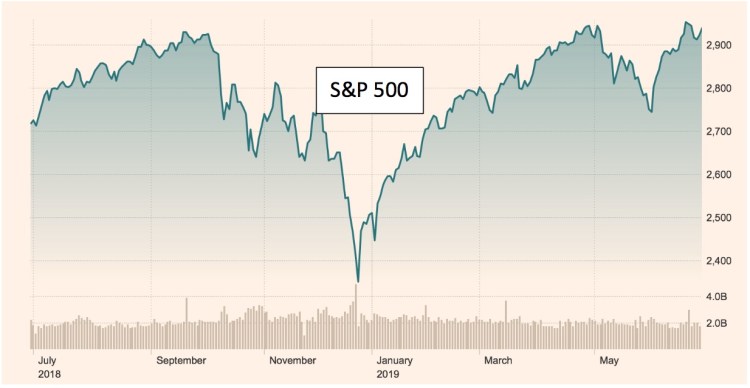
The first half of 2019 has been very rewarding for investors. The world’s stock markets, as measured by the FTSE World index, are up 16%! Among major markets the US is a clear winner, up 18% while other developed markets are up 13%. For the US, it’s been the best first half since 1997.

These numbers are flattered by the fact that we ended 2018 with very weak markets, so there is a strong element of catch-up in the data. Looking at the S&P 500 index in the picture below we can see that we are not that far away from where we were last September. The lack of a major negative in US-China trade talks also helped. The final support for stock markets has been the line-up in recent weeks by a flock of increasingly dovish central banks which coaxed markets over the line.

Economic data overall has been mixed and not a catalyst for market moves so far in 2019. I suspect trade and interest rates will remain key factors for the rest of the year. As well as divergence in returns at overall market level, there has also been meaningful divergence in sector performance. For example looking at global sectors; Technology is up 22%, Banks 11% and Food Retailers 1%.

It will be interesting to see active manager performances, for the first half of the year, against this background.

S&P


The Boys are back in Town!

Dateline: September 23rd 2019

The Boys are Back in Town

Last week’s batch of data from the US and Eurozone economies did little to clear the fog around near-term direction. Business confidence remains especially low.
One thing is clear though – Central Banks are centre stage – again.

Members of the US Federal Reserve said they would take whatever action was appropriate to sustain the economic expansion. This probably means interest rate cuts during the year with some members, such as James Bullard, wanting cuts immediately.
Mario Draghi, ECB president was equally “dovish” promising rate cuts, more bond buying and strong pledges on how long rates would remain low, if economic conditions fail to improve. All eyes on Central banks then!
In further evidence of their critical role, President Trump has managed to complain about both central banks in the past week!

Of course a successful life-enhancing Brexit or an outbreak of sweetness and light in Sino-US relations at the G20 could change the picture.
(Still something worrying at the back of the mind, when policy makers say they are concerned about growth and stock markets go up!)


People to avoid at Parties No. 86 Someone who actually knows what an inverted yield curve is

Swiss Tony

Yup – it doesn’t rank as the most enthralling of topics, but there are some folks who are obsessed by it. Now if they work in the investment/economic milieu there may be an excuse for that, but if they are in the real world, it may be time to seek help.


Why does it matter and what is it?

The inverted yield curve is regarded by many as the best single predictor of an economic recession around the corner.

The yield on government bonds (that is the interest rate that the market demands for holding them) should get higher as those bonds get longer. For example, the yield on a 10 year bond should be higher than on a 2 year bond and that for a 30 year bond higher than the 10 and so on. Investors typically demand higher returns for locking their money up for longer periods. This is to compensate them for higher economic risk such as an outburst of inflation or a payment risk.

When that is not the case – when yields are turned around (or inverted) it sets alarm bells ringing for many commentators. It has a good track record. In the US, whenever the yield curve has inverted, in the last 60 years – with one exception in the late 1960’s – a recession has followed.

What’s the rationale for this. The shorter end of the bond spectrum is likely to reflect the Central Bank’s policy on interest rates, so rising rates to choke of inflation or growth has a knock on effect on them. This naturally can lead to lower growth.


We have recently moved into that territory. Today in the US, 10 year bond yields are about 2.08% while shorter 3 month rates are 2.2%. Is a recession imminent?


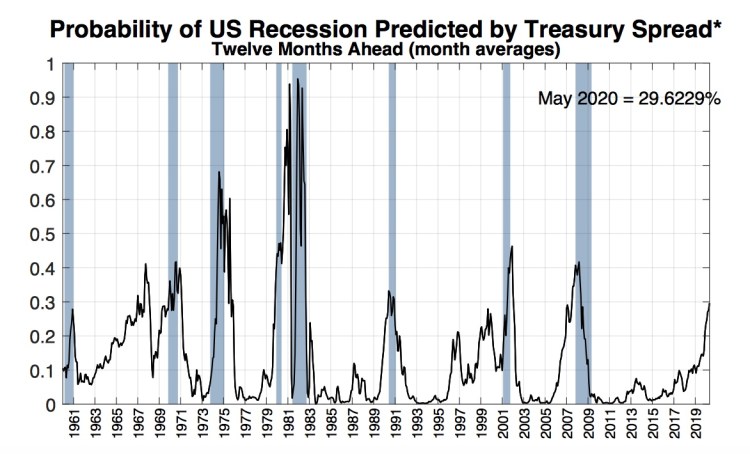
The US economy looks OK at the moment though everyone acknowledges this has been a very long expansion. The New York Fed see the probability of a recession in 2020 at 30% currently. This is probably a bit lower than the followers of the inverted yield curve society would be thinking.

NYF Recession IndicSo, despite its pedigree the inverted yield curve may not be getting the universal acceptance it thinks it should merit. Why might it have lost some of its power?


 

We are at extremely low bond yields already after the greatest monetary experiment ever and  unprecedented bond buying by the world’s Central Banks. That has to play some role.


Also longer dated bonds typically have built in this premium because of inflation risk etc. Inflation has not been on the agenda for a number of years, is not an issue currently and market forecasts, 5 and 10 years out, see it as being very benign.


What does this mean in the short term?

Many board members of the US Central Bank keep track of the yield curve and would, if there was an overwhelming signal of an imminent recession, look to cut rates. Others will take a more balanced view of the economy and weigh up the pockets of strength against the weaker areas, as well as signals from the bond market. Some talk of an “insurance cut” i.e. to smooth market behaviour in case of any further tariff escalations.

All in all this could push us into a “wait and see” stance.

“Neeeaaaoorgheee!”

Tommy

Tommy Tiernan has a brilliant piece where he discusses the global debt situation. It’s not a typical topic in stand-up comedy and well worth a look on YouTube.


https://youtu.be/E8DfCzOS1lE


He says we all owe – Germany owes billions of gazzillions, while England owes trillions of willions of billions and as for the US it owes so much it’s not even a word; it’s a primordial screaming deafening noise.

(Tiernan also has a solution to this debt problem)

It’s not clear how much Tiernan based his views on the 2012 work by Reinhart and Rogoff noting that countries with high debt levels face massive losses of output often lasting more than a decade.


What are the numbers? Global debt last year was $243 trillion. That’s just over 3 times the size of the global economy!   This is actually higher than it was in 2008 – and that was when all the trouble started.

The debt is held by corporates and governments and mainly in China and the US.


It’s a topic that we are always being warned about from the likes of the IMF, OECD, World Bank, Institute for International Finance as well as the rating agencies and the media. Talk of debt sky-rocketing and words like impending crisis, financial time bomb and catastrophe mark the debate.

The IMF says that our financial vulnerability remains elevated – which I think means

*We have too much debt

*It’s growing too fast

*The quality of the debt is getting worse


The IMF is concerned that these debt levels are handicapping governments’ ability to increase spending or cut taxes to offset any weakening economic growth.

And at the company level we are seeing shareholders in some cases pushing for balance sheets to be restored to some degree. This certainly emerged in investor calls with companies like Verizon, AT&T and AB InBev in recent months.


But apart from the constant warnings and the company promises to reduce bloated balance sheets, financial and market life seems to roll on. Whenever markets have a few bad days, global debt gets rolled out as an excuse and then quietly slips into the background again.


So is it a thing?


I think it is something, which if we are entering tougher times, will make it more difficult to respond effectively, and this weaker policy response may exacerbate any slowdown. It’s like the road directions you get in Ireland “Well if I was you, I wouldn’t start from here.”


The fact that a lot of the corporate debt is poorer quality (lent to companies with weaker balance sheets etc.) is also important. In the US we have seen the weaker type of corporate debt, such as what has labelled BBB go from 30% of all debt in 2008 to 55% in 2018. This probably means that if things do go pear-shaped we could potentially see higher default rates than in previous cycles.


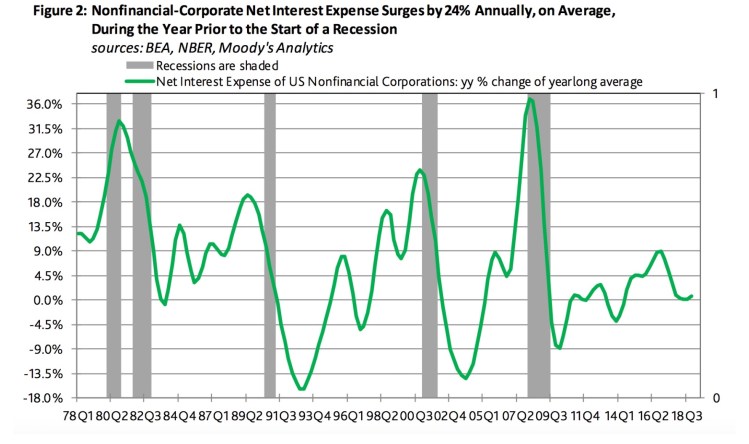
But……….. today, this week, this month it’s hard to think this monster debt level should have a huge impact or indeed on its own prompt a downturn and the picture below holds the key. It looks not at the level of debt but at the interest costs of that debt.


Debt levels are at extreme highs but the cost of that debt is at extreme lows. The graph is from a recent report from Moodys and they note that the 5 recessions since 1979 were prompted by a surge in interest expense, whereas wehave seen interest costs at very low levels and declining. As you can see, the current position of the green line is way below previous stress levels.

Debt graph3


The key here is that interest rates remain low. This clearly depends on things such as inflation and if you want comfort on that, Lawrence Summers said in a speech in April that in his view current levels of inflation and interest rates are here for the next 10-15 years!

Travelling and Arriving. Brexit Collateral Damage

EU UJ Flag

The Brexit debate seems mired in dates and deadlines. Progress and attention span  is incremental with every week seeming to be all important and then fading into memory. Red lines do little more than lose their colour.

In Ireland it is never far from centre stage but even now fatigue and an October deadline have succeeded in taking it  off the front pages.

The relentless focus on dates and parliamentary procedures robs us of the opportunity to consider what type of environment the process will actually lead us to – not in terms of trade or tariffs but quite simply in how we get on with each other, the UK, Ireland and the EU.

What also doesn’t get a lot of attention is how Ireland will fare in an EU without the UK and how Ireland’s relationship in the round with its most important neighbour will develop.

For both of these questions there have been developments in recent weeks which should rule out any complacency.

The Republic of Ireland is pro EU. Membership of the EU gets an 85% approval rating in Ireland compared to a 62% figure from the EU 28 as a whole. This view has been long held and well embedded.

Ireland’s relationships with the UK are equally deep (and complex!). Putting history to one side, in purely commercial terms, the UK is our second largest export market taking 12% of our exports and when it comes to food and drink exports alone, this goes up to 40%. When you consider the prospects of leaving a trading bloc against the backdrop of those sort of numbers you can understand why it has been headline news for three years.

That our relationships both with the UK and EU will change is a given, but the actual process as we’ve seen it so far highlights some of the risks around that change and the nature of the relationship into the future.

Regarding Ireland and the UK, there has been outstanding progress on the quality of the relationship over the past ten years. Can that pace be maintained? It’s clear that the backstop has been a major fault-line in the negotiation landscape in the past 12 months. Generally there has been acceptance on the UK side of the need to honour commitments in the Good Friday agreement. However as progress stalled, we have seen lesser commitment from some of the leading Brexit proponents. We have also seen a degree of negative reporting  in the UK media. This led to the very unusual event in the first week of April of the Irish ambassador to the UK writing an open letter complaining about “snide and hostile” remarks in sections of the UK press. This is not a usual avenue for a diplomat to pursue and underlines the gravity of the situation. The Irish government had been fully appraised of the diplomatic action in advance. The key risk here of course is that we see more of this and some roll-back in what has become a very healthy relationship.

And Ireland is facing changes on other fronts. An EU without the UK will be a new experience for Ireland as both joined together in 1973.

And this is shaping up to be quite a different EU.

Even if the leader of the Italian Northern League, Matteo Salvini’s proposed alliance in the European parliament of AfD from Germany  and Marine Le Pen’s National Rally in France doesn’t come to fruition, this could be quite a fractious parliament, and the radical right may make some gains in May’s elections. Also with the UK leaving, France and Germany on their own become very close to achieving a blocking minority. Does the nature or tone of the assembly change without UK presence? As for the Council, research by Goldman Sachs in late 2016 pointed out that the UK had been the most “out-voted” member state in the previous 12 years. Also France is better at forming coalitions than Germany. What is clear is that Ireland will have lost a hugely influential neighbour with a common language and often common view point.

On the question of the controversial backstop, there has been reasonably wide-spread support across the EU. While we are still not clear how it will be resolved in the near term, it is also possible to see it re-emerging in three or four years’ time. Could Ireland count on the same degree of support in a future round of talks or has all the political capital been spent?

Recall in January this year, Mr. Czaputowicz, the Polish Foreign Minister, suggested a time limited backstop in order to move the talks along.  So far this has been the only meaningful sign of break-down in consensus and cohesion. However looking forward, the dynamics within the EU and lack of appetite for another round of negotiations may overwhelm principles. Support for a long term backstop across the EU27 cannot be taken for granted.

Europe still has an array of issues to deal with – immigration, overall debt levels, US trade and a sluggish economic cycle, etc. – all of which will require a decisive and cohesive response.

We run the risk of being dazzled by dates and deadlines in this Brexit odyssey. The journey as much as the destination is critical. How we actually get there, the language used, the tone of the debate, and ultimately how well we get on with each other, may matter just as much for the long term health of Europe overall.

Maybe that’s the real risk in Brexit.

Gin and Tonic anyone?

G&T Picture

How did we get here?

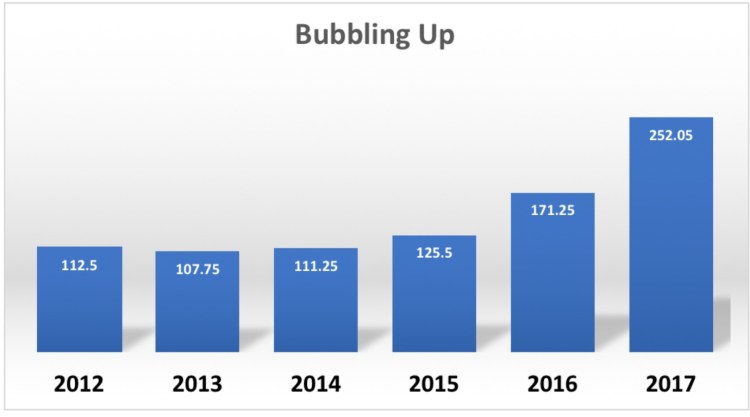
Look at the graph below. It’s not about GDP or the S&P 500 or CPI – it’s more important than that. This is how much gin we have consumed in Ireland in the past six years. Total growth over that period? – about 125%!

Probably doesn’t come as a complete surprise. It’s a trend that has garnered newspaper and magazine articles, and pubs have gone from having one gin bottle on a dispenser to a smorgasbord of offerings laid out on a menu.


Graph JPEG

Source: IWSR 000’s case


Still though – 125%?


Why?


Why gin? Why now? Why so successful?


Firstly what it’s not.


This is not an Irish phenomenon – it’s practically global. We have seen it in the UK, Europe, Australia. India is currently seeing a growth rate of over 12% per annum.


The real surge in growth in Ireland is from 2015 onwards and I suspect 2018 figures will confirm that trend. So it’s not just a general economic recovery story as we were reasonably out of the woods by then.

And yes, it is off a reasonably small base but that base was close enough to the likes of rum, brandy, scotch, and other liqueurs, many of which have actually seen a drop in consumption over the same period.


So what was it that has led to this phenomenal growth?


I don’t think there was one blockbuster reason but rather a conflation of a number of factors.


We did see some innovation and investment from some of the “majors” such as Hendricks and Bombay with some change of taste and market positioning. They were seeking to gain a wider (and younger) appeal, establish a premium drink and get rid of what had become a stale old image.


It also helped that at the same time there was somewhat of a revival of interest in cocktails. Many “mixologists” drew upon vintage sources and books like Harry Craddock’s “Savoy Cocktail Book” (1930) for inspiration. Many of the classic recipes relied heavily on gin because of its versatility and lighter touch.


Also getting the word out was also made significantly easier as Gin’s targeted core audience was also the most active and engaged social media demographic. Details on events, brand stories, promotions etc. could be spread well beyond what previous drinks could have achieved.


Gin was also able to latch on to an existing trend. Gin overall, but especially from smaller batch distillers, with its use of botanicals and local natural ingredients was able to catch a wave around concepts like freshness, organically grown, wild harvested, that was emerging especially in the much vaunted millennial segment. This was a similar concept to what many craft beers have benefitted from.


And as the demand rose so did the supply.

While imported gin still dominates the market here in Ireland, the growth in locally produced gins has been one of the outstanding features. Reports suggest about 50 Irish brands from 20 or so distilleries currently in production.

The economics of production are very supportive certainly compared to say whiskey. There is no need to lay stocks down for a number of years but gin can be shipped straight away both domestically and overseas. In fact some of the new local gin production came from whiskey producers using existing plant while they waited for stocks to mature.

The Irish Spirits Association has clear roadmap that should see local production outpace global trends – looking to treble over the next three years.


This new local supply adds to the general “buzz” around the product.


Gin has a long history especially in England and at various times has not enjoyed the best of reputations. Previous surges in consumption have been accompanied by instances of mass displays of public nudity and spontaneous combustion in women! To date, this current uptick seems to have been free of such occurrences.


Will it continue? It is difficult to see the pace of growth continue but at some point it will plateau. In the UK it has now been included in the basket of goods used to calculate inflation so the Office for National Statistics feel there is a degree of permanence about it. So in the near term there are no signs of the bubbles bursting.

Dad’s Army on the outlook for Global Financial Markets

Mainwaring

Wall Street, Davos, Walmington-on-sea – all major financial centres. We checked in with the members of the local Home Guard platoon to get their views on the near-term outlook for global financial markets.

Captain Mainwaring  Now look here men, I can’t tell you that it’s going to be easy. On the contrary it’s going to be tough. These markets are going to throw all they can at us. But looking at you, I see a crack investing force, and no amount of earnings revisions or economic downgrades is going to knock us off course. So stiffen the sinews, and our stiff upper lips and strong balance sheets will see us through whatever Adolf, or whoever the current global dictator is, throws at us.


Private Frazer Well now, my extremely balanced view on all of this is that…….WE’RE DOOMED! Doomed I tell ye. There’s nowt to be done. Yon central bankers are all out of weapons, conventional or no. We’re marooned, marooned in a sea of debt moving closer and closer to the rocks. Oh.. oooh.. there’ll be weeping and wailing and gnashing of teeth – unless of course I’m wrong.


Lance Corporal Jones The most important thing is not to panic. Don’t Panic! Don’t Panic! Let there be no panicing! It’s the data sir, the data d’ye see it’s all fuzzy wuzzy. But when there is a clearing of the data, and the data is clearer because of the clearing ,it’ll be time to fix bayonets, cold steel d’ye see, and advance. Permission to invest sir!


Private Pike    My mum says that the best thing to do is to wrap up well and stay protected. Uncle Arthur says it’s all fine and no need for such stuff and nonsense. But my mum says that lashings of spotted dick, toad in the hole and a program of out of the money put options will see us right as rain.


Private Sponge


Private Walker           Leave it to me. I know a couple of blokes…well I say blokes I mean highly regarded, well respected, global investment bankers…and they kind of owe me a favour, know what I mean. They can get all our – what do you call ‘em? Oh yeah debt to GDP ratios and change them (did it for Greece didn’t they) and then hey presto – problem solved. Bob’s your uncle. Billy’s your aunt and the job’s OXO. Failing that we can get a can, find a road, and kick………


Sergeant Wilson         Oh Lord. Well now really…… this has all gone quite too far. I’m sure those lovely chaps at the central banks are really frightfully nice, and will play cricket and simply do the awfully nice things that we’ve come to expect. It really is the decent thing to do and then we can all just muddle through as usual.

Fund Managers – Brave New World

Galaxy

2018 was a tough year for fund managers. Markets were unforgiving and saved a lot of the angst for the last month of the year. Performance suffered and what the Financial Times labels “flowmaggedon” , where we saw very hefty outflows from funds across a wide range of asset, combined to hit the P&L  accounts at fund management companies. According to the FT, the sector lost a quarter of its value in 2018.

Asset management CEO comments in the first few weeks of the year haven’t been all that up-lifting. Active fees continue to be ground down under pressure from the growth in indexed, cheaper alternatives. In US equity funds as an example it is now 50/50 between active and passive. This will continue. Here in Ireland auto-enrolment, with its cap on fees, will be further highlight the cost gap.


We have also seen this year further indications of the road map that regulators have for the asset management industry. At the start of February the FCA in the UK issued further rules for the industry on fund benchmark and fee disclosures. While there are a number of issues the key question that the regulator wants to help the consumer answer is:


“Is my fund manager doing a good job?“


Performance benchmarks come under scrutiny. Why were they chosen? Are they appropriate? How can we assess the manager’s performance relative to that benchmark? If fund managers work under a tracking error constraint, the degree of divergence will need to be highlighted.


And if the manager doesn’t use a benchmark there has to be some way for the customer to answer the same question – how do I know this manager is doing a good job. This could well be the case in multi-asset or outcome orientated-products. The level of risk taken on to deliver returns will be under the microscope.

And these performance disclosures will have to be as straight and jargon free as possible. As the CFA noted, it is about protecting those customers least able to actively engage with their investments.


Good fund managers do all of the above already – it now becomes a hurdle for all.


Regulators globally are all on the same hymn sheet so we can confidently expect a similar pathway in all jurisdictions.


In this regard it is very interesting to see what the prudential regulator in Australia is proposing, in seeking to address the issue of poor performance. Like the UK, greater clarity on performance benchmarks and investment outcomes is being demanded. But also the Australian regulator is considering intervening in underperforming funds. Whether this could mean revoking licenses, forcing consolidation etc. is not clear but it would certainly be a major step.


Brave new world.


The Next Big Thing

So there’s been a bit of a recovery in stock markets so far this year after a dismal December. It’s not very surprising and it does seem to lack conviction.

earnings

The year so far has been marked mainly by official downgrades to global economic growth, accompanied at times by “Game of Thrones” rhetoric and headlines such as “Darkening Skies” (courtesy of The World Bank).

We are likely to see more of these downward macro revisions – institutional economists are very aware of what their peers are saying, and don’t reverse direction easily. Other issues which have unnerved markets in recent months are still on the table – end of supportive Central Banks, health of China’s economy, increasing trade friction etc. These are guaranteed to resurface.


Yes, markets may offer better value than 3 months ago – but valuation alone is never enough.


A slower pace to economic growth is not a catastrophe. In fact sustainable slower growth which doesn’t force the pace of inflation or interest rates is quite a benign backdrop for equity markets.

It’s the degree to which corporate profit forecasts may be out of synch with that economic reality that really matters.


There is quite a strong correlation between analyst revisions to their forecasts and stock market direction.


It can be hard for markets to make progress in the face of a storm of analysts downgrades. The next few weeks will see profit forecasts being revisited on the foot of quarterly numbers and company updated guidance. As far as we can tell, this is the next big thing for markets, and at least it’s grounded in company fundamentals and not determined by the next tweet from 1600 Pennsylvania Avenue.


Analysts did move at the end of 2018 to rein in their numbers for the outcome for 2019. Today the consensus forecast for growth in global profits this year is just under 6%. 2020 numbers at just over 10% do seem a bit elevated still. The key question is whether that 6% figure for 2019 comes under further pressure. There will be wall to wall coverage of the actual quarterly announcements, but remember this is a highly choreographed event with companies guiding the stockbroking analysts as to how close their forecasts are to the likely outcome. There is little real predictive power in the exercise.


To make sense of markets it is better to focus on the company statements (like Colgate who last week  spoke of profits actually being lower in 2019 than 2018) and critically whether analysts take the red pen to their forecasts.


If we weather that near term storm then the possibility of a Fed pause, perhaps a softer US dollar, and subdued bond yields would all provide support for stocks.

Laundry List

llistWe are smack bang in the middle of the “market outlook 2019” season. Despite the fact that economic and market fundamentals don’t really recognise the Gregorian calendar, economists, strategists, commentators et al, rush to give their views on what the next 12 months holds – usually conveniently forgetting what they may have said at the start if 2018!


2018 was a tough year – it was tough to make money. Global equities declined by about 12%.

This in itself yields the first article of faith put forward in this outlook season – equity markets are cheaper now.

Probably true  – as long as prospective earnings don’t fall commensurately. But here’s the thing; in the short term it doesn’t really matter. Valuation does not drive markets in the short term. It is more of a hygiene function. The fact that equities may be cheaper now is a good thing but it is not a catalyst for major market moves. Markets, like stocks, can stay cheap or dear for an extended period.

For 2019, It may be more important  to focus on those catalysts to try and chart a course through markets. And many, if not all, are the same as in 2018.


There is no shortage of potential catalysts – in fact It’s a laundry list.

Among the issues which could drive markets in 2019 are:


When will we see a US recession? Many feel that the indicators point to late 2019 or 2020. Current data is still robust but some forward looking indicators are softer, especially new orders. We shouldn’t talk ourselves into despair and a slowing economy isn’t necessarily a bad thing for stocks.


Will the US Federal Reserve pause on interest rate increases if the economy slows? They have more or less said they would. However this could be a mixed blessing. In Janet Yelland’s tenure at the US Central Bank, decisions not to hike rates sometimes unnerved markets even more.


China continues to loom large as a potential catalyst for markets. We have of course the soap opera of the trade talks where the tone and pace is driven as much by US domestic politics as global trade patterns. Recent numbers from Apple show how a less confident Chinese consumer directly impacts on US corporates.


There is also the overall health of the Chinese economy itself, and the question of whether Chinese policy makers will be as supportive in the event of weakness, as they were during the Global Financial Crisis. It does appear that they have less room for manoeuvrability given aggregate debt levels etc.


Closer to home, Europe could play a more material role for markets than it did in 2018. Brexit rumbles on. Macron’s position is clearly weaker. German politics is in transition. Italy remains unresolved. European elections in May could well see a further shift to populist policies. With economic growth subdued and the ECB  shifting gear, there is ample opportunity for policy mistake.


I see these as key catalysts for market direction in 2019. And as they get resolved we can move into sunnier climes for investors. Equally they have the potential to upset.


So much of what may drive markets this year is less to do with economic fundamentals and more to do with politics and policies.

A recent Financial Times editorial was headlined

“Investors must rely on political common sense”


And that’s what’s scary!

The Central Bankers’ Christmas Party

Santa Draghi

‘Twas the night before Christmas

And all through the Central Bankers’ house

The governors were snuggled up and fast asleep

With no more interest rates left to announce


The up piped young Mark Carney

“This is all too quiet, I say

Let’s have a Central Bankers’ party

For tomorrow is Christmas Day!”


So they sent old Mario Draghi out

For wine, beer, puddings and cakes

And Mario set off and confidently replied

“I will get whatever it takes!”


Then Mark Carney shouts out

“Let’s do a Panto” to Ben Bernanke

“Cause I could play George Clooney

And you could be the Widow Twankey”


But look Mario’s back with hampers aplenty

And welcomed as a real Christmas hero

Says he “it’s amazing how much you can afford

When you keep your rates at zero”


Well now there’s dancing, kissing and hugging

Though in fairness a bit too blokey

But then Kuroda gets a better idea

“It’s time for Karaoke!”


But Kuroda won’t let go of the mike

And Powell wants to give it a shot

But after 23 verses of Sweet Home Alabama

He’s clearly lost the dot plot.


There were governors swinging from the chandelier

There were two on top of the Holly Tree

And quietly in the corner were Lane and Yellen

Discussing macro-prudential policy


But soon things just got out of hand

The authorities had to be alerted

For Jerome Powell after ample liquidity

Like his yield curve, he was now fully inverted.


Soon the Central Bankers’ house was quiet again

So the markets need not take fright

And the words of the governors rang around the world

“Happy Christmas to all and to all a good night!”


The day Mark Mobius came to Dublin

Mobius Pic

Look, it may not have been the only time, but such visits certainly aren’t that frequent. And  the Emerging Markets guru did stand out in his off-white suit and encircled by his entourage. At least he made it to the city centre – one of his analysts spent his Dublin visit in the private jet on the tarmac at Dublin Airport as some visa issues arose.


So anyhow Dr Mobius addressed a small gathering in the Conrad hotel, no notes, and from what I recall no Powerpoint. It was a tour de force performance on Emerging market investing with depth, breadth, enthusiasm and story-telling. And then straight back to the airport, and the jet, and the analyst.


I was reminded of the visit this week, as several asset managers have tipped Emerging Markets as  the place to be in 2019. I spoke with one manager who is very positive on EM bonds and I note that Morgan Stanley have gone bullish on EM equities, moving from underweight to overweight.

Are they right?

EM assets certainly appear cheaper than they were 12 months ago! Global EM stocks are down 13% so far this year compared to 5% for stocks overall


Investors will have to form their own view, but there are a number of issues worth bearing in mind in coming to, or implementing a view.


Valuation: most strategists look at Price to Book as a default valuation metric and yes –  P/B is somewhat below the 20 year average. But that average contains a period (2006 -2008) when we know valuations were daft, which elevates the longer term figure and flatters the current reading.


Experience counts. EM does dance to a different rhythm and I value managers who have managed successfully over several market cycles. Conventional desk top research has greater limitations, in my view, in an EM context. Anthony Bolton, the highly successful Fidelity fund manager, found the investing environment quiet different when looking to transfer his own investing skills and process, which worked well in Europe, to China.


Open or closed. Once you’ve made your decision the issue then becomes how to access the opportunity. While there is a wide range of open ended funds investing in Emerging Markets, it can be worthwhile researching closed ended funds as well. They are not bashed around by inflows or outflows and can stray away from the high liquidity large caps that everyone tends to own. When I’ve compared investment trusts and open-ended funds run by the same manager, the trust usually performs better.


Big picture. I think currently, more than ever, global factors are playing a role in the progress of EM.  The two most significant factors currently are the US dollar, and the health of the Chinese economy. A strong dollar has put emerging economies under pressure  due to capital flow impacts and debt servicing costs. In periods of dollar strength in 2018 we have seen EM sell off. A lull in the rate of growth in China has also played into EM weakness. What would work well for EM in 2019? A sense that the US Federal Reserve was close to the end of its rate cycle and would pause, and also if markets are convinced that the current pro-growth policies in China will prevail and outweigh any negative trade war impacts, would be very supportive of EM as an asset class. If you think the US dollar strengthens further and China stalls, it would be hard to square with a positive EM view.


Don’t buy the label. There is quite a degree of differentiation within that EM category. Turkey and Argentina’s experience in 2018 was quite different from many of the other constituents of the EM universe. EM economies overall may be in better shape than in previous downturns (better balance of payments etc) but there are still outliers. I believe that this argues for an active approach at regional, country and stock level. If you have a risk budget to spend, I believe you will see a better return from it here, rather than, say, in large cap US equities.


I do think there is opportunity here and now.


And who knows we might get Mark Mobius back in Dublin…….

Are Fund Managers a cultured bunch?

Les Patterson   What do you think? Do they know their Verdi from their Vardy?, Van Gogh from Van Morrison, or their Rigoletto from their cannelloni? Hard to know really! But this culture thing seems to be getting more and more attention. In Ireland the Central Bank has been devoting a lot of resources to this issue and getting the banks to refresh/redefine/find their appropriate culture. My initial reaction used to be that this type of thing was a bit waffly, with little real world application. Management consultants immersed themselves in these concepts, and for a reasonable fee their clients could dip a toe in, as required. But if we strip away a lot of the jargon and think of culture as just being “the way we do things around here” (Bower), I think it becomes more meaningful in an asset management context, and should be considered in evaluation, selection and review of managers. Towers Watson and Roger Urwin have been flying the flag on this for many years. Since the early 1990s it has been a critical component in their formal manager evaluation. For them, culture is a unique ingredient in generating alpha and a bedrock on which a competitive advantage is sustained over a long term. They have published good research on the topic, seeking to define and measure what constitutes culture in an asset management context. This is by no means an exact science. Factors involved will typically include leadership, ownership, procedures, policies, diversity, respect, remuneration etc. Should we care? – or should we only care about investment outcomes. Positive culture should underpin alpha generation and importantly (in my view) its persistence. However there my be times when strong performance can disguise a weak culture. Equally weak performance can exacerbate culture issues. How does a solid asset management culture deal with disappointing performance. I read one of GMO’s quarterlies recently where they spoke about the importance of “crying over spilt milk”. This means when things go wrong, try and understand why, and see what might be done better. Other managers speak of having a WWW (what went wrong) wall, noting poor investment decisions and focussing solely on the learning points. I think that acknowledging poor performance (because it will happen!) is a necessary and positive aspect in a good asset management culture. Investors and selectors should view it similarly. In recent weeks, a named lead manager for a large blockbuster fund that had been through over 5 years of failure to meet targets, suddenly announced a decision to leave. So I presume there had been 5 years of meeting with clients justifying and defending performance and process again and again. But conviction may have morphed into stubbornness and It seems to me that the final outcome (manager departure) didn’t really do clients any favours. Maybe a culture where there was some crying over spilt milk and learning opportunities sought along the way would have served clients (and the asset manager) better.

Money for Nothing

MFN

Funds, fees and the future

So you’re an investment manager – would you work for free? – nothing, nada, zilch, zero?

Fidelity grabbed headlines recently with a zero charge on fund management – granted it was for a basic index product where fees were minimal anyway and stock lending can provide the manager with an income. But it was another milestone in a trend.

Fees are falling.

There’s nothing new in this. In the UK, for a typical equity fund the annual management charge (AMC) has fallen by 22% over the last 5 years. Costs matter – the data shows that for both active and passive funds, the cheapest 20% of funds attract the vast bulk of flows.

The reasons for cost compression are well-known:

– Greater use of cheaper options such as index funds and ETFs

– Demand for transparency from consumers, intermediaries and critically regulators

– Auto-enrollment with its cap on charges will heighten the use of “cheaper” options in the mix

– Value for money issues in a world of lower and more volatile returns.

The FCA in the UK has highlighted the issue of value for money in what asset management companies charge and the Central Bank here has written extensively on the complexity of performance fees and issues around their calculation.

For the majority of investors still however the issue is the overall charge as distinct from performance fee calculations. And the issue is very much about value for money.

Asset management is a very attractive business with operating margins in the 30% range (source: Bernstein) with reasonably assured growth into the future and through the cycle. Barriers to entry are very much in the regulation and reputation spheres. It will continue to attract attention from would-be players from other sectors. Ali Baba through Ant Financial is now offering investment product. It will also attract growing attention from regulators.

There are very few businesses where you would pay the same price irrespective of outcome (either relative or absolute). There needs to be a greater link between charges and outcome – certainly in actively managed funds. Of course fund returns depend on what markets do but they are also made up of thousands of decisions (asset allocation, stock selection, etc.) made by the manager and ideally there should be some evidence of “skin in the game”.

Should remuneration be based wholly on investment outcome in any given year? I’d argue not – asset management businesses need some predictability of cash-flow and profitability so that they can plan ahead, invest in the business and resource it properly to provide the required outcomes in a compliant and sustainable structure.

Bottom line: Asset Management charges will continue to fall and if today you’re paying the same as you were 5 years ago, you’re probably paying too much.

As well as the overall level, I suspect we’ll see some moves to align the fees charged with the outcome delivered. So rather than the question being what level the market can bear, it will be about what level is fair.

Absolutely not quite so Fabulous Darlings


Lumley.png

Sure who wouldn’t like them?

Investment funds that can deliver positive returns in any kind of market conditions at  a lower level of risk. That’s broadly what Absolute Return funds say they do. (Yes I know, the managers will  use phases like over a reasonbable time frame, market cycles etc. but let’s be grown up here – reasonably consistent positive returns was the pitch)


And it was very – I mean very – successful. In the UK Investment Association Absolute Retun category there were 20 funds in 2009. There are 74 today with total assets of £69bn. These funds have been a huge success both on an insitutional and retail basis. Well a huge success in asset gathering terms!.


Investor experience hasn’t been that great.


It’s been poor – and as far as some of the block-buster funds in the sector are concerned it’s been poor for quite some time.

For a while it was that market conditions didn’t suit (even though they weren’t supposed to be a factor at all). Reminds me of 1991 when British Rail complained about the wrong type of snow!

Drawdowns (moves from peak to trough) have also been more severe than was anticipated. Investors rightly get unnerved when we see a downward shift in value of c. 8% in a proposition that emphasises low volatility.

Absolute Return funds seem to polarise the investment community. We have seen some outflows, quite significant in some funds. In aggrgate according to Morningstar data we did see outflows in mid 2018, but this was the first since 2011. However most investor surveys suggest a signifcant proportion of investors are looking to increasetheir allocation to the category over the next 12 months.

Can performance pick up? Well yes it can and I suspect that’s the reason we haven’t seen a greater level of outflows. Investors hoping to recapture some of the lost ground.

However, hope is not great as an investment strategy.


Remember even with all the diversification and risk management going on within a multi-strategy absolute return fund, it still hinges on a “view” – a view on growth, interest rates, inflation etc. And this view underlies a lot of the portfolio positioning. These views can lead to a long position in European banks, a position in copper futures or a short position in developed market soveriegn bonds etc. But what if the view is wrong……..?


Also increasingly I believe we have seen more and more  macro outcomes not translating into the asset outcomes we might have expected in the past. I believe this is one of the reasons that recent reality has not mirrored the promise.


Consistently delivering a return of 3-4% above cash is a challenge. Especially in a climate of low inflation and bond yields and equity markets well advanced in the cycle. Absolute Return funds in the past have had the benefit of benign tail winds of both strong bonds and equities and improving economies. This can’t be counted on.

For funds who look to beat a benchmark such as the S&P 500 in the US or FTSE in the UK, underperformance may mean that you don’t make as much as the overall market. In the absolute return world, underperformance translates directly into losses.


I believe Absolute Return can work but it’s tough. I think the range of performance withinthe sector is greater than in conventional sectors. I also think consistency of performance is harder to establish – beware of fantastic one year records!

I looked at the performances in the Morningstar Absolute Return Multi-strategy sector. For the top ten funds over one year, only five even existed three years prior. Of the top ten over three years again only five existed two years before that and for the top ten funds over five years only three existed in the prior period. Fund selection is critical – this is not a generic sector. Manager skill and risk budgetting are the key differentiators.


Future articles will focus on the track record of absolute return managers in single asset classes and whether this might offer a more stable outcome.


Passing the Buck

bank note banknote banknotes bill
Photo by Pixabay on Pexels.com

I know it’s always been the case, but lately in chatting through how markets have done, I find myself talking as much about currency moves as asset moves. Yet in my experience, currencies never feature that much whenever we try to look ahead. The talk at that point is more around asset fundamentals like economic growth, interest rates, profits etc.

But we can’t ignore currency if we’re putting money to work globally.

As that well known group of currency gurus, 10 cc, noted in Wall Street Shuffle:

“You need a yen to make a mark

You need the luck to make a buck”


And currency matters a lot.

I looked at 3 major currency blocks – US dollar, Yen and Sterling – over the past three years from the perspective of a Euro-based investor. In that period the return from investing in US stocks was almost entirely from the asset with actually little currency impact. In Japan, we got about 11% from the asset and in fact the same again from the move in the Yen. In the UK, a positive return of nearly 20% was more than wiped out by an even bigger move in Sterling. This is not about volatility – currencies should be less volatile than stocks- but lately they seem to be playing a bigger role in investment outcomes.

But I’ve rarely seen market commentators zoning in on what a currency might do over the next 12 months while they will happily talk/write at length about GDP growth rates and company profits.

Why is this? Are currencies harder to call? Are investment managers less comfortable/confident in managing risk and return in forex? Research shows that a lot of institutional fund managers simply accept the currency exposure that comes along with global investing. In explaining this approach to clients they may use highly technical language such as “swings and roundabouts”! (what you gain on the swings, you’ll lose on the….).

Other investment managers, much cleverer than me, say that a 50% hedge on any currency exposure provides the most optimal outcome from a statistical risk/reward perspective.

Others may take positions based on PPP (purchasing power parity) and when that doesn’t work, move onto IRP (interest rate parity). Both tend to be a tad long term….

Why is currency a concern now if it’s always been in the mix?

Well, a lot of folks think that the returns we’re likely to see from investing in stocks over the next few years could be lower than what we might be used to. Mid-single digits is probably a reasonable estimate. This is all based on above average stock market valuations, peak margins, more modest top line growth etc. – all fairly plausible.

However, I’ve seen nothing to suggest that currency moves are going to be any less dramatic into the future.

So in any given period, currency swings may swamp asset moves by a factor we haven’t seen in the past with a direct impact on investor returns.

Why not just hire a bunch of clever gals and guys to manage this part of the return. Some do and call it an “overlay”.

It may be tougher than we think. I looked at a survey of currency managers and their funds (15 in total) where they focus purely on getting forex moves right, In the past 12 months, only one actually produced even a positive return and that was a staggering 0.2%!

All others were negative.

So in a world where we may see greater bottom line impact from currencies compared to the underlying assets (especially if some world leaders see currency as a weapon to achieve geo-political goals) it is a decision whose importance increases.


“Swings and roundabouts” may not suffice anymore – we’re going to need a bigger playground!

Fancy a Coffee?

20180513_130322.jpg

Nestle certainly does. They are set to pay $7 billion to add Starbucks’ products to its portfolio. And this is at a time when Starbucks growth rate has been on a decline since 2015. But that decline may have more to do with Starbucks than the industry overall.

There’s still a whole lot of coffee drinkin’ goin’on.

In the US, the NCA (National Coffee Association obviously) estimates that 64% of the population drink coffee every day. This is up from about 50% at the start of the millennium and is now back to the previous peak of 2012. That rate may well be peaking around these levels, but within this, the percentage who consume espresso based coffees has gone from 4% in 2003 to 24% today. Starts to explain a lot…….

Afternoon drinking is a problem. Apparently we are not doing enough of it! Starbucks has mentioned it at practically every quarterly conference call over the past two years. Some coffee experts feel that the baristas are more focused on cleaning up and restocking than enhancing the customer experience in the afternoons.

Starbucks are also facing a bit more competition now. Though I suspect that statement has been true for a number of years. The advent of McDonalds and McCafe is changing that competitive landscape. And not all coffee drinkers are the same! A recent research report from Bernstein outlines the key differences (psychographic distinctions they call them) between those who take their caffeine at Starbucks and those who head for the Golden Arches.. The survey results suggest that compared to the coffee drinkers at McDonalds, the Starbucks folks are somewhat younger, with higher income, watch less television, are more tech savvy, more environmentally conscious and tend to eat out more. If there was a box for “can linger 4-6 hours with a MacBook Pro and half a cold latte”, Starbucks would have won that too I suspect.

Any business built on passion and enthusiasm as Starbucks is, is to be regarded but on the ground in the US today, in terms of same store sales, McCafe is making headway.. Starbucks are taking action on this (closing some underperforming stores), but a snippet in the Sunday Times this morning also points to potential elsewhere. Starbucks plan to open a new outlet in China every 15 hours and have more than 5000 up and running by 2021. That’s a lot of coffee.


Now a really interesting survey would be the psychographic distinctions between Lyons Tea drinkers and Barrys!