Time to add to Property in your Portfolio?

Is it time for Irish investors to look at commercial property again? 

BlackRock, the global investment giant, last week told its clients that the outlook for property is brightening, with falling interest rates and reduced yields in other assets.

Does Ireland fit into this “brightening” picture?

Portfolio allocations to the sector have been dragged down by weak prices coupled with a lack of investment interest. Within the market itself, the first quarter of this year was especially sluggish, with an investment spend of €160 million marking a 12 year low. A pick up in the last two quarters has seen investment volumes rise to €1.3 billion for the first 9 months of the year. This is still low. By contrast average volumes over the last 10 years were in excess of €4 billion.

While the figures are dominated by a relatively small number of larger transactions, better activity leads to clearer price discovery. It is worth noting that many sales are happening at substantial discounts. Some 2024 transactions have happened at a 25% discount to already-lowered late 2023 guide prices.

Where has the money been going? In the quarter just gone, investment into retail has been to the fore, followed by office where some investors see signs of value.

The office sector still dominates most institutional property portfolios (such as pension funds) with allocations north of 60% being typical. Other sectors include logistics and to an extent residential. 

We know the last few years have been tough for the office sector.

Today there are three important consequential trends to consider in this sector – two on the demand side and one on the cost side.

What is the likely direction for hybrid working? Many companies have moved to smaller spaces or restructured existing buildings for a lower attendance. This has impacted demand.

But we have seen moves from some employers who look to move back to a 5 day week. According to LinkedIn, there has been a decline in the number of both hybrid and remote job offers in the past 12 months. It appears that we may be past “peak hybrid”. Even if there is no mass return to the office, current trends may reduce the drain on the demand we have seen post pandemic. 

Will foreign direct investment hold up? The technology sector, especially from the US. has been a pivotal part of office demand. We have seen some cracks in this demand profile recently. Some investment plans have been paused. Political developments in the US may also play a role here. The outlook is uncertain. FDI flows are a vital element in the future demand for Grade A office space.

Finally there’s the environmental status of already established office space.    Former central banker Mark Carney has been warning of “significant stranded assets”, as many older buildings may not make economic sense to refurbish or repurpose for environmental reasons. The scale of the issue is immense. The International Energy Agency says that operating buildings accounts for 26% of global energy-related emissions. For investors, the “environmental health” and age of the property portfolio is a key metric. IPUT, for example, who have long championed their environmental  credentials, highlight the fact that 67% of their office portfolio is Grade A+.

So after a multi-year decline of 25% and more for property funds – does the sector offer value?

Office property yields today are about 5%. Retail and Logistical yields are in the 5.5% to 6% range. By comparison, 10 year bond yields in Ireland are in the region of 2.6%, down from 3.2% 12 months ago. So property offers an attractive income. But with a stubborn office vacancy rate bubbling under 20%, and the very specific and substantial issues highlighted around demand and costs, it’s difficult to see capital values making much headway in the near term. 

Are Irish Investment Managers charging too much?

Fees charged for managing money have been coming down. This has been a long term trend which has picked up pace. A recent global survey by Morningstar shows that over the past 4 years, management fees for all active funds in their universe have shifted down from 0.68% to 0.6%. Most of this decline took place in the 2020 to 2022 period. For comparison the same survey shows fees in the passive space stabilizing around the 0.1% mark. Other surveys also show evidence of this fee compression.

KPMG note that Irish Asset managers see this reduction in fees as the single biggest driver of change in the business. The decline has been driven by greater accessibility to lower cost options such as indexed funds and ETFs. Scale players have also played a role in the downshift of investment management charges.

And it matters. These lower fee levels have meant that investors in the US, for example, saved $3.4 billion between 2022 and 2023.

Lower revenues for asset managers are coinciding with burgeoning costs. A report from the Boston Consulting Group in the US notes that costs for US managers have risen by 80% since 2010. Costs as a share of revenue have grown from 64% in 2015 to 70% today.

Some see AI as one route to tackling this cost issue. 72% of global asset managers think AI can transform their business model – but only 16% are actually working on it.

It’s interesting to note that where costs matter, they really matter. In the passive fund space the cheapest 20% in terms of fees garner 90% of all inflows.

Some investors point to performance-based fees as a way of aligning manager and client interests. But for managers this introduces a degree of volatility into their revenues which can be challenging. For those funds, in Ireland, Luxembourg and UK. offering performance-based fee structures, the average performance fee last year slumped to just 0.09%, down from 0.54% two years previous. 

Have investment management fees in Ireland come down?

Well it’s clear that the trend to passive options has seen average AMC here reduce. But it is also clear that there is a wide range of fees being charged in the market-place. I looked at Active Balanced Managed Funds with the same risk rating, and very similar asset allocations, from a number of the key providers here. Management fees charged ranged from 0.7% to 1.5%. And with total expenses clearly being higher, it’s quite a gap between relatively similar options.

There has been a dramatic fall in the average fees on investment funds globally, with a lot of the impetus coming from new entrants. But there is some sense of a stabilizing in this drive to lower fees. The most recent figures show a slower pace. This is supported by comments from Morningstar that today there is more reluctance to compete on fees.

There appears to be a reasonably wide range in fees charged by Irish fund managers for what are quite similar investment strategies. Funds rarely cut fees, though new series of a fund may carry a different cost structure. But costs matter. Key investor information documents for many of the selected Irish funds show that over a recommended holding period, typical costs can siphon around 2.4% annually from returns. 

If we enter a world of more modest market returns, this could start to bite.

Back to School! What Irish Fund Managers are saying today

2024 has been a good year so far for investors. But now, as we put away the buckets and spades and head into the home straight for the year, how do Irish investment managers see market prospects?

Well, all in all, they seem to be a reasonably positive bunch. Not too concerned about recessions, expecting a string of interest rate cuts and generally seeing more upside in financial markets. Some are a bit concerned about pockets of over-valuation and nearly all talk of political risks – but not enough to spring a market meltdown.

I’ve had a look at what some of the major local players are saying.

Zurich are firmly in the camp of lower interest rates  – starting in September in the US with more to come in Europe. In their view, recession fears in the US are overdone and the US consumer remains resilient. Zurich have been broadly neutral in terms of equities and bonds for most pf this year and remain so. Within equity markets their preference is for IT and financials. Zurich have always been very effective in terms of their currency calls and this is a feature of their current allocation.

Positivity also reigns over at Irish Life whose call is to remain invested as they see further upside for both equity and bond portfolios. Some softening in economic growth is likely but this will lead to less inflationary pressure and like all managers they expect interest rate cuts. Political risk in the US may be a feature but any fears over growing deficits are a 2025 or 2026 problem. However this political cycle in their view may lead to heightened volatility as we move into the final quarter of the year

New Ireland also have a constructive view on assets and express this in a clear and succinct fashion. They see the overall economic backdrop as very supportive but feel there may be some risk from the political arena as the year moves on. The risk revolves around the potential for higher tax rates and growing deficits. The fund managers believe that the beginning of a new interest cycle may mark a turning point for bond investors. One caveat they note is to be wary of a bubble in the technology sector.

However the managers at Blackrock hold  a more positive view on technology and see a sustainable trend in the theme of Artificial Intelligence. Overall Blackrock feel that US recession fears  have been overdone and with a brightening macro environment,  it is right to stay overweight risk assets and they feel there are opportunities for investors. They suggest an overweight in US equities and a strategic overweight in Japan. A clear view on government bonds is to prefer short duration over long duration.

The AI theme is echoed over at Amundi, the European giant with significant operations here, but with a more nuanced stance. Amundi feel that there will be winners and losers in this space, and caution that the overall technology sector may need a “reset” in valuation levels, given how far it has already risen. While positive overall on equities, Amundi believe there is better value outside US mega caps. The managers here also see government and corporate bonds as attractive, given where policy rates are headed for the rest of the year. For Amundi, the “window of vulnerability” for markets is in the geo-political sphere. And while this is a long term theme, the outcome of the US election can have impacts beyond North America.

Investment management companies see their role (rightly)  as providing long term solutions and are highly unlikely to advise clients to liquidate everything and head for the hills!

 Nonetheless it is useful to keep an eye on what they say and the language or nuance they may use. Commentaries will rarely go full negative. Key words to watch out for though are “challenging” “lacklustre” or “headwinds”!

Based on what Irish fund managers are saying today, the message would seem to be “proceed with caution”

Big Question: Has the US Consumer run out of Gas?

Maybe the single most important question for investors.

Economists discuss, debate and differ over whether  or not the US economy is headed for a recession. 

Let’s put the theories to one side, focus less on Wall Street, and look at what’s actually happening on Main Street.

Just how healthy is the US consumer? 

This is the key question for the US economy. The consumer, by the most recent data, accounts for just under 70% of the economy overall. 

And looking at actual retail sales data up to mid-summer, the US consumer has stalled. On an annual basis, consumer spending is just grinding higher by about 2.7%. And this was helped by a better July outcome, due to a recovery in autos, following a prior slump.

But away from the official statistics, what are we seeing on the ground? 

In recent weeks we have had a unique window into the state of the US consumer, as many of the leading consumer-facing companies post their earnings, results and outlooks.

And if there was one watchword to sum up how CEOs and CFOs view their customers today, it is “cautious”.

The CEO of Pepsi described their customers as “cautious and choiceful”. Demand for many Pepsi products has been subdued. The consumer is looking for value and the company is looking to respond by lowering entry level prices. 

It’s a similar picture over at fast food giant McDonalds, where their most recent set of results showed an actual  decline in customer revenues in North America. McDonalds are feeling the most pressure among lower income households and they expect little let up in the near future.

Marquee names such as Hershey, Heinz and Starbucks all paint a similar down-beat picture. 

Home Depot, the giant home improvement company, has cut sales forecasts for this year by up to 4%. A few months back they felt revenues would be close to flat. One retailer which bucked the trend was Walmart, with its ‘every day low prices’ mantra, which is seeing better consumer numbers in 2024. But this in itself could be due to consumers trading down as they seek out value.

This cautious customer in the food and drink arena extends to sectors like  travel and leisure. Airbnb is forecasting a slowdown in travel and seeing signs of a slowdown in demand from US guests. Bookings are also occurring later. The picture is similar at Hilton Hotels where management categorize the growth rate as being very, very, low, and feel the market is definitely softening. 

It looks like the period of revenge travel and spend is coming to an end.

What’s behind this caution? Quite simply the US consumer is stretched. Take credit cards as an example. Credit card debt has surged. Since early 2021, credit card balances have rocketed upward by 48%, fuelled by a post-pandemic boom in services spending. And Americans are falling behind in their repayments. Delinquency rates for credit card users are reaching fresh highs. According to the New York Federal Reserve, over the last year, over 9% of credit card balances have moved into delinquency. Car loans are not that far behind. We haven’t seen levels like these in 12 years.

And while debt is up, savings are down. Last week,  research from the San Francisco Fed noted that a lot of the cash savings built up during the pandemic have now run dry, and this is most prevalent among lower income families.

It’s not surprising that consumer confidence levels are off. The Michigan Survey last Friday pointed to flat-lining consumer sentiment levels and a view on current economic conditions 20% below 12 months ago.

So with low confidence, low savings and high debt could the American consumer be running out of gas?

Probably.

And the Winner is….

What’s driving the strong performance of Irish investment funds?

What’s driving the winning performances amongst Irish fund managers today? And can it be sustained? 

Firstly, it’s been a good period to be invested in markets. Over the past year, Irish fund managers have on average returned around 20% in Global Equities and about 12 to 15% in a typical multi-asset fund. These are good numbers.

What types of funds are doing well? Looking at the league tables and the range of funds available to Irish investors, the increasing role of indexed funds is one stand-out. There has been huge growth in passive or indexed funds (which track a pre-determined benchmark}, compared to active funds (where the fund manager decides on stocks and sectors). Irish fund management companies and platforms offer a wide range of these low cost investing options, which have been outperforming their active counterparts over considerable periods. 

In the US for example, this year so far, only 18% of active funds have beaten their benchmark. This is lower than it was in 2023 and in fact 2024 is shaping up to be the 14th straight year of underperformance for actively managed funds. League table numbers here at home show a similar picture.  

One thing which I think has helped index funds in the past year, especially in the global equity space, has been a significant exposure to US equities, and consequently to many of the large cap technology names. The US market has powered ahead in the past 12 months with returns close to 25% -double what has been achieved in Europe. The MSCI World index today has over 70% exposure to the US. Index managers are not concerned with what may look like daunting valuations, which might give an active stock picking manager pause for thought. This US performance boost has been especially notable in those global index funds which exclude Eurozone equities.

Investors should note not all index funds are the same. One of the best locally managed global equity funds which has returned 36% over the past 12 months – a very strong performer – is indexed. But this fund specifically tracks about 50 of the biggest stocks on the world’s markets. The result is today nearly 85% of the fund is invested in US stocks, and nearly 40% is invested in one sector – technology. 

So performance has been exceptional, but has been very dependent on one market and indeed on one sector.

Indexed funds haven’t had it all their own way in Ireland. Some actively managed funds have delivered exceptional returns for their investors. With returns of over 30% in the past 12 months, a number of quite concentrated global equity funds, with a smaller number of holdings, researched and selected by the manager, have done significantly better than their indexed counterparts. Worth noting that these active funds carry a higher cost and there is always a risk that the manager makes the wrong calls. 

So while some actively managed funds have excelled, there has been a strong tailwind behind many indexed options in the shape of high US equity exposure – very high in some cases – in the past year. 

Investors have enjoyed exceptional returns but may need to consider what risks (very heavy in one market and one sector) they may now be taking on.

ESG funds in Ireland – What’s the Story?

Not all ESG funds are the same

We all know that there has been a seemingly never-ending avalanche of investment funds that fall into the wide ESG, sustainable, impact, climate, renewable etc. bracket launched in recent years.

It’s a broad church.

There are so many variations on this theme in the market place. Some are successors to what were originally labelled Ethical funds. Many fly a full ESG flag. Some highlight UN sustainable goals. Some funds focus on climate, while others just admit to being climate-aware or focus on green or blue strategies.

Technically, both ESG and sustainability are concerned with environmental, social, and governance factors. ESG focuses on evaluating the performance of companies based on these factors, while sustainability is a broader principle that encompasses responsible and ethical business practices in a holistic manner. 

So, many funds, with many definitions of how they invest.

However maybe it’s time to take stock.

What’s happened to activity in this sector? 

It can be difficult to get robust data, given the broad aspect of the classification. But according to Morningstar, global ESG fund launches have slumped to a 5-year low. 

In the first quarter of this year, closures of ESG funds outpaced launches. And in that first quarter, the number of fund launches was half what it was in the same period a year ago. Research from Barclays also points to the first year of ESG outflows across all main regions.

Are investors still interested in ESG?  

Research from the Financial Times pointed to 83% of financial advisors saying investor interest in ESG funds has waned.

A recent Citywire survey of fund managers confirmed this trend, showing that the percentage of clients expressing interest in sustainable funds had declined in the past 12 months. When asked: ‘How much of overall assets are now invested in an ESG approach?’ 13% said ‘more than 75%’, which was down from 33% two years ago. 

And this is totally separate from the anti-ESG backlash we have seen in the US in states such as Texas and Tennessee. 

We may also see a different progression between retail and “institutional” funds (such as pension funds), as regulation and public policy drive investment into ESG type strategies for many large “institutional” portfolios. In this institutional space, requirements for evidence-based disclosure and documented consideration of sustainable issues, will copper-fasten the move to such strategies for years to come.

Importantly, how have these funds performed? 

Again getting data can be problematic. It can hard to compare funds on a like for like basis. I looked at a number of global equity funds, marketed here in Ireland, which fall under the broad ESG/Sustainable umbrella. Comparing performance over the last 12 months, we can see quite significant performance differences. In that period the difference between best and worst was close to 12%, for funds with a similar geographic mandate. 

ESG investing can be a more complex issue than we might think.

It’s relatively early days in this space, and we may need the dust to settle. But it may be a while before we get to robust “performance discovery”.

For investors, does China matter anymore?

The South China Morning Post is worried about a recession in China. 

Fortune magazine speaks of a dead-end for the Chinese economy. 

And Bloomberg talks of China’s economic miracle fading. 

Chinese consumers lack confidence and the property sector’s problems seem to be intractable.

It seems a far cry from the years when China was growing at a 10% clip and was the focal point of the global economy.

What’s got us to here?

Several policy mis-steps coming out of Covid didn’t help. A staggered re-opening did little for confidence. Attempts to get consumers to buy new durable goods products was ineffective. Interest rate reductions were minor. But above all, government policy seemed content to accept a lower level of growth as many of President Xi’s initiatives were more concerned about concentrating political power.

So what’s the current picture? The economy is probably growing around the 5% mark. Morgan Stanley forecast 4.5% growth for next year. The consumer remains under pressure. The most recent reading on retail sales was for growth of just over 2% – well below what economists had been expecting, and a decline in the rate of growth. Consumers are also facing  surges in utility bills. Manufacturing is doing a bit better posting an increase of nearly 7% on the year.

Property problems persist. Major property developers are essentially bankrupt. Home sales values dropped by over 28% per year in the first 4 months of this year. The most recent development on the property front saw local governments allowed to buy up undeveloped land and unsold housing to promote activity in the sector. This will be financed by sale of bonds and some Central bank support. The plan is to help developers reduce inventory and generate some cash. However many local governments are too indebted to procure land. The other concern is that the programme is too small to really move the needle. It will account for only 0.4% of China’s GDP. Local authorities’ total debt load last year was estimated at $23 trillion. $42 billion of lending support from the People’s Bank of China in this new initiative is simply not enough.

Apart from the slower economic numbers, China also continues to present investors with a degree of geo-political risk. Support for Russia in its Ukraine war could have lasting consequences. Relations with the US are marked by escalation of tariffs and the continued tensions in Taiwan. Taiwan’s newly inaugurated president Lai Ching-te has done little to ease such tension, calling on China to accept the existence of it’s democracy.

President Xi’s China seems to be happy to sacrifice economic growth for national security, self-sufficiency and social cohesion. This seems unlikely to change. It has meant that many policies to reboot the economy have been too cautious. Politics shapes policy. For investors this means that a return to growth rates of 10% or more and an unleashed Chinese consumer may remain wishful thinking.

Recently, Investment Week asked if China’s risk premium was unfair, with many investment managers responding that they saw opportunity. 

However it is important to evaluate China as it is, rather than as it may have been in the past. Despite growing at close to 5%, this, by its former standards, is a sluggish economy. Average incomes are growing at the slowest rate since the 1980’s. Political risk has also increased – this week’s military exercises by China around Taiwan are a case in point.

For investors, China is not one-way bet anymore, but a much more balanced risk and return proposition.

So….you still want to be an Investment Manager

Asset Management should be a great business.

If you’re successful, you can grow, scale up your business, while keeping your costs under control, and generate huge profits.

Also the demand for your product looks set to grow persistently as pension and wealth flows increase globally. 

However all is not well in investment management – certainly not according to the markets. 

Many asset managers have been performing poorly. Share prices of marquee names in the investment management business such as Schroders, Aberdeen and Jupiter are down by over 30% on average over the past year. The UK stock-market is broadly flat over the same period.

This is not to say that all investment houses have suffered the same. Some, like European giant Amundi, have gained through acquisitions and fee increases.

But it’s clear that a broad swathe of the investment management industry is under a cloud – and one that may not lift anytime soon.

So despite the structural positives for the industry, there are also challenges. And these challenges can be more acute for certain sectors in the investment management business.

The costs of doing business are on the up. Regulatory compliance costs, which had been shifting up, have received a further boost with the drive to sustainability standards in funds. And, as the rush into sustainable funds continues, these costs are expected to grow. 

For Irish asset managers, the costs of meeting these new regulatory and reporting requirements is the number one challenge, according to a KPMG survey.

Europe continues to lead the way in sustainable funds. In Q1 2024, $11bn flowed into sustainable funds in Europe. The US by contrast had its worst ever quarter, with outflows of $9bn from sustainable funds. The US is becoming increasingly politicised in this area, with many state pension funds making decisions along party lines.

While costs of doing business may be rising, downward pressure on revenue  continues. Low cost indexed investing continues to win market share and the advent of “active” Exchange Traded Funds (ETFs) presents a particular challenge for many traditional managers. Management fees can be extremely low. A recently launched US equity ETF commanded a fee of 0.03%! 

It is estimated that 90% of net flows into the industry since 2010 globally have been into passive, and active strategies have recently moved into outright net outflow. 

Last year, global passive assets surpassed active for the first time ever. The fact that many traditional fund managers are now building up “active ETF” ranges is a clear sign that the competitive threat is real. 

For Irish asset managers, according to a KPMG report, this pressure on fees will be the single biggest driver of change over the next 3-5 years. Profit margins are forecast to fall further over that period. 

Aside from the issue of costs, part of the problem is that active investment managers as a whole still fail to deliver on expectations. The Financial Times points out that of over 1400 Global equity funds managed in Europe, only 18% beat their low cost passive counterparts over three years after fees. This figure falls to 6% over 10 years!

Brand values in Asset Management fell in 2023 (by about 25% according to Peregrine) for the first time in years, reflecting all the above pressures on profits.  Looking ahead there will be no rising tide to lift all boats – progress will be choppy.

There will be winners  – and size, market positioning and balance sheet strength will help decide those.

Does Debt Matter?

The amount of debt that governments owe gets called out on a regular basis by commentators and analysts as one the key economic risks that we face.

The IMF has been to the fore talking about the fiscal and financial risks of a high debt, slow growth world. In their view, higher long term interest rates, lower growth, and higher debt will put pressure on medium-term fiscal trends and financial stability.

High government spending following the Great Financial Crisis, and then driven by the Pandemic, have pushed up government debt levels persistently since the start of the century. This was manageable when interest rates and government bond yields were at rock bottom.

But now these rates have shifted up, increasing funding costs. So public debt is taking an increasing fraction of GDP. At the start of this century government debt as a share of GDP for Advanced Economies was about 75%. The IMF expect it to reach 120% over the next 4 years.

And this is at a time when projections for global economic growth have fallen to the lowest level in decades. 

So – rising debt burdens with declining ability to pay.

The IMF have especially highlighted the impact this can have on the health of the financial sector. High debt levels may reduce governments’ ability to support ailing banks, should the need arise. At the same time the more banks hold of their countries’ sovereign debt, the more their balance sheet is exposed to potential weakness and fragility of the state finances. 

In short, higher national debt levels make for a more vulnerable financial sector.

This is clearly important – but does it matter to investors?

It seems to be something of a “frog in boiling water” issue as far as financial markets are concerned. As debt levels have risen, stock markets have really paid little heed and pushed on regardless. Incremental increases, year by year, in the level of government debt play little role in day to day investment decisions.

However, this may be changing.

Firstly, the IMF are getting very specific in their warnings on debt levels. Last week it singled out the UK, US, China and Italy as needing to take urgent action on their debt levels. With the UK for example, it highlighted the fundamental imbalances between spending and revenues. Specifically the fund noted the recent cut in national insurance in the March budget which is only part-funded.

Secondly, many of the rating agencies are now more explicitly taking account of the overall debt position in their country reviews, and scoring accordingly. For instance, Moody’s have urged France to rein in their spending, and both Fitch and S&P are set to review France in the coming weeks.

Finally I’m starting to see some fund managers systematically include overall debt (household and government) in their allocation framework to government bonds. A recent M&G piece noted the varying levels of total debt across a range of countries and recommended weighting towards those with relatively lower levels of total debt. This would imply positioning away from countries like Japan and Greece and leaning towards the likes of Poland and Hungary. Assuming the individual investment case stacks up, countries with low outstanding debt offer greater fiscal resilience and policy flexibility. 

In M&G’s view this presents an attractive insurance policy against a debt sustainability crisis.

For this fund manager, debt levels will continue to move into the spotlight as there is minimal appetite anywhere to bring borrowing levels down.

The Numbers Are Wrong!

For many investors in financial markets, economic data is crucial.

The latest instalment on inflation, growth, or jobs, can have huge influence on market sentiment and market moves.

Battalions of analysts and commentators pore over such numbers in the greatest of detail and then rush to publish their findings.

But it seems that the only thing we can sure about is that the numbers are wrong!  

For instance, currently many investors are focussed on how the US jobs market is performing. Investors (and policy makers) would like to see the labour market cool and take the pressure off inflation, which the US Central Bank is striving to reduce to closer to 2%. The first Friday of every month gives us an update on how many new jobs have been added to the US economy. January’s report was a blockbuster showing that 353,000 new jobs were created in the US – a staggering number way above average.

However only one month later, that number was revised down by 124,000 jobs -that’s a difference of 35%!. And December’s number was also revised by 43,000 jobs. January’s number was revised again last week.

In fact, in the past 12 months, we have seen revisions each and every month – of up to 90,000 on several occasions. 

It is thought that immigration may be part of the problem in collecting the US data. But whatever the cause – the result is a very volatile set of data where first estimates (which is what the markets focus on) are wrong.

This is not new – nor is it exclusive to the US. We have seen similar discrepancies in other economic data such as GDP which have seen subject to significant revisions over multi-year periods. Over the past ten years, global GDP has been revised in each and every year by an average of 0.5%. 

In some economies, such as the UK, the degree of revision has been as much as 1% – on average. When you’re looking at lowish growth rates of around 2%, such differences matter.

Published economic statistics in many countries are subject to much revision. Much of this has to do with changed work patters following Covid and deteriorating response rates to government surveys.


In the UK for example, the Office for National Statistics (ONS) was for a while unable to publish an estimate of unemployment because the response rate to its survey had fallen from 50% to about 15% making it unreliable. The ONS still advises users to exercise caution in interpreting the data.  

There have been similar reports of “survey fatigue” and declines in response rates in Europe and In Canada.

Clearly this is an issue not just for investors, but for policy makers too. 

Is there a solution? Well improving tha actual data collection can be problematical. Even making surveys legally compulsory, where it has been tried, doesn’t seem to work.

For investors seeking a signal on where we are in the economic cycle, it might make sense to diversify your sources. More timely, higher frequency data could be used to complete the jig-saw. For example, data on same store sales, traffic flows and credit card spending may provide a better steer on GDP than  GDP itself!

Are Investors too complacent today?

Stock markets around the world have hit record highs this year. 

In fact, markets have enjoyed a good run since end October last year – the US S&P index is up about 25% in that period. Principal driver was probably a benign view on where interest rates may go in 2024, coupled with a resilient enough economic back drop, especially in the US.

And many analysts are still quite positive. Many of the forecasts I see highlight the likely cuts in interest rates in 2024 and further growth in economies and company earnings as the basis for a positive view on markets – even if it is a modest enough call in terms of magnitude.

But how much of this positive outlook is already baked into today’s market levels?

I think there are a number of issues worth talking through, in assessing this consensus benign view on equity markets.

Is the market move too concentrated? Has the market rally been dependent on a small number of stocks? There has been much talk of the “Magnificent Seven” and how these stocks have dominated returns. In the US today the top ten stocks account for 30% of the broad index. However a useful piece by Goldman Sachs points out how the valuations on these stocks are nowhere near what previous bubble valuations looked like. They are also more profitable and have stronger balance sheets than were demonstrated in previous major out performance phases. 

So there is an underpinning to these market leaders which may give some comfort to investors.  However it is worth noting that a market that becomes dominated by a few stocks becomes increasingly vulnerable to some source of disruption or contagion. 

What about political and geopolitical risks – are they fully discounted in market prices? There certainly is an abundance of risk events – notably conflict in Europe and the Middle East. Concerns over Taiwan have also surfaced intermittently. Yet markets don’t appear to be overly concerned. Blackrock produce a geopolitical risk indicator which seeks to measure investor concerns. This peaked at the time of the Russian invasion of Ukraine and has fallen since then. While risk rose again in October last, it still sits at levels well below its peak. 

And as a further barometer of the lack of investor concern, we have seen a surge in flows into funds. For example, UK investors piled into equity funds at the fastest rate in almost three years, adding more than £2.6bn to their holdings in February. And in the US, equity funds drew a record $56bn last week, more than the previous peak of $53bn set in March 2021. Of course flows can easily reverse, but many investors are piling in. 

We are likely to see continued event risk as 2024 unfolds. This will be a year with more elections that usual – with the US perhaps being the most problematic. It is difficult to see a smooth outcome after November in the US, irrespective of who wins.

But perhaps the key issue to consider in assessing market risk is simply whether markets today are cheap or dear – especially in the context of the economic and profits outlook. Focussing on the US, we’re on around 20 times prospective earnings which is probably supportable, but leaves little room for disappointment. Valuations may get some help from lower rates later in the year. But any declines in interest rates are likely to be measured. Also we are not embarking on an economic super-cycle  or a surge in company profits. Broker forecasts are for modest growth in profits over the next few years – in the 6-10% range – on the back of unspectacular economic growth – around the 2% range. What price are you prepared to pay for such an economic/profit environment?

So while factors such as economic growth, interest rates, inflation and profits growth are pointing in the right direction, such moves may be modest and not without risk. 

Investment strategies should take this into account. 

Interest rates will fall in 2024…..but when?

2024 will provide some relief for borrowers and potential borrowers as interest rates fall.

But the question is how long they may have to wait, and how much should they expect, in terms of a reduction.

Last night’s comments from the chief at the US Central Bank suggest we may have to wait a bit longer than some in financial markets are thinking of at the moment and that the amount of reduction may also disappoint.

The US Federal Reserve (Central Bank) was early to start its rate cycle – first increasing in March 2022. The European Central Bank moved that Summer, hiking by 0.5%. This was the first hike in 11 years and ended an era of negative interest rates.

Further rate hikes are now off the table and nearly all Central Bankers have pointed to reductions – but when?

I suspect the US will make the first move again on the way down.

Before Christmas, the Governor of the US Federal Reserve really got markets excited with his comments that suggested the first cut was imminent. Many pencilled in March as the likely date. The Fed has its target of lower inflation and the numbers seemed to be heading in the right direction – but economic growth and jobs numbers still suggested a fairly hot economy. Officials sought to pour cold water on this exuberant interest rate outlook.

The US Central bank in its fight to get inflation down to a core rate of 2% would like to see a more balanced jobs market. Every month we have seen record breaking numbers of new jobs being created in the US – the most recent being 199,000 in November. There are signs though of a change. Most of the surge has come from the “post-covid” categories of leisure, hospitality etc. This now seem to have run its course, and from here we will see a broader but more balanced picture on the jobs front. Also looking at surveys of whether jobs are easy or hard to get, again the labour market seems to be cooling a bit. This supports the Fed in its drive for a “softer” economy and less price pressure.

Financial markets also are looking at maybe 5 or 6 cuts in the year overall. The US Central Bank’s view is closer to 3.

How long is it usually between the final hike in the interest rate cycle and the first cut? On average it can be around 7 months. This time could be longer. It may take longer for interest rate policies to work than in the past, as less debt is variable and so less responsive to higher or lower rates. On consumer debt, approximately 88% of household debt is locked in at a fixed rate – in 2006 this was about 75%. This means higher rates don’t flow through to the system as speedily.

Policy makers in the US actually have a choice about when to lower rates, given lower inflation, but still a very resilient economy. Other Central Banks, like our own ECB, face much weaker economic conditions and so are a bit under pressure to cut as soon as possible.

And as of now, the US Federal Reserve doesn’t feel it has enough information on inflation to make that interest rate call. The Governor of the Fed said last night that they probably won’t even be confident enough to make that call in March either (as many expected they would). Stock markets sold off on what some considered disappointing news.

So the US could well wait till later, closer to the Summer, before they pull the trigger. Our own ECB won’t be far behind.

So we have a while longer with interest rates at current levels.

Will Economists do any better in 2024?

Throughout 2023, the war-cry from many economists and market experts was for an imminent recession in the US. 

A tightening US Central Bank was going to derail consumption and investment and knock between 2 and 3% off economic growth. A stronger dollar would undermine exports. In a Wall Street Journal survey of economists  at the start of the year, the average probability given for a recession  was 63%. Highly respected research firm Ned Davis cited a 98% chance of a global recession.

The actual results for the year will probably show the US economy growing in 2023 around 2.5% and be one of the better developed economies.

And these calls for recession weren’t half hearted views but full throated cries for the US economy to give up ground.

One of the largest global investment groups, well into the year was publishing banner headlines of “recession without rescue” and urging investors to abandon current “playbooks” to navigate through this new set of circumstances.

Our own economic think-tank, the ESRI, spoke at the start of 2023  of international recession and much slower growth in the US, which would have a knock-on impact on our local economy.

Even into mid-year, the recession calls continued with Moody’s , the debt rating agency, calling for a recession in the US. In July, the World Economic Forum told us the US was already in recession.

Interestingly as well, many high profile individuals were on the recession bandwagon. Investor Stanley Druckenmiller said he would be stunned if there was no recession in 2023. JPMorgan CEO Jamie Dimon warned us  of great economic danger lurking just over the horizon. In fact he has done so on about four different occasion in the past year!

Official channels also supported the view. “Nowcasting models” from both Atlanta and New York Federal Reserve Banks gave high probability to recession risk more or less throughout the year.

So the “crowd” was clearly disposed to hearing bad news. A PWC survey of Irish CEOs at the start of 2023 showed 83% expecting a global slowdown.

“Group Think” emerges as a major factor in so many experts being blind-sided.

Could the analysis , especially in the US, have been sharper?

Firstly not everyone was in the recession camp. Goldman Sachs held a non-consensus view of no recession through the year. How were they different? They actually felt that  2023’s rise in interest rates would be a lot less impactful than what had already been experienced. They also (rightly) placed much emphasis on real wage growth and jobs growth.

As I read CEO statements and conference transcripts from the big retailers through the year, one word which resonated was “resilience”. The consumption side of the economy which accounts for just under 70% was proving healthier than some anticipated. New jobs created typically and substantially surprised – last week’s number of another 219,000 a case in point. US wage growth, plus stellar growth in US jobs, well into the cycle, underpinned this consumption.

Keeping a closer eye on Main Street might have improved macro forecasts. Paying less attention to signals from financial markets (such as an inverted yield curves) when those same financial markets were anything but normal, might also have helped.

As for those who called it right in 2023 – what do they see for 2024?

Broadly  — more of the same.

The Central Bankers’ Christmas Party

‘Twas the night before Christmas
And all the markets were closed.
Dealers all snuggled up in their beds
No asset positions left exposed.

But soft in the distance, the bells rang out
And cherubs sang hale and hearty
Coz after another year of decision making
This was the night of the Central Bankers’ Christmas Party.

The biggest night for governors past and present
A break from all that rate hiking or cutting
After a year of constant communication
That’s 12 months of trying to say nothing

This was the night all central bankers longed for
Festive fun and craic without any limits
And perhaps the best thing of all
There would be no one publishing the minutes.

A night of music and food and dancing
No standing on ceremony or being aloof
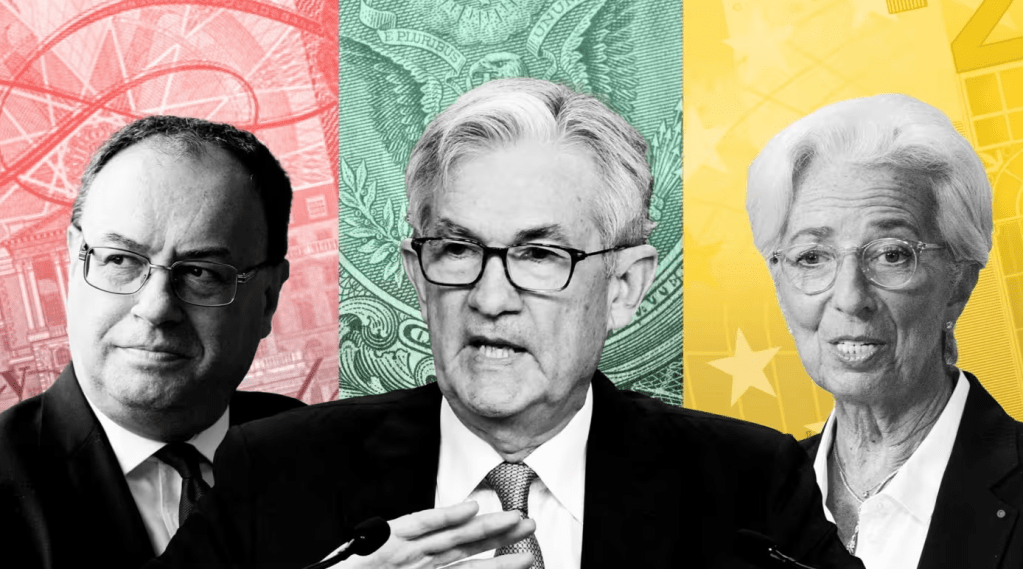
Here’s Lagarde, Powell, Ueda and Bailey
And of course our very own Gabriel Makhlouf

Well the liquidity taps were fully on
And I don’t mean M1 or M2
There was Stella, Heineken Asahi and Watneys
Not to mention Carlsberg Special Brew.

There was the finest food from around the world
Every governor brought the best of their nation
As they all tucked in, the next issue was
A severe bout of gastric inflation

There were vol au vents, sliders and oysters
Trays so heavy the waiters would waddle
Smoked salmon, and pigs in blankets
Oh and somebody brought some coddle.

Christine brought sumptuous escargot
Ueda-san brought sushi and sole
Andrew Bailey felt a bit out of things
With his spotted dick and his toad in the hole.

Pernod, schnapps, sake and sangria
It was not a night for the squeamish
Jay Powell sophisticatedly sipping a martini
Makhlouf piling into the Beamish

Then the music started and the dancing followed
Guaranteed to ease any tension
All the governors out dancing to Simply Red
Singing “Money’s too tight to mention”

Now the dancing was getting to fever pitch
Madam Lagarde, like a ballerina, did float
While Philip Lane, now wearing his tie on his head
Was on the floor doing “Rock the Boat”

Andrew Bailey now swinging from the Chandelier
Unusual for a man of his standing
Then the chandelier broke and the governor flew off
Desperately hoping he’d get a soft-landing

Now they were all going on about their policies
And the innovative things they might do
Pretty soon all their yield curves were twisted
And most of the Governors too.

Soon it’ll be back to work at the desk
Back to forecasts and market calling
But perhaps, interest rates in 2024,
Like the snow, will be gently falling

Why is the US economy in better shape than Europe?

Today the European Central Bank described Europe as being fragile and vulnerable. In contrast, the US Central bank spoke of broad based strength  across all categories. 

What are the facts? Compared to the US, Europe has higher inflation, higher unemployment, weaker stock-markets and significantly  lower economic growth.

And the gaps aren’t marginal – unemployment in Europe is 6.5%. In the US it’s 3.9%. And looking at basic measures like retail  sales, the most recent reading in the US was a positive 4%; here sales slumped by 3%.

It seems to be a question for investors every year – which will do better – Europe or US? 

As a fund manager I would wait for those January strategy pieces from experts telling me it was going to be Europe’s year! It was also (usually) going to be the year when stock selection would be key and Japan would re-emerge as an investment power-house!

As well as economic superiority, so far this year, US stocks are up nearly 20% while European averages are closer to 10%.

Why?

There are a number of reasons – some short term; others have longer to play out. 

This has to date been a crisis-laden millennium. And it seems that with each crisis, the Eurozone permanently loses a few points of growth to the United States. French economist Francois Geerouf notes “For the past fifteen years, Europe has been falling further and further behind, shock after shock: the eurozone crisis, the Covid-19 pandemic, the war in Ukraine, the Great Financial Crisis have all followed quickly. GDP is only one measure of economic well-being but since 2007, per capita growth on the other side of the Atlantic has been 19.2%, compared with 7.6% in the eurozone”. In 2010 US GDP per capita was 47 percent larger than the EU while in 2021 this gap increased to 82 percent.

Take the response to the Pandemic. The US was prepared to run a deficit of twice what Europe was prepared to do to restore growth. The run of blockbuster numbers on the jobs front in the US is testament to this. This also under-pinned the consumer surge. US consumers remain resilient and have bettered many forecasts. The fact that the lowest paid Americans have experienced the strongest pay growth has played a role here.  In Europe in contrast, the latest reading on consumer confidence is the lowest in 7 months.

Geography is also playing a role here and being physically closer to the Ukraine war is no doubt  impacting on European confidence. Issues such as the supply and price of energy  and the arrival of Ukrainian refugees keeps the war front of mind, much more so than in the US. This impacts on consumer confidence and spending.

If the US stock market didn’t have a stellar technology sector it would be closer to, or indeed lag, many European bourses. Technology stocks, with their run-away growth potential, account for about 30% of the US market while are practically non-existent in Europe. This year alone US technology stocks are up 50%. The US financial system itself also appears deeper, broader and more fluid, with a greater appetite for risk than a bank-heavy Europe. For example investment in the field of AI in the US has exceeded $450bn in the past decade, 10 times what we have seen in Europe.

So policy, geography and structure of capital markets are a big influence. Of course, this current situation can change and factors favouring Europe could dominate, but there are some factors which are not up for change.

Perhaps the greater source of the gap will be the fact that Europe is getting older and our workforce smaller. The workforce in the US  (those aged 15-64) is still showing some growth whereas here it is contracting and will continue to do so. The total number of European has risen by 1.6% since 2012. The corresponding number for the US is over 6%. This ultimately is a key driver of economic growth. Unless Europe had a seismic shift in attitude to immigration. As John Train said “Demography is destiny”.

Of course there will be quarters, years perhaps, when European growth will edge out the US. But as Mohnish Pabrai noted in his book “The Dhandho Investor” successful investing is all about the odds and seeking to get them even slightly in your favour. Favouring the US over Europe strategically would seem to achieve this.

Understanding China

Last week, two of the world’s most powerful leaders met in San Francisco. One representing a resilient economy with continuing impressive growth in numbers of people working. The other heading up an underperforming economy with huge issues in key sectors such as property – but China still matters.

For many investors, China is just a number.

Markets wait on the quarterly GDP number to assess whether the Chinese economy is back to its former glory when growth rates of around 12% were commonplace, or whether the more recent pedestrian figures of 5% prevail.

For what it’s worth, the most recent GDP reading was +4.9% for the third quarter this year – broadly in line with expectations but well below the 6.3% for the previous quarter and the IMF is forecasting a sluggish 4 % for 2024 and little improvement thereafter. Recent manufacturing data also pointed to continued contraction.

By historic standards these are disappointing numbers and there’s been a disappointing feel, a sense of drifting, in much of what’s gone on in the People’s Republic this year. From the start of the year there was a view that finally coming out of Covid would see an economic rebound with some degree of “revenge spending” – much as we saw in the US and elsewhere. Western economists expected a full-throated economic revival. 

It didn’t happen.

And the lack of real policy response also unnerved commentators. In previous downturns, the investment burners were turned on, and China (and many global sectors) surged. Instead we got marginal reductions in interest rates and small tax changes in stock market transactions. Coupled with a cumbersome exit from Covid, it made many doubt the degree of policy cohesiveness. 

There didn’t seem to be a Plan B.

Problems in the Property sector  haven’t helped. And to date this has been more a slow moving train wreck than a bust. More than half of China’s former top 50 developers have gone into default. Country Garden has defaulted on overseas bonds. Evergrande continues a tortuous path to restructuring. HSBC CFO Georges Elhedery believes we may have seen the worst in the China property saga, but it will be a multi-year recovery story. The scale of the problem supports the view that it will take time. Central Government is becoming much more interventionist in the housing market and it remains to be seen whether this will crowd out private initiatives. The entire property investment and shadow banking system are also going to be part of the remit of the newly formed Central Financial Commission (headed up by a Xi  Jinping loyalist) – another example of party control.

Where is China’s focus then? The President recently hosted many world leaders to celebrate the 10th anniversary of China’s global investment effort – the Belt and Road initiative (BRI). Although investment performance has fallen well short of expectations and many developing countries are mired in debt as a result, Xi Jinping was keen to sing its praises and potential. This partly reflects the fact that the success or otherwise  of the BRI is not purely short term financial but its aims are wider, reaching into areas such as national security, sustainable supply chains and Chinese jobs. With 1$ trillion lent over 100 countries it has dwarfed Western spending in many developing nations. However China must tread carefully here to avoid the perception of “debt trap diplomacy” and risk squandering its influence in the developing world.

But what about investment into China? This has in fact gone in the opposite direction. 

Foreign Direct Investment has fallen 34% in the past year – the biggest decline since figures became available in 2014. The fall partly reflects the steady stream of lacklustre economic news as well as increasing political tensions. Many global companies now look to “near-shore” many of their activities as they focus on supply chain issues. One very telling datapoint is that Private Equity firms that invest in China raised over $5 billion this year. Two years ago, that number  was $48 billion! This investment collapse isn’t going unnoticed in China and indeed at the recent BRI event, Xi Jinping announced some removal of restrictions on foreign investment. But really this  needs the same level of effort as was applied to the BRI, as there are potentially big wins to be had in sectors such as batteries, electric vehicles and renewable energy.

It’s clear Chinese policy makers are not measuring success in GDP points. National security and Common Prosperity play an equal if not greater role. This is not the China of Deng Xiaoping. Government policy in clearly more intrusive in many sectors including Property and Finance – the Central Financial Commission is one example of this.

Some worry about what they term as the “Great Walling-Off of China”.

Ian Johnson, a Pulitzer prize-winning journalist, speaks of a turning inwards, political ossification and ideological hardening. When the economy was at its most dynamic, there was a social contract or implicit understanding – the government would allow (and promote) economic opportunity for the people in return for a give-up of some political freedoms. The slump in earnings and growth questions whether the contract is being upheld.

China does have structural issues to contend with such as demographics, but by definition there is no short term solution here. A highly entrepreneurial people seem to lack optimism. The slump in foreign investment and the poor performance of Chinese stock-markets (down 40% from 2021 highs) are reasonably objective red flags pointing to a need for a different response –  or at least some response. 

In this regard, it may be that the biggest issue for the Chinese economy is Chinese Politics.

Understanding Christine Lagarde

Central Bankers: Financial markets hang on their every word. 

Speeches are parsed and pored over to gain the smallest clue as to where policy may be headed. 

And if we’re close to a peak in interest rates, with an extended period of little change ahead of us, what Central Bankers say may matter more, than what they do.

Now to be fair, many Central Bankers are not best known for their outstanding communication skills.

It was Alan Greenspan who, when running the US Federal Reserve, famously said “I know you think you understand what you thought I said, but I’m not sure you realize that what you heard is not what I meant”

So the standard has been set.

Now how do we in Ireland and Europe fare as regards Central Bankers’ clarity of communication. 

Christine Lagarde obviously has to be careful and cautious in the language she uses as she is dealing in an uncertain world with issues that investors, consumers, savers, borrowers and many more are desperate for certainty.

And she is. 

It is clear from looking through Lagarde’s speeches, that you’ll gain significant insight into monetary policy – 

– but by Jesus you’ll get an education as well!

Not for Christine is the arid Central Bank language of yield curves and liquidity traps . 

Her landscape of monetary policy is a rich tapestry of, amongst others, European philosophers, acclaimed novelists, Greek explorers – oh and the Head of the Catholic Church.

Take the annual meeting of the world’s central bankers in Wyoming this year. While the head of the US Central Bank was enthralling his audience with PCE and GDP; Christine Lagarde was introducing her audience to the works of Soren Kierkegaard, the Danish philosopher. She explained that one of the key problems for Central Bankers was summed up by Kierkegaard – “life can only be understood backwards but must be lived forward” – perhaps his version of data dependent!

European philosophy seems to loom large in the Lagarde lexicon.

In her September speech, up pops Ludwig Wittgenstein, Austrian born philosopher, who no doubt referring to Central Bankers, said “the limits of my language mean the limits of my world”. Hard to imagine Greenspan admitting to such shortcomings.

And it’s not only philosophers, Christine Lagarde expects us to be well and widely read. Earlier in the Summer she pointed us to acclaimed novelist Graham Greene, as a guide to the hard work that goes into interest rate decisions, when he said “a feat of daring can alter the whole conception of what is possible.”  Echoes of Mario Draghi’s “Big Bazooka”?

American author Helen Keller also was promoted by Lagarde this Summer. She offered Keller’s words of “our worst foes are not belligerent circumstances, but wavering spirits”. I think this was aimed at preparing her audience for “higher for longer interest rates” and the need to be patient and strong. At least I think that’s what she meant!

But it’s clear we have a Central Bank leader with interests in more than just supply side constraints. In fact, Lagarde’s ambit extends beyond the philosophical giants and great literature, she also cares for our spiritual welfare . Pope Francis and his encyclical, Laudato Si, feature in her most recent speech. 

The true measure of her influence will perhaps only be seen if Christine Lagarde features in a papal encyclical!

The next crisis will start with empty office buildings

The above headline ran in the Atlantic magazine last week in the US.

Also, the Financial Times speaks of a “financial storm” bearing down on the US commercial property market. Many analysts are talking of commercial property as the biggest systemic risk in the US today and being the next shoe to drop.

Is there a read across to the Irish Property market?

Firstly how dire is the situation in America? There are a lot of factors prompting the property panic. In New York and other “super-cities”, buildings are selling for less than the value of the land they sit on. Many valuations are less in absolute terms than they were 20 years ago. Office vacancy rate is over 20%. With a third of all office leases expiring by 2026, this vacancy rate could rise. The refinancing occurs at a time when costs of doing so are at a 20 year high.

So, it’s definitely challenging.

And the issue about property in the US is how critical it is to many other sectors. Property in the US is highly inter-linked in the system and seems to be Hydra-like in its impacts elsewhere in the economy. 

Property taxes underpin municipal city budgets. In New York, commercial real estate provides 16% of city’s total tax revenue. Many pension funds, public and private have been adding to commercial real estate. Some funds now have over 15% exposure. And as we know from the recent crisis, many regional banks have lending exposure to property. About 70% of all commercial property bank loans are with regional banks.

How should investors in Irish commercial property respond?

The sector has already been under pressure here, and in many of our European neighbours. A typical fund of listed European real estate is off about 18% in the past 12 months.  As with the US, we all face many of the well-rehearsed challenges – struggles through Covid, disruption with hybrid work practices and rising interest rates.

It is worthwhile to take pulse of Irish commercial property.

A typical institutional property portfolio will consist of, in ascending importance, logistics, retail and office.

Logistics typically means warehouses and transport hubs. Today this sector is characterised by solid demand, long term leases, low vacancy rates and good visibility. We have seen rents move up as retail, aided somewhat by the pandemic, has seen the trends to on-line continue.   

Retail itself, has seen the highest share of investor activity so far this year. Volumes and footfall are up and we are beyond pre-pandemic levels. Those parts of the retail market that need that “face to face” option are doing well. Vacancy rates are still high at around 13% for Dublin city centre. Some locations on Henry Street have seen a 14% increase in rent! But a lot of café-type retail, dependent on office occupancy, is challenged.

The bulk of commercial property investment is in offices. Today this is the sector of maximum change, maximum risk and maybe maximum opportunity. The office sector is intensely impacted by one of the major consequences of the pandemic – WFH (working from home).

While rising interest rates or economic growth are typical issues to consider in analysing property trends, WFH is new, unique and revolutionary. 

And we don’t know how it ends.

For some it’s a matter of time, and like the Nike “swoosh”, after the sharp fall, over time we see a pick up in office attendees. Many companies are now looking to limit WFH absences or issue return to work mandates.

Others, such as the consultants McKinsey, say hybrid working is here to stay and that office attendances are stabilising at 30% below pre-pandemic norms. It is hard to see the genie going fully back into the bottle.

But it’s clear Office Property has not caught up with this change in behaviour.

New York city has lost 5% of its urban core residents in the past two years. Footfall in many CBDs in US and Europe is down 20%. McKinsey estimate on modest assumptions that demand for office space in 2030 will be 13% lower than today.

Already Dublin is seeing changes. There are examples of massive remodelling within existing structures, changing how space is used. We have also seem companies simply relocate to smaller spaces. Buildings may need to be aligned more specifically with the culture of the occupier company, and indeed with the local community. The good news on this front is that we clearly have the skills as evidenced by IPUT’s award winning Tropical Fruit Warehouse project where art, culture, and sustainability all shine through an office space.

It’s hard to see a clear picture as activity has been subdued so far. Vacancy rates across all offices is about 14%. 

Is it a US level risk?  We are probably less exposed to knock on effects such as bank exposure, tax dependence and pension fund allocation. A consensus pension fund here has under 4% exposure to property compared to that 15% exposure in the US.

But of the sectors within a property portfolio, Office looks the most uncertain – and probably with the greatest distance to travel. 

Are Investment Funds getting too Big?

One trend that has been persistent, protracted and powerful in the Asset Management industry is consolidation.

And it’s not just the mega deals. Mergers, acquisitions and restructurings have been an ever present feature, on both buy-side and sell-side, at all points on the size spectrum. Recent names in the headlines include Franklin Templeton, Liontrust, Crux, Generali, Invesco, Rathbones, GAM, Brewin Dolphin, Numis and many more.

It is driven by a number of factors – increasing lower cost competition from ETFs and passive, ever increasing compliance burdens, strategic synergies, or just looking to “fill the gap” in the investment offering.

And consolidation means concentration – the big getting bigger. 

As an example, BlackRock in the UK, have doubled their market share since 2013 going from 8% to 16% of total net assets in the market.

This corporate activity is “super-charging” the growth in some funds way ahead of market moves or routine asset gathering. This has implications for what the fund managers may hold in their portfolios. 

Consolidation in the Asset Management industry typically leads to mergers of funds. It can also mean that what had been hitherto different funds, now being managed to the same common single model portfolio. The net result is a greater amount of assets targeting a smaller number of stocks. 

Regulators and risk managers place huge emphasis on fund liquidity. This involves looking at issues such how much exposure there may be to any one stock, whether any of the holdings are particularly illiquid or how long it might take to sell the whole fund.

These are all important issues as they can provide “red flags” to any potential risks in the fund for the investors.

But it also has implications for the contents of the fund. Basically as funds grow, the size of stock they can consider, and the  minimum size of any deal they can trade also grow. Depending on the size of the funds, perhaps only larger, more liquid stocks can be considered. 

Does this matter for investor choice? Probably.

In the UK for example fund managers were often significant investors in Investment Trusts, but as fund size has grown, their ability to invest in trusts and not break their liquidity rules (such as not owning more than 10% of any entity) has diminished. As a result fund ownership of investment trusts has fallen dramatically and many trusts now sit at multi-year discounts reflecting the absence of a significant buyer. 

This can apply to stocks and sectors in the same way.

For the investor a risk from this frantic fund activity is that diversity in fund contents declines, and that there is a “sameness” about what’s available. 

Even today we can see a huge overlap in fund holdings which means that investor choice is compromised. The table below shows three of the major active funds investing in Eurozone equities being sold here in Ireland, – note the very high level of common positions.

Fund AFund BFund C
LVMHASMLASML
ASMLLVMHLVMH
TotalSAPTotal
SanofiSchneiderSiemens
Deutsche TelL’OrealAllianz
SAPBMWSanofi
Air LiquideDassaultSAP
L’OrealAllianzL’Oreal
AllianzInfineonBNP
AXAEssilorSchneider

And these are all active funds, with individual managers making their own “calls” and stressing their ability to take off-benchmark positions. Yet the outcome doesn’t seem to offer much choice to the investor.

This matters because consolidation in Asset Management looks to continue at pace. 

According to the highly regarded PWC industry survey, nearly three-quarters of all asset managers are considering consolidation of some kind. 

One in six of all asset and wealth managers globally are expected to be swallowed up by 2027!

And as regards concentration, today the top ten asset managers control around 42% of mutual fund assets. By 2027, this moves to over 50%!

It’s not that clear that all this industry consolidation will be in investors’ interests.

Beyond the Taverna

Just over 10 years ago, it’s major cities were on fire. 

Bank buildings were burnt and foreign owned stores set alight and looted. Mass demonstrations were violent and fatal and met with riot police and tear gas. The political system was on the verge of collapse.

Today, Greece is one of the fastest growing economies in the Euro bloc. This year over 30 million tourists will flock to Greece’s beaches and temples. Irish tourists will again be to the fore of this wave, as Greece and its islands continue to top the travel surveys here. Greek tourism agencies are planning on how they can grow this vital source of revenue even further. 

The coffee shops in Heraklion are busy from early morning with this renewed tourism influx.

The improvement is not just visible in the bars and restaurants. Financial traders’ screens show a much improved picture than even 8 years ago. Today Greek 10 year bond yields are around the 3.4% rate, lower than many other Euro members, reflecting a willingness from investors to lend money to Greece. In the past investors have demanded yields as high as 15%!

The  international rating agencies such as S&P and Fitch are also on the brink of upgrading Greek debt. In June, Fitch affirmed its stable outlook for Greece, while S&P has a positive outlook on the country.

The Greek economy made one of the strongest recoveries from Covid with GDP up 8.4% in 2021, 5.9% in 2022 and looking like 3% this year and next.

Greece is still burdened by a high debt level – about 160% of GDP. But it has been falling, is set fall further, and is relatively long term – on average about 17 years.

Drilling into the economically crucial banking sector, we see further evidence of improvement as non-performing loans which made up over 50% of bank balance sheets in 2016, today account for just 7%. Unemployment which in the darkest of days accounted for over one quarter of the workforce, today just nudges over 10%.

To be clear though, the economy and its people  have suffered pain, as a result of the enforced austerity measures. 

This economy  is still a shadow of its former self. The Greek economy today is smaller than it was before its financial crisis by about 24%. And while unemployment levels have improved, they are still too high amongst younger age groups and females overall

For those in work, it is still very challenging. Average wages today are 25% lower in real terms than before the crisis. 30% of the Greek population is at risk of extreme poverty or social exclusion according to Eurostat. This is the third worst reading in the EU.

Greece is set to continue to receive European fiscal support – in excess of 3% of GDP per year until 2026. Such support buys the economy more time to deal with its chronic problems such as a long standing investment gap of about 7% of GDP on a yearly basis. 

There is still a need to move more of the economy out of the shadows and become more tax compliant.

Interestingly, Covid which saw an increase in on-line activity helped somewhat in this regard. But the country still ranks too unfavourably in global corruption indices and political leadership is required. 

Tax evasion in Greece exceeds 60 billion euros annually, according to Bank of Greece governor Yannis Stournaras. 

“We are considered European champions” in tax evasion despite the progress made, Stournaras said. About 2/3rds of tax raised comes from just 1/10 of the workforce.

The Greek economy is showing good top-line numbers and Greek bonds may soon regain an “Investment Grade” rating. But so many of the issues that signposted the way to the financial crisis still exist today. It looks like a financial recovery rather than a broad-based economic one.

So for the thousands of Irish holiday makers who flock to the beaches in Greece this summer, it will look like “business as usual” – and that may be part of the problem.