
At least I don’t have to pretend anymore

QE2So anyway there I was listening to Morning Ireland, and this chap, who used to be big name in the ESRI, giving their highly thought of views every quarter, garnering acres of media coverage and attention, but now he’s saying “I’m not in the forecasting business anymore so I don’t have to pretend that I have a great sense of what’s actually going to happen”
 

Pretend!


He never mentioned the word pretend when he was handing down the pronouncements of the great and the good in the economic community. Forecasting GDP growth and its components to a decimal point seemed to carry an air of (self) importance that didn’t entertain the concept of pretending. Nor was there ever use of phrases like “ we were wrong”; no – people simply revised their initial assumptions! If you’re interested have a look at the ESRI Medium Term 2005-2012 Review and see how closely it captured the outcome.


I don’t pay huge attention to economic forecasts. If the economic growth outcome is 2.1% or 2.5% doesn’t really make that much difference in the investment world. Pay more attention to things like whether growth is running ahead or below potential.

And it’s not just that we can’t forecast the future, we don’t even know where we are today. Historic economic data gets revised and rebased often and sometimes in a very material way.

So should we pay these forecasts so much heed when the task seems akin to Rowan Atkinson’s description of the blind man in the darkened room looking for the black cat that isn’t there.

And it’s not just me who questions the usefulness of the effort. Elizabeth Windsor ( HRH Queen Elizabeth II, see above) put it to the highly regarded economists at the London School of Economics following the great financial crash “well lads, yis missed that one” (I para-phrased that somewhat).


Investors shouldn’t spend a lot of time or effort on forecasts which will most likely be wrong. Time is better spent looking for well managed companies generating good returns on capital and good cash flow. I read of a fund manager, many years ago now, who abandoned macro-economic forecasting in his investment process altogether – and did very well indeed. His name was JM Keynes.

He probably knew a thing or two

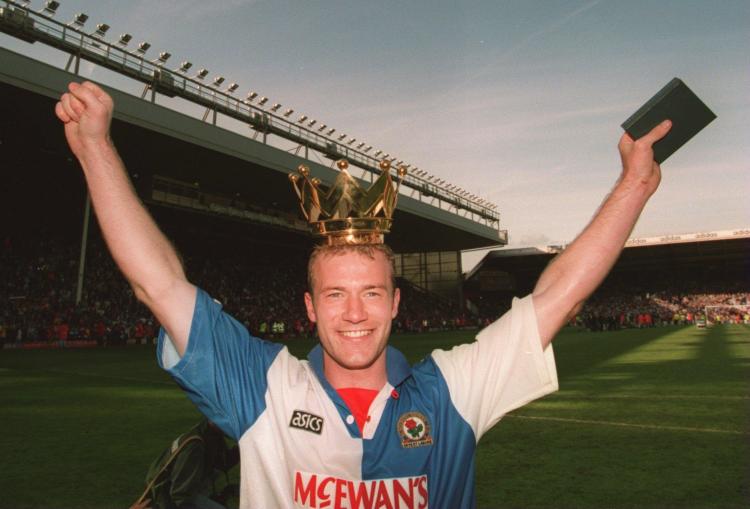
Alan Shearer was one

ShearerIt was a Sunday evening in August way back in 1993. I was stood in that cauldron of emotion, United Park, where Drogheda United were playing Blackburn Rovers in a pre-season friendly. Blackburn were on the verge of greatness at that point. The first half was scoreless, which was a very good performance from Drogheda United. Kenny Dalglish wasn’t happy. He kept his team on the pitch at half time. Second half – no real change. The he sent on Alan Shearer who nonchalantly scored a couple of goals and basically ended the match. That late summer evening in United Park, I had seen a “game changer”
 

“Game changer”

It’s a word that gets bandied about a lot in financial markets. People look for that one big thing that sets the direction for prices over the next six months, year, three years. I’m not so sure they exist. It may look like they exist in hindsight like AOL/Time Warner signalling the dot com crash. Actually it was as much coincident as causal. And it’s rarely that simple one single factor or event determining a complex outcome. “Mono-causality” is what people much more intelligent than me call it.

But life is never really that straightforward

If you had the same European history book for Leaving cert as I had, it went through the eight causes of the first World War. Eight!

As another example, reports looking at the 2010 Macondo Deepwater Horizon well blow-out cite between eight and ten reasonably unrelated issues that led to the tragedy.


I think it’s the same in markets. It’s an array of factors that move markets in a certain way, at a certain pace. Today, the removal of Quantitative Easing, and specifically the cessation of bond buying by some of the world’s leading central banks, is seen by some as a possible game changer. Of course, it is important but it has to be seen in the context of many other factors such as improving economies, better corporate earnings, stretched valuations, investor attitudes etc.

Don’t be swayed by bombastic statements that hinge on one single event or factor. It may be dramatic but not really that useful. Also the financial world can be fickle – what seems to be all important today, and garners huge attention and comment, can quickly become an irrelevance.

I recall one day, many years ago, a US strategist called in and told me to forget about things like GDP growth or earnings or suchlike and go and learn everything I possibly could about a man called Ross Perot (then a US Presidential candidate) because his views on tax policy, jobs, international trade was going to be the most important thing in markets for the next three years. Well you know how that went…….

So apart from Alan Shearer that evening in United Park, there aren’t that many.

Penneys or Louis Vuitton?


“I don’t subscribe to labels. Unless I’m labelling other people” *


I met a US Equity fund manager in Dublin last week who told me about a “once in a lifetime” opportunity for his style of investing. In fairness to him, he did say that he had been through town almost exactly 12 months ago and said exactly the same thing!


He was a Value fund manager. And a very good one. His fund has a very good performance track record against other value managers.

I’m not so sure I get all this label stuff – like Value or Growth. Certainly I think it sounds better to be a value investor, and that value matters. It wouldn’t seem right to set out to buy things that weren’t good value. Value also sounds right and a bit homely. Value in the world of investments means you’re looking for stocks that trade at a price, where that price relative to its book value or relative to earnings is less than the average in the market. The more conservative you are, the more of a discount against the average you might look for. And if you want to be really sneaky you’ll use words like “intrinsic value” which is basically whatever you’re having yourself.

And then there’s Growth. Here you’re buying stocks where you think the growth in earnings or sales is going to be better than the average. (For shorthand think Amazon or Google). Equally growth sounds nice too!

The idea is that when times are bad and growth is scarce or in short supply, investors should place a premium on stocks that can deliver growth. On the other side when things are picking up, value stocks are the best and cheapest way of getting a slice of the action.

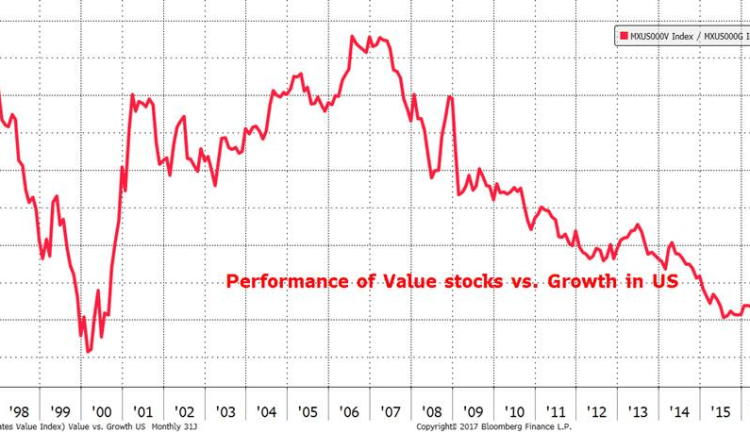
Now the investing world is divided into those who swear by Value as a strategy to make money and those who swear by Growth. And the Value folks will point out how if you go back 30/40 years owning a “Value” portfolio has made you better off than owning a “Growth” one. Problem is since 2007 Value has performed poorly compared to Growth – and that’s about 10 years. (I’ve had careers shorter than that). That’s why I’m not too keen on labels. The length of time when your label can be out of favour can be very long indeed. (See graph)

STYLE


And I know that the discount between value stocks and the market overall is as wide as it’s ever been and yes we did see a bit of a bounce in Value in last quarter of 2016 into this year, but I’m not sure I know what the catalyst is for a sustained period of out-performance. They used to say rising bond yields were well correlated with the value style performing but I suspect that’s because they were seen as a proxy for better growth. Economic growth today is good and looks resilient but “Value” is not responding. John Authers in The Financial Times thinks this means investors are generally negative.

I wouldn’t hang my investment hat on either style, given how long they can be out of favour and that it’s difficult to call the turning points. Also I think stocks which in the past were considered value, may now have valuations which shoves them into a growth basket.

I’d rather look for stocks which are mispriced relative to their potential, whether that’s driven by assets or future profits.


I do think these labels may play a role in risk management in as much as high flying growth stocks when they do hit an air pocket in terms of some disappointment can fall sharply whereas expectation in the value sector may be more modest to begin with.


*Gaby Dunn

Dance first. Think later.

Wise words I got from a wise person and she got them from Samuel Beckett, but she dances and thinks and I struggle with both. So anyway this is a bit of a grand jete for me into a world where I probably don’t belong but you’ll have to deal with that. All my working life has been in financial markets and investing and there is so much rubbish spoken and written that I hope this is a bit different – well a lot different. Anyway I’ll work it out as I go along with help from my friends.