Globalisation – is it over? Does it matter?

Talk of the end of Globalisation seems everywhere.

Tanaiste Michael Martin and Ursula Von der Leyen, European Commission President, have both spoken recently about “de-risking” our trade flows. 

More extreme views believe that current global trade trends point to the end of Globalisation. The Peterson Institute sees Globalisation in retreat, and in its place they talk of “slowbalisation”

This matters because such an outcome could mean a major negative headwind to Global Economic growth over the next 5, 10, 20 years. 

Much of this pessimism comes from looking at trade flows – aggregate world trade data relative to world GDP. 

It’s true this trade data did soften around 2020 – which is exactly what you would expect in a world of pandemic and locked-down economies. The last two years have seen much talk of broken supply chains and massive trade disruptions due to the Pandemic and then various conflicts. 

However improvement has been swift. If we look at more timely and dynamic surveys, we can see this. The New York Federal Reserve index, which tracks global supply chain pressure, now points to a largely  normalised global trade picture. This clear improvement in physical trade is backed up by the noted Kiel Institute trade data.

Perhaps we’re not back at the pace of the growth in the “Golden Era” of global trade between 1970 and 2008, when corporates rushed to set up new supply chains.

But trade alone seems like a narrow enough gauge to capture the connectivity of the Global Economy. 

Given the importance of capital flows in the world economy and the ever increasing feature of human flows, a more holistic gauge of “Globalisation” would be in order.

The DHL Global Connectedness Index considers trade, capital, human and information flows.  This much more comprehensive measure of Globalisation continues to push to new highs, and is well above its pre-pandemic level. Trade did take a bit of a knock in 2020 but has been on an upward trajectory since. In mid 2022, the volume of world trade in goods was 10% above its pre-pandemic level. The biggest blow (no real surprise) was to the movement of people, as the world closed in.

But it’s not business as usual. There is evidence of decoupling  between the US and China, reflecting heightened geo-political tension between the two blocs.

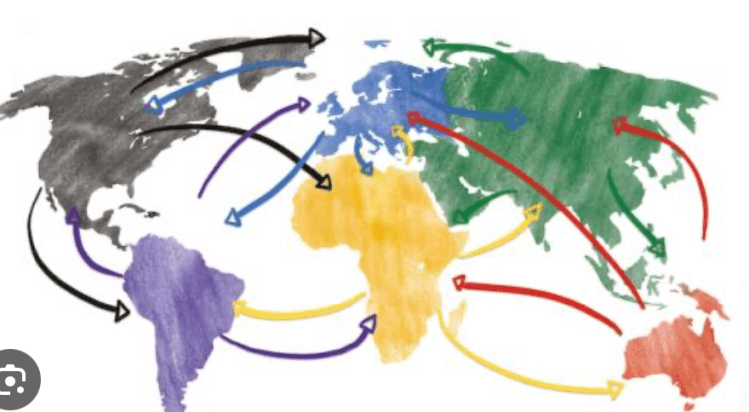
Another key trend is what looks like a pick-up in trade within regions. Today roughly half of all international flows happens within regions, and this has been on an upward trend over the last 10 years. In a world of “near-shoring”, there is scope for this to grow.

Global trade will continue; even in what may appear a less benign world.

Michael Martin and Ursula Von der Leyen talk of de-risking –  not decoupling. 

And there is a sensible need to reduce risk in strategic sectors such as semi-conductors or critical minerals. G7 Finance Ministers have also spoken of the need for supply chain “diversity” where they may focus more on emerging economies to supply components and materials.

As regards capital flows, foreign direct investors will also continue to have a global perspective on their potential locations. But it may be a more risk aware perspective which some have described as a “China plus one” strategy, where they keep making things in China, but also have a back-up, for example Malaysia. 

But trying to move production takes longer than we might think.  A US Chamber of Commerce survey showed that 70% of US companies who manufacture in China have no plans to move in the next three years.

Undoubtedly, the shape of, and patterns within, global flows are changing. While western leaders look to de-risk and unbundle their trade with China, others like Bangladesh and Thailand are pivoting their economic future towards China. Indeed the World Bank sees this as the natural outcome of increased US/China tensions.

Globalisation has survived through wars and periods of protectionism. Now in the face of war and pandemic it continues to move ahead, though pace and patterns may have changed.

Heightened geo-political uncertainty serves to reveal the fragility of Globalisation.

Rumours of the demise of Globalisation have to date been unfounded. 

The World Bank has rightly warned about the risk of fragmentation. 

The greatest threat to globalisation, which we know has a beneficial economic outcome, may be complacency. 

Do Investment Models Work?

Yes  – until they don’t.

What I’m talking about here are the models, processes, frameworks that some investment managers may use when they are allocating across the various asset classes such as stocks, bonds, property, cash, alternatives etc.

The usual building blocks of such models may include factors such as valuation, economic growth, interest rates, currencies, bond yields, momentum, geo-political risk etc. These factors are often given a weight and scored to come to a ranking of assets and final portfolio.

Do all of these factors matter to markets? 

Absolutely.

The problem is not all at the same time; their impact and importance wax and wane through time.

There will be periods of substance and periods of irrelevance. For example there are times when currency moves can appear to be the key focus of markets.  At times in the 1980’s, for example, Yen/Dollar and Japanese trade data were the touch paper for the World’s equity markets. 

Economic growth has also been important at different times. But even if you can correctly forecast the shape and direction of the economy (no mean feat in itself) , forecasting the asset market response is a different matter. We could well be in a “bad news is good news” environment, as the market reaction can be based more on how  a Central Bank might react rather than the level of underlying activity.

Long term performance of such models has been poor. Research suggests little real value-add on average after costs. In the hedge fund world so called “Global Macro” funds which are a transparent way of gauging how effective these strategies are, shows them to be among the worst categories. In fact, over the last five years to date performance has been negative – in a period when the S&P 500 stock index was up over 50%.

There is a risk that if a sophisticated investment process has been constructed, there is a temptation to slavishly follow the turn in every outcome, and to “tinker”. The literature on this subject points to making the right strategic decision, doing so in a meaningful manner and then doing as little as possible. The legendary Charlie Munger has said:

“The wise ones invest heavily when the world offers them the opportunity.

And the rest of the time they don’t”

If there’s nothing to do, do it.

It can be useful to think of the investment universe in broad terms of “regimes” as these may have a longer life span and be easier delineated than many themes.

For example, are we in a rising interest rate regime or a falling one? This then determines an asset bias and may also point to what style might be prevalent within stock portfolios.

Is it a regime of falling or rising valuation multiples? Again this can be reasonably well defined and help us in deciding whether to be aggressive or cautious in portfolio construction. The particular strength here is as an aid to avoiding downside. Protecting against downside risk is one the most powerful portfolio management tools there is.

Even if an investment process appears to be delivering, that’s when real vigilance is called for. In renowned fund manager Anthony Bolton’s view, that’s “the period of maximum risk”

David Swenson, the fund manager’s fund manager, stresses the quality, integrity and discipline of the manager, rather than the sophisticated models shown in the power-point slide.  He does want to be as diversified as practical to ensure the best risk adjusted returns.

In short – the message from proven market experts seems to be not to slavishly follow investment models, but to be diversified, disciplined and decisive.

Could there be a Chinese Credit Suisse?

The Great Wall of China dates from the 7th century BC and is over 20,000 km in length.

It has had a profound military, economic and political impact on China. But at times of global financial crisis, China also seems to have had a financial “great wall” protecting it from contagion. China’s economy in the 80’s. 90’s and the start of this century was posting growth rates in the 10% region despite regular global wobbles. Admittedly these rates have come down and currently the economy is operating at a run rate of about 5%.

So as we deal with our latest banking crisis it seems fair to ask: Is China immune? Is the financial Great Wall working?

Well, the people who watch these banking issues closely – the rating agencies –  don’t really help us differentiate. Moody’s have a negative rating on Chinese Banks. But they rate US, UK and European banks equally negative. 

We know there is plenty of debt.

Using a broad definition that adds official government borrowing along with debt run up by so-called local government financing vehicles and state policy banks, Goldman Sachs analysts estimate  that the public burden has surged 10-fold over a decade. It reached $23 trillion last year, or 126% of GDP.

Property, where perhaps we have seen most stress and focus in the past 12 months, continues to require attention and Goldman expect increased default rates in property high yield bonds in 2023. The Evergrande saga appears to have reached some satisfactory conclusion. The property market experienced its “worst-ever slump” last year, with sales down 24 percent. The property sector, which along with construction accounts for about a quarter of China’s GDP, is a key pillar of the country’s growth. 

Prices of new homes in China rose at the fastest pace in 21 months in March, in the latest sign of green shoots for the world’s second-biggest economy as it recovers from three years of pandemic restrictions. No one is forecasting or indeed looking for a return to exuberance but we may be entering a more steady cycle.

The recent banking concerns in the US originated in the smaller banks, and indeed regional banks as a sector are still 20-30% down so far this year. Is there comfort for investors in China’s large State owned Banks?

Small local banks actually account for a sizeable share of China’s banking assets.

The smallest of banks account for nearly $15 trillion in assets. This is more than half the size of the large Commercial Banks. These smaller banks are laden with non-performing loans and face difficulties attracting stable deposits.

But won’t the Central Bank step in, in any of difficulty?

Pre-pandemic, the authorities allowed Baoshang Bank be the first Chinese bank to go  bankrupt in nearly two decades, wiping out bond holders and forcing a hair-cut on depositors. However we may take some comfort from Beijing’s more recent focus on financial stability.

Perhaps the financial threat could come from this side of the Great Wall.

China has been investing in roads, railways, ports and other infrastructure projects across 150 countries in Asia, Africa elsewhere over the past 10 years in it’s widely touted “Belt and Road” initiative (BRI).

There is no official figure for the scale of this spending but some analysts put it at around $1 trillion. However in the past three years, estimates are that about $80 billion has been written off or renegotiated, and the pace has been growing. China has also lent another $100 billion or so to prevent sovereign defaults. Estimates are that before the roll-out of BRI only 5% of Chinese overseas lending portfolio supported borrowers in financial distress; today that figures stands at 60%.

Given how closely BRI is associated with Xi Jinping, and its role in China’s international policy, it is difficult to see it being halted, but it may get fewer resources. In a world of higher interest rates, slow economic growth and record debt levels in the developing world, further write-offs are possible.

The risk of a banking crisis is top of mind with Chinese policy makers. This was clear at the recent party forum. The last ten years have seen greater power being accumulated by the centre. This applies to Banking and Financial Services as much as anything else. Xi’s view is that the financial sector should better serve the real economy, and has deepened structural reform to ensure this. Bank fraud in Henan Province last year was a strong catalyst for action. 

A new all-encompassing financial regulator, the State Bureau of Financial Supervision and Administration, has just been set up to oversee the sector. Allies of Xi Jinping have been appointed to key regulatory roles. One of the key targets is to prevent domestic funds moving overseas. 

In sum, China does have many of the ingredients that lead to our recent banking stress – large number of small banks, growing non-performing loans, singular focus on one asset – in China’s case, property. 

Western Central Banks chose to ensure liquidity and force mergers in the recent crisis. This was reacting to the crises, rather than having the appropriate regulation in force. The US Federal Reserve in a report this week blamed SVB’s collapse on Trump-era rule changes that meant regulatory standards were too low and supervision lacked force. 

China’s policy seems to be to “turbo-charge” their Regulator. It’s an ultra-cautious approach (similar to full lock down in the face of Covid 19) and remains to be seen how well this approach may work in a crisis.

US Economy 2023: The Consumer Conundrum

The US consumer seems to be on a solid footing today. 

Spending volumes increased in both January and February and look to be on course for a positive year overall in 2023. 

Spending is clearly helped by a red hot jobs market. January saw half a million new jobs created and while that pace will not be maintained, unemployment could well hold onto a low 3% handle for the rest of the year, an amazing result so late in the economic cycle. 

Wages are increasing at about 4% p.a. based on the most recent employment report, and job openings are at record levels.

This positive macro message stands behind the very significant jump we saw in the  consumer confidence survey from Michigan University up 7% in a year.

So the income picture is very supportive. But what about the other side of the equation – the household balance sheet? Here again we see a very constructive picture.  Covid saw a jump in saving and an improvement in household net wealth. 

Excess savings still remain impressive post Covid, but now they are in a downward arc. Savings are now being depleted. About 40% of excess savings have probably been spent so far – by end 2023 that will be closer to 70%. So, while still a factor, most of the wealth effect on spending is probably behind us. 

Consumers seem to be in a comfortable credit position today with little sign of stress so far, as delinquency rates on credit cards remain low. But as interest rates move higher and higher, this is likely to change. 

So the 2023 US consumer outlook is somewhat of a tug of war between the two key forces of income and wealth.

Can we add any clarity by moving from Wall Street to Main Street, and investigate what’s actually happening on the ground? Are these trends being played out at the check-out or being discussed in the boardroom?

We are just coming through the Q4 2022 earnings season in the US, where CEOs and CFOs try to guide investor expectations for 2023. Looking at the retail sector, if there was one word that permeates what CEOs have been saying in the past few weeks it is uncertainty. Many retailers are coming off resilient sales figures since pandemic but now feel that some of those trends are played out and the future, especially in the second half of 2023, may see some moderation.

Walmart, the retail giant, is a good barometer of what’s happening on Main Street. They do see some gains in 2023 in the face of what they see as stubborn inflation that’s depleting consumer wallets. However they see a risk of sales moderating in the second half of the year. Walmart specifically mentions a weaker household balance sheet and declining savings as a concern. 

Home Depot, the world’s biggest home improvement company, echoes this weaker 2023 view but for them the deceleration has already started. Roofing and flooring products have been especially weak suggesting a lot of the pent-up home  improvement is behind us.

The lack of visibility into 2023, is repeated across many widely diverse retail CEO comments from American Eagle  to Dollar Tree.

Retail CEOs do see a potential weakening at some point in 2023. This may also be in the US Central Bank’s playbook as they look for some of the heat to be taken out of the economy. A pull-back would also be in line with a recent PWC survey which shows 96% of global consumers intend to adopt cost saving measures over the next 6 months.

Consumption matters. It accounts for close to 70% of US GDP, and today near-term prospects seem very finely balanced. 

Target Corporation for example, with nearly 2000 stores across the US, probably sums it up best. The company said last week that the retail landscape is unpredictable and that they have seen a cutback on discretionary items as consumers make room for the higher prices in necessities. Brian Cornell, Target CEO, feels certain aspects of the retail environment have changed forever. 

The clearest indication of the unpredictability is that while Target expect their 2023  sales to move in low single digits 

– they’re just not sure if that’s up or down!

Can Investment Managers Manage?

At times of stress, investment managers’ actions may not be in investors’ best interests.

Even before the trade press headlines spoke of record fund outflows and weak financial markets combining to create a winter for the investment management industry, fund managers, both big and small were falling over themselves to cut jobs.
They still are.

The biggest garnered most headlines. BlackRock, the world’s largest asset manager, told employees in January that cutting around 2.5% of its total staff was necessary for it to “stay ahead of changes in the market and focus on delivering for our clients”.
Goldman Sachs has also begun to cut over 3000 jobs in what has been described as a brutal process. Alliance Bernstein is cutting jobs – directly linking it to a 17% fall in assets under management. Jupiter, JP Morgan – it’s a growing list. Fund analysts and commentators see more to come.

2022 was certainly a tough year as far as fund flows were concerned – and (with the exception of some ESG mandates) outflows were across the board, sizeable and persistent. UK funds for example saw record outflows every month of the year. US funds had their first year of outflows since 2016. Passive funds had their first ever year of outflows.

So combined with 15-20% decline in the value of many asset classes, it’s easy to see the knock-on revenue impact on asset managers.

And managers have acted quickly to cut costs. Salaries in a typical asset manager account for over half total variable cost, so it may seem like a logical place to bear the brunt.

But does it make sense? Was 2022 a typical year?

No – to both.

Fund outflows on such a broad protracted and massive scale are an exception. Especially for large asset managers, who may have both a retail and institutional profile, actual negative annual numbers are rare. Morningstar data points to persistent positive inflows in the industry. In 2021, fund inflows smashed records.
On top of record fund outflows, 2022 was notable for the sheer fall in markets – not only the depth but also the breadth of negative asset class returns.

Asset management is often said to be a “people business.” Before making the choice, selectors and investors will spend a huge amount of time looking at, and analysing the fund managers, the analysts, the risk managers, the compliance team and many more. They will consider how the culture of the firm depends on key individuals. It can aften be a sensitive “eco-system” of relationships, experiences and dependencies between people that ultimately deliver good performance.

Why put all of that at risk with swingeing job cuts in the face of what we know are infrequent or unusual market conditions?
Investment managers should manage their business through the cycle and not find themselves forced to cut numbers in response to market wobbles – and at a time when, they need experienced resources the most.

Another oft-used arrow in the quiver of cost cutting is fund amalgamation – where two funds with broadly similar mandates may be merged into one. Often cited as being to unlock cost synergies – these are synergies to the firm, not to you as investor as your management costs will not change.

How firmly held are these cataclysmic views and outlooks from those investment firms embarking on job cuts?

Interestingly, I looked at the example of a large company who recently announced very significant cut-backs, in the face of what they described (and here I paraphrase) as once in a life-time perilous market conditions. Into this abyss of doom, what was their investment advice to clients? ‘Stick with stocks, good half two coming’!

Bottom line: If a firm cannot manage their own finances, why should you be content for them to manage yours?

Irish Fund Managers 2022 – What Worked; What Didn’t

It was a shocker!

Red numbers across all significant stock markets, global bonds and most investment styles, made for very negative outcomes for most Irish investment funds in 2022.
Fear of inflation followed by fear of recession, coinciding with huge geo-political risk (Russia/China) and Central Bank catch-up, made it a year of living dangerously for many assets.

Developed market stocks are the mainstay of many multi-asset funds. Despite many mini-rallies, that were among the biggest we’ve seen since 1981, stocks never achieved escape velocity and in aggregate delivered negative returns in the region of 12% in Euro terms. Emerging Market equities followed in the slip-stream losing about 15% for the year.
Central Banks really called the tune for stock markets as rate hikes increased in frequency and lot-size. This interest rate uncertainty naturally flowed through to bond markets where yields spiked up. Global bonds saw losses in excess of 20% in 2022.

Commodities provided little comfort. Gold, the favoured safe-haven asset underwhelmed. Granted it didn’t fall but I expect more from my safe haven assets if apocalypse seems to be beckoning! The price peaked in March after the invasion at about 2050$ and finished the year at 1850$

Reasonably slim pickings elsewhere in the commodity space – using Copper as an example. A slowing global economy weighed heavily on Copper, the only metal with a PHD in economics. Similarly peaking in March at 4.9$, a downward summer shift meant it finished the year at about 3.9$.

So as investment reports start to arrive on peoples’ desks, how did Irish fund managers cope with miserable markets? Looking at the major surveys of Irish Multi-asset managers, most multi-asset funds experienced negative outcomes in the 10 to 15% range – and there was a strong degree of clustering around this average. Choices around style or risk bucket made little difference although Value did hold up best out of the major factors.

In the UK, a typical balanced fund had its worst year since 1937.

It was interesting to see how some funds performed in this dismal landscape. Many of 2021’s winners (those who performed significantly above average) brought up the rear in 2022, (performing way below average). The figures below show 2021 outperformance being given up in 2022. Delving into some funds shows that a high exposure to US technology names was the driver of returns, both to the upside and downside.

What about Absolute Return funds – funds that were intended to give reasonable returns and be less dependent on overall market conditions? Well they provided little safe haven for Irish investors in 2022. Of the three main absolute return funds marketed locally, two delivered negative returns in excess of 10%, while the third just edged into positive territory.

Clearly it was a tough year for investors globally. Was there any relief to be had anywhere in the funds space?
We did see very positive returns from so-called Global Macro Hedge funds as they benefitted from the widely signalled seismic upward-shifts in global interest rates. Many high profile Macro funds delivered returns in the 30 – 40% range. This was their best year since 2007. But it wasn’t across the board in the Hedge fund space as equity hedge funds were on average negative.

And indeed there was relative success closer to home. Within Irish Multi-asset funds we saw some that came close to a positive return. One outstanding fund delivered a return just about 1% negative – which in 2022 was a very fine outcome.

2022 proved difficult because so many market friendly trends were reversing – interest rates, earnings growth, bond buying etc. Near term, these 2022 trends will continue but it is possible, over the course of 2023, to see – if not a reversal – certainly a relaxation in pace.

The Central Bankers’ Christmas Party

It was the night before Christmas
And all the markets were closed
All the experts and analysts
Were safely home and hosed

No more forecasts for the year
Ni more unprecedented events
No more comments from Central Banks
And wondering what the Hell they meant

But all wasn’t peaceful and quiet
As the snow now began to fall hard
For oft in the distance, a disco light shone
It was the house of Christine Lagarde

“Free to say whatever I want”
She shouted out hale and hearty
“Forget your policies, rates and targets
It’s time for the Central Bankers Christmas Party!”

So the word went round to Governors all
No more speeches or blah, blah, blah
Just get yourself down to Christine’s house
And grab some ooh lah lah !

There was Yellen and Draghi and Carney
Governors, past and present, filing through the door
Alan Greenspan turned up with his punchbowl
Saying “I don’t really use this anymore”

Soon the governors were all mingling
Lagarde all stylish and sharp
Jerome Powell drinking trays of martinis
Philip Lane with a six pack of Harp

Formal protocol was soon abandoned
Even Kuroda was no longer aloof
Last seen standing one-legged on the bar
Doing shots with Gabriel Machlouf

Jay Powell, shirtless and swinging from the Chandelier
Shouting out “it’s just like an Irish Ceili!”
The UK governor replies at the top of his voice
“Does anyone fancy a Baileys?”

Some governors came in Pantomine dress
As usual there was Ben Bernanke
Who stole the show 3 year in a row
With his version of the Widow Twankey

Well the Liquidity was ample and flowing
“I think I’m drunk”, Kuroda blurted
You can forget all about your yield curves
It’s the governors who were now fully inverted

All the governors had brought food from home
And Christine says “This cooking’s a doddle.
We’ve French bread, British beef and noodles
But what the hell do I do with this Coddle?”

But the fun-filled night went on and on
Now it was really really quite late
The Central bankers were all exhausted
From lowering pints and raising rates

“Let’s call it a night” Christine declared
I think I’ve a meeting with Santa Clause
All the governors agreed and for 2023
Said maybe ….. we might just Pause.

Sustainability Faces Headwinds

Last week, European Fund Managers down-graded nearly €50 billion worth of investment funds on grounds of sustainability.

In total, nearly 10% of the premium rated sustainable funds have moved their rating down a notch since early November. And these are not peripheral players. Among the fund management groups to make these moves have been Amundi, Blackrock, UBS and HSBC

Regulators now require investment funds to be ranked on how well they adhere to environmental, social and governance factors. The fund managers who down-graded felt that a wide range of their funds which had previously held to the higher sustainability regime (so-called Article 9) didn’t meet the required criteria.

This is fund managers reassessing their own funds to see if they measure up. It is part of a broader reclassification drive in the European asset management industry ahead of the implementation of new measures at the start of next year. We may well see more downgrades

Just to recap: At a very high level, European regulation requires that funds classified as Article 9 funds in the new legislation are those funds, which can invest in a wide range of assets across equities, bonds and real assets ,that specifically have sustainable goals as their objective. The next category would be Article 8 funds which are somewhat more “relaxed” i.e. those funds that promote ESG characteristics but do not have them as the overarching objective.

Fund managers clearly don’t want to risk the ire of the regulator and “over promise” on the sustainability of their funds. The Central Bank in Ireland has affirmed that standards must be high. This is leading to a deliberately cautious approach from some fund managers.

Other fund management groups who had declared their funds as Article 9, on reflection feel that a more restricted universe of sustainable investments would lead to holding less stocks, meaning poorer diversification in the final portfolio – adding to greater investor risk.

As the Central Bank points out, the criteria used, and the rankings applied, need to be constantly assessed. Looking through an ESG lens can have significant impact on company evaluation. Moodys estimate that the credit impact of ESG considerations is highly negative for about 20% of a 6000 company universe they analysed. So transitioning from one level to another is not straightforward.

There is also a need for investors and agencies to drill down into how companies are assessing themselves. Cop27 jumped on this issue and demanded a stop to “dishonest climate accounting” where companies relied too much on buying questionable carbon credits rather than cutting their own emissions.

This is a new area and likely to be fluid for some time. There can often be lack of consistency in terms of how individual companies are rated by third party providers, and indeed managers may apply their own interpretations as to how “sustainable” companies may be.

This inconsistency and lack of common language is also apparent in the drive to Net Zero. We learned at Cop27 nearly one third of the largest companies now have a Net Zero vow. While this is higher than the 20% figure we saw at Cop26, it is totally undermined by a lack of robust rules.

According to UN Secretary General Antonio Guterres, this lack of rules and consistency has left “loop-holes big enough to drive a diesel truck through.”

We are at the beginning of this process. As at July 2022, the Central Bank estimated about 2% of Irish funds are at the elevated Article 9 level with about 25% at Article 8.

There seems no end to the wave of marketing material from fund management groups currently. They display very detailed schematics showing how investment management and sustainability factors seamlessly blend into a proven process – often under a Head of Sustainability recently appointed! All fund management groups strive to emphasise their difference.

We will see more changes in this funds sector and the amount of assets invested along these lines will grow. It is right that fund management groups should ensure their funds are “in the right sustainability box”. The Central Bank has insisted that all fund names and literature are consistent, clear and constantly under review.

This is how it should be.

Pension Funds and the Big Question

Three Facts

This year, 830 million people will go hungry.

We waste 40% of food globally.

Pension Funds can help.

After steadily declining for a decade, world hunger is on the rise, affecting nearly 10% of people globally. Of the 830 million going hungry, 50 million are facing absolute famine. This set-back is driven largely by conflict, climate change, and Covid. 45% of child deaths every year are driven by hunger. These figures compiled by Concern make for grim reading. The sad thing is that after 10 years of making progress, in the last three years the numbers are moving up again – by about 150 million in last three years. We are failing and falling far short on what is required. Only 7% of appeals for urgent hunger-related funding through the UN humanitarian system are filled. 

Hunger has a woman’s face. Gender bias is clearly visible in the numbers. Two thirds of all those impacted by food insecurity are women. 

Not only are we moving backward in trying to tackle this, but climate change foreshadows a future with even deadlier, more frequent humanitarian emergencies than we know today.

It’s a grotesque number  — 40% of global food production is being wasted. 

That’s about 2.5 billion tons of food produce that goes uneaten annually. This data emerges in this year’s Capgemini Research Institute’s report. The financial cost of food waste is estimated at $1 trillion. 

Where does it happen? Food waste occurs across the food chain. 

Almost 1.2 billion tons of food is lost on farms during pre-and-post-harvest/slaughter operations. Nearly 930 million tons of food is wasted in retail and final consumption levels, with the bulk of that occurring at the consumer end. 

While it’s a depressing number, the good news is everyone wants to change.

We know this. 72% of consumers have become more aware of this wastage post-pandemic, compared to 33% before. On line searches on “shelf life” are up 80%! Consumers feel guilty and want something done. Today, 61% of consumers feel brands, stores, and supermarkets should do more to help reduce waste. Producers share the view but have a way to go to match consumer demands. The survey suggests only 28% of food producers and retailers are focussing on waste reduction today.

This points to opportunity and increased benefits for all.

How would producers and retailers benefit? There are clear bottom line benefits – the costs associated with food waste account for 5.6% of total sales. And an organisation aware of food waster should also grow that revenue. 91% of consumers say they would prefer to purchase food from organisations that are taking steps to curb food waster. So for the organisation with deliverable plans on food waste it mean higher revenues and profitability.

OK so where do Pension funds come in? We know environmental, social and issues around governance (ESG) are now front of mind for pension funds and investment funds generally. European regulations mean that pension scheme trustees must at least consider such issues in arriving at decisions. Retail investment funds also must now be clearly classified in terms of environmental impact. So it’s on the agenda – but is it working?

In terms of food production many pension funds are looking at (and investing in) new approaches to agriculture which can deliver both improved outcomes and better environmental impact. The aim of this “regenerative agriculture” is to protect soil, make it more resilient and productive, and act as a storage sink for carbons. This seems much like a “win – win” proposition, but today only 15% of the world’s cropland is cultivated along these principles.

A Dutch pension fund is working with local agencies to restore 16,000 hectares of degraded land just north of Sydney Australia to build bio-diversity and critically increase its value. This is being repeated in many other locations, although often has to navigate local political issues. This type of investment by Pension funds is, by itself, not going to feed the world, but is an important building block.

Of course not all pension funds can act as directly as the above but through active engagement and clearly outlined ESG principles they can change corporate behaviour. 

Not all ESG factors are created equally.

Arguably some have greater and more timely impact than others. 

If we take food waste, where consumers want action, firms want action and the outcomes can be both beneficial and profitable, it would appear to be very powerful as a lever. It is a priority area – the United Nation’s Sustainable Development Goals (which many pensions associate with) have at number 2 –  Zero Hunger. Rather than a broad brush approach over an array of ESG factors, a dynamic, targeted and smart approach to this factor might be able to achieve results quicker. 

There is no ambiguity in terms of its importance.

Will the US economy avoid a recession?

The “R” word continues to haunt our Global Economy. 

Europe is facing recession in 2023 as energy costs, and indeed energy availability, are threatened by the war in Ukraine. Rishi Sunak is facing a deep recession as a £40 billion gap in the UK balance sheet needs closing. Xi Jinping’s renewed commitment this week to  a zero covid policy means Chinese economic growth totally compromised. 

And in the giant US economy, despite a better third quarter number, talk of a 2023 recession abounds. According to nearly 65% of US economists, as polled by the Wall Street Journal, the US economy is on the verge of recession..

Or is it?

Typical narrative in the US involves a very aggressive Central Bank which will continue to raise rates, engineer a dramatic economic slowdown, and in its own words bring the economy “more pain”. 

Is it widely forecast? Yes

Is it inevitable? No.

One of the risks in economic forecasting is that the data we rely on is out of date. 

GNP itself is a lagging indicator by the time we get it, and subject to a lot of revision. Labour market statistics are notoriously lagging.

However there is a way around this.

Recently, many economists have started looking at more short term ‘real-time’ data. Such data  might include restaurant bookings, electricity usage, rail traffic data or Google mentions. It may not have the same quality as government sourced GDP data but neither does it have the unwelcome time-lag. This became especially useful during Covid as this so called ‘higher frequency’ data informed the debate over when best to re-open economies.

Policy makers who pay heed to high frequency may have an edge in judging the real underlying strength of an economy.

The US economy is slowing – that’s not the question. 

In 2021, it grew close to 6%. The OECD have it at 1.5% this year and 0.5% next year 2023. 

But what does higher frequency data tell us? The Atlanta Fed produce a survey of where they see the economy in the past week. It is based upon about thirteen different factors. This measure actually picked up in October and is suggesting a substantially more positive direction than blue chip economists are. Another new short term indicator – the OECD weekly tracker of economic activity through October – is also holding up better than conventional forecasts.

The consumer holds the key to the US economy, accounting for close to 70% of all activity and while we are seeing record inflation which impacts on disposable incomes, recessionary cutbacks don’t appear imminent. October’s retail sales data was basically flat on the month and up close to 8% on the year. If we move away from the official data, we still get a picture of resilience. Based on the OpenTable reservation service, which manages booking at restaurants, people are back eating out at pre-pandemic levels. People are also confident enough to spend money on travel. The numbers flying and traveling generally are also holding up based on TSA data.

Can we drill into the jobs market to look at more unconventional measures to gain perspective? Looking at job site postings, demand may be slowing somewhat but still remains very strong by historic records. Some analysts have also been looking at Google data which shows that searches for items such as “unemployment benefits” are at lows in the US. Bottom line is there is little sign of stress in the jobs market.

Some captains of industry, such as Amazon’s Jeff Bezos, are warning of a severe recession in the next six months, while Jamie Dimon of JP Morgan sees a downturn that will spark panic in credit markets and lead to a stock bear market. It is worth noting that Dimon has been of this view for some time. 

So can the US economy sidestep this recession risk despite the odds? Brian Deese, President Biden’s top economic advisor, believes that the US has the strength and resistance to shield it from recession. A strong jobs market and a sold household balance sheet are key in his view.

Even if a recession is not avoided, much of the higher frequency data suggest it may be shallower than many expect. 

Irish Pension Funds and Property: Where to next?

The ultimate “Safe Haven”? 

It’s how many see Property as an investment – it’s not true of course, but it does give us a sense of where it stands on the risk spectrum.   

Certainly in 2022, for Irish pension funds and investors generally, Irish commercial property has played this role in what has been an abysmal financial market environment. 

Most, though not all, Irish property funds are showing small positive returns in 2022 – while stocks are in a bear market and bond yields have surged. Other investments such as so-called Absolute Return funds available in Ireland are also deeply in the red.

Typically an Irish pension fund might hold 5% in commercial property – it’s been higher in the past. Some would hold higher – some none at all. This is in turn allocated to the Office, Retail and Logistics (Industrial) sectors. 

Today a confluence of factors sees all three sectors are in the midst of seismic shifts.

Office has always dominated commercial property portfolios and probably accounts for about 60% in a typical fund. Rents today point to the city centre still being sought after with rent levels over twice what’s being charged in any of the suburbs. We continue to see substantial activity here. And while issues such as global and domestic growth always play a role here, we are also facing the impact of new factors such as hybrid working and an institutional drive to sustainability. 

Some potential office occupiers are understandably delaying expansion and relocation decisions until we can see greater clarity on what the week  in the office will look like.

In other words –  do we need the space?

It’s simply too soon to say where the endgame is on hybrid working. There is a lot of flux between employee surveys, corporate intentions and the health environment. Throw the energy crisis into this and any forward looking view on the extent of hybrid working is unsure. Perhaps the most that can be said is that in Ireland today  about 31% of the workforce are not in the office five days a week. That number has come down and in all likelihood will fall further even if we’re not sure to where.

Return to office plans have been making headlines since mid 2020. Ultimately the issue will not just be about space. McKinsey say that executives should focus on making the workplace matter and measuring that success. There is a need to design and activate offices that truly foster human connection. It’s a complex issue; McKinsey highlight research which shows that work experience accounts for at least half of the average person’s human capital. That cannot be squandered in remote working.

Owned space can also be repurposed for other activity that can still meet corporate goals. A US insurance company has donated some space to third level education – creating a “triple bottom line” for the company, the local community and society. 

The other watchwords sweeping through the Irish office market are sustainability and resilience. Property is pivotal in the race to net zero.

The OECD recently noted  that buildings and construction account for nearly 40% of global energy-related CO2 emissions and, in larger cities, sometimes as much as 70%. 

Many occupiers and investors have made bold and public commitments around decarbonisation with goals of 2030 or sooner. 

This trend is irreversible. 

JLL estimate that zero carbon commitments are expected to double over the next two years from 43% to over 80%.

The good news is that huge strides have been made by builders and developers in pursuing this agenda.

IPUT, for example, which is the largest office owner in Dublin, has had ESG factors embedded in its DNA for decades now and its practice and processes reflect standards many still aspire to. Through new builds and refurbs to science-based targets and occupier engagement, a truly holistic approach has been shown to work. It is now working on its first net zero carbon build.

So there will be a supply of best in class office space but also a stock of secondary buildings with poor ESG metrics. The investor will need to choose wisely.

While office dominates portfolios and grabs headlines, other sectors are also undergoing fundamental and unprecedented change. 

As regards Industrial, the post covid obsession on supply chains, puts emphasis on “near shoring” and probably higher local inventory levels. Strong demand with little supply has seen rents rise and under-pins further advances. Corporates with a clear ESG mission will insist upon sustainability levels through the supply chain. Investors should do like-wise.

The Pandemic had a huge impact on trends in retail. During lockdowns, on-line sales in Ireland naturally rose to 15-20% of all retail sales based on CSO data. These levels, not surprisingly, fell back on re-opening, but settled at higher than pre-pandemic levels. The issue for investors looking at the Retail property sector is that some, such as consultants Oliver Wyman, see the on-line proportion moving to 25% over the next 5 years. Even for those who don’t avail of on-line, frequency of trips may have reduced. 

Transaction activity in the sector is recovering from almost nothing in 2021 but investors need to think long and hard about how consumer habits may have changed for good.

An investor in Irish commercial property needs to consider (as they always have) risk of tightening financial conditions, level of supply, level and breadth of demand, valuations etc. Liquidity and vagaries in pricing are also ever present factors.

Current yields, at around 4%, stack up quite well in European comparisons.

Investors need to consider what sector offers the best risk return profile.

But perhaps today there is an imperative to drill deeper into those sectors and identify the winners and losers in a world of decarbonisation, hybrid working supply chain rebuilding and changed consumer habits.

For the investor, this may present more challenges – but also more opportunities.

Should Investors just forget about Emerging Markets?

It is one of the key tenets in investment.

If you take on more risk, you expect more reward.

It underlies why we invest in start-up businesses, new technologies, illiquid assets and much, much more. And it explains why individuals and institutions have ploughed vast sums into Emerging Markets.
Emerging Markets, now taken as a given asset class, really came to the fore in the 1980’s as investors looked to enhance what they assumed would be moderate returns from developed markets. An Emerging Market (EM) was usually smaller with lower per capita income, had some characteristics of a developed market, but did not fully meet its standards in terms of liquidity, transparency, regulation etc. Think Indonesia, Ecuador and others.
The asset class exploded in terms of investor interest and assets invested. The main components within EM were Asia, Latin and South America, and Central and Eastern Europe.

So has EM delivered for investors in the past 15 years or so?

In terms of risk, the answer is yes. The standard deviation of returns has been higher in EM than Developed Markets. For Latin America, risk levels have been almost double. Drawdowns in EM have also been more severe.

It’s a different picture when it comes to investment returns. In the past 15 years, EM equities as measured by MSCI have delivered cumulative returns of about 130%. Developed markets for the same period are up 220%! There have been blowout years such as 2009 when EM stocks rose 80% compared to mainstream returns of 30%, but these were often catch-up years. Over the longer period EM has failed to deliver.

We have also seen performance diverge within the EM universe. We have for example seen Latin American stocks in negative territory when the overall EM outcome was positive.

So how does EM stack up today?

In the past 5 years, EM trailed Developed Markets by about 5% per year in investment returns. This is probably not surprising – EM economies had a tough Covid. Delayed vaccination and less fiscal ability to support the economy meant low growth and weakened government finances. It also means any rebound will be constrained. Within EM, Latin America endured an especially high level of suffering. Brazil, for example, experienced 34 million cases and nearly 700,000 deaths. This poor social and economic picture is reflected in financial market outcomes. In 2020 when EM overall posted a positive return of close to 20%, Latin America was down by nearly 15%. This divergence in performance continued into 2021.

But in 2022, we have seen a closing of this gap. EM markets are off 17%, In common with global equities.

But Latin American stocks are up by 7%.

This difference has nothing to do with business models, corporate strategies, or any other micro issues. The gap is due to two global trends – surges in oil prices and other commodities notably copper. Chile is up close to 30% reflecting the improved price environment for copper – its signature export. Other countries such as Brazil are effectively petro-economies and record energy prices have boosted government finances.

This matters as investors need to be clear on market drivers, their sustainability and likely direction.

And it is important that such drivers, no matter how powerful don’t distract from what may be less positive undertows. Politics may well play a role in many Latam countries over the next 6 months. Argentina has a 100% inflation rate, a divided government and a recent assassination attempt on the vice president. Chile has a left leaning government which recently had its proposed new constitution voted down by the people. Brazil is facing into October elections, where a victory (claimed or otherwise) by Bolsonaro, a politician who makes Trump look like a beacon of integrity and gravitas, cannot be ruled out.

Investors need to take such issues on board, together with the issues of interest rates and inflation which EM is facing into in common with global markets.

How should investors look at EM now?

c The premise that higher returns will accompany higher risk has not be borne out

c EM is not a homogenous asset class but can display a wide range of returns.

c EM are still tightly linked into global, macro trends.

There is no shortcut. The golden age for EM started with absurdly low valuations.
Today this may apply to selected stocks – but not in aggregate.

What’s Moving Markets?


Just what is driving global stock-markets in 2022? 

A stuttering start to the year, based on fears around economic growth and rising energy prices, was followed by the Ukraine war induced decline into early March. Markets then rallied from about St. Patrick’s day to the end of March only to fall more substantially by about 20% on renewed and indeed reasonable inflation fears. This was the bear market many feared.

But stock-markets staged a strong recovery from mid-June to late August. Earnings season came and went with little market response, as previously reduced company earnings forecasts were easily met. Also most economic forecasts were being downgraded – so there was little positive for stock markets in that.

The strong Summer rally was really facilitated by comments from the US Central Bank that interest rates might not be that far off neutral, and markets took heart that future rate hikes could be more modest. 

But now the S&P index has lost over 7% from its recent high.

What is driving financial markets today?

 —– Central Banks. 

This last market fall can be traced to the comments of the US Federal Reserve Chair Jerome Powell who at the Jackson Hole symposium called for “forceful action to restore price stability”. This torpedoed any market confidence that US rate increases might moderate. Any improvement or stabilisation of inflation rates we have seen, falls far short of where the Central Bank wants to get to. The prospect of a further 0.75% increase in September was left firmly on the table.

In what was really a call to arms for Central Banks around the world, Jerome Powell said the responsibility to crush inflation was unconditional. He affirmed that the US Central Bank won’t stop until the job is done.

This was a more “hawkish” tone than the market had been expecting. Some commentators took too much comfort from mid-summer inflation statistics that showed headline numbers falling back as food and energy (both highly volatile) declined from higher levels earlier in the year. But Central Bankers look more at core inflation and inflation expectations. The issue here is that core inflation can be quite sticky. Some of its principal components include rents and services where prices, once higher, can be difficult to peg back. This requires a vigilant Central Bank and points to an interest rate profile that may be less market-friendly.

Will other Central Banks heed the call of the US to recognise unconditionally the need to be forceful in tackling price inflation?

The ECB is next up to take a swing with the interest rate bat. While the language and imagery from the Federal Reserve has shifted up substantially as we have seen, the forward guidance from the ECB is still, to a degree, “Emm….” 

ECB Chief Economist Philip Lane favours a gradual step by step, meeting by meeting, approach and typically smaller increments when it comes to upping rates. In fairness, this was also his view prior to the last hike which proved wide of the mark.

However many of the heavy hitters on the council – such as Schnabel, Muller and Knot –  are looking at rampant inflation and calling for more dramatic rate hikes – some for a 0.75% increase, similar to the US.

Communication from the ECB continues to be less than clear, and this further increases the market nervousness in what will be an uncertain regime of rising interest rates anyway.

Central bank policy has been at the centre of what’s driving global stock markets in this latter part of 2022.

Even though we may see bigger instalments of hikes than a typical cycle, it may still be quite a drawn-out reversal in inflation. Core inflation has a tendency to be more “sticky” and if Jay Powell’s vow to “keep at it until the job is done” holds up, interest rate levels and policy will continue to be  significant market drivers for some time to come and markets will be wary of any Central Bank errors.

Jerome Powell and his Federal Reserve say they are braced for more pain – but is the US economy? 

The Global Food Crisis and Pension Funds

We are in a global food crisis.

While food prices have eased somewhat from the highs of March April, they are still 43% higher than 2020 levels (as measured by the FAO index). Though the rise is widespread, grains have been to the fore in pushing higher. In lower income countries, where food makes up a large portion of consumer spending, it is hard to compensate. In Egypt, food accounts for over a third of household spending. In Ethiopia that figure is 38%; Mozambique 60%!

It has never been more expensive to be poor, according to Oxfam

But the statistics too readily bleed from the page to mind pictures of what this actually means – 770 million people went hungry in 2021. 

2022 will be higher

2023 will be higher again. 

A leaked UN email speaks of 60 countries struggling to afford food imports this year. This is all coming after a 6 year period of low and often falling foodstuff prices.

This doesn’t feel temporary. This is not just because of the war – there are multiple major causes behind it. Broken economies due to Covid, widespread droughts and dismantled supply chains are all part of the cause. Some analysts believe the true impact of this combination will only become apparent next year.

So, where do Pension funds come in?

Most major pension funds today invest across a wide range of assets and look for those assets which may perform at different times and so reduce the overall portfolio risk. Commodities have been one such “alternative” asset class that investors have looked to. While energy and metals were the mainstay of such exposures, many of the leading players in this field looked to include agri-products such as grains, oilseeds and other soft commodities from the early 1990’s. It’s been a target for investment funds generally. It is estimated that the number of investment funds backed by agriculture grew from fewer than 50 in 2005 to over 600 today. 

One possible question is does institutional investment in commodities push up prices, to the detriment of subsistence farmers in the Horn of Africa who requires seed for next year’s crop.

Some may argue that much of this investment is in swaps, ETFs or futures rather than direct, but ultimately upward pressure in derivatives can lead to arbitrage opportunities and actual buying of commodities. S&P noted a net long position of over $50 billion in agri-commodities in the middle of this year  – a huge amount of buying by investment funds. The corresponding figure in 2019 was a net “short” $13 billion. Analysts have shown that the degree of speculative as opposed to fundamental activity rises dramatically as commodity price rises. Oxfam continue to liaise with many of the sponsoring banks to control and curtail this investment behaviour. 

Standard & Poor view this institutional buying as a “contributing factor in pushing prices higher”.

Pension funds should also apply laser focus to any hedge fund holdings they may have in their “Alternatives” category . Many hedge funds have a “go anywhere” mandate and may look to generate returns as global food prices rocket. This can be less easy as exposures are often opaque but should emerge in pre-emptive due diligence

Pension funds need to drill down to fully assess the impact of all exposures.

The impacts of the global food crisis needs to be assessed in the round. There are knock-on effects which investors in Emerging or Frontier markets need to be aware of. Soaring inflation and the inability to feed a family have in many cases meant an increase in social unrest which has implications for  the risk assessment, investors should apply to any investment case for many of the “newer” emerging stock markets. Many such Emerging markets, still struggling to pay for Covid, have been beset by social and political unrest. The IMF Social Unrest Index has been rising steadily since 2021. Recent examples include Sri Lanka, Kenya and Nigeria.

By being diligent, Pension Funds can ensure they are not part of the problem, but there is also clear opportunity to be part of the solution. 

Improving farmlands, greater access to agronomists, increasing yields, tackling irrigation etc. are all long term projects and ideally suited to the time frame for pension funds. There is a clear role for public and private finance here which can be sustainable into the future and produce financial returns

Pension funds can have serious impact in this area.

As Pension funds wrap themselves in the mantle of Environmental , Social and Governance concerns, they should ensure that the reach of that impact is global and not just parochial.

Forget the economists – what they are saying on the Street?

As the second quarter company earnings season closes out, it provides a good window on to what’s actually happening on the ground in the US economy.Rather than listen to the economists and analysts, we can hear what the women and men who actually run companies, and have to report to shareholders, think where we are in this business cycle.

The numbers are less important than what forward guidance is given by management, and what answers are given in post announcement briefings. The earnings numbers themselves are part of a highly choreographed exercise to make sure market expectations are not out of synch with economic reality. 

So, what can we tell from what CEOs are saying?

Profit margins are under pressure. 

This is the second quarter when year on year margin comparisons are negative for most sectors – Energy being a major exception.  

Higher material costs, higher transport  and labour costs are quite a common feature in what executives managers have to say.

Domino’s Pizza, for example, faced with higher energy prices, higher flour costs, and shortage of drivers have actually had to discount to retain demand. Naturally this hits margins  – for the pizza maker gross margins fell this quarter from 40% to 36%.

Can anyone pass on cost increases to customer prices and preserve margins?  Pepsico, maker of Quaker Oats and Frito-Lay, one of the earlier companies to announce, pointed to their core business where price increases were having no negative impact on demand. They have increased prices twice already and see more room to go further if required. There is a similar story over at Coca Cola where CEO James Quincey spoke about their ability to push price increases through to offset the rise in fructose, aluminium and transport costs, but he cautioned that there will be limits to doing this continuously. Unilever also spoke about being able to pass price increases through on a lot of their premium brands. 

Despite what may be near term recessionary fears, companies continue to invest – especially in technology and especially in the “Cloud”. We can see this in the numbers from some of the companies which often facilitate that investment.  IBM. In this quarter, saw robust demand growth, making for double digit performance from its consulting side. This cloud migration theme was backed up by very  strong numbers from Microsoft coupled with a very positive outcome.

What about the health of the economy overall? Most companies refer to macro-economic challenges. But is the US entering a full-blown recession?

Well a lot depends who you listen to. Many companies are cautious. Apple for example, well in advance of their announcement, surprised the market, saying they would look to slow-down hiring and spending  in 2023 to cope with potential economic down-turn. It wouldn’t however be company-wide but in selected teams.

But it’s not universal and many CEOs speak of resilience in the economy and notably the consumer. General Motors, historically a bellwether stock for the US economy, speaks of robust demand and a strong pricing environment and in fact didn’t have enough vehicles to meet demand. This positive view on the all-important US consumer was repeated by many of the main street banks. Looking through what was said at press conferences, the message was not to jump on the recession bandwagon just yet – at least not a consumer-led one. 

Citigroup CEO Jane Fraser said little of the data she sees suggests a US economy on the brink of a recession, with strong household savings providing a “cushion for future stress”. Jamie Dimon, CEO of JP Morgan, thinks the consumer is in great shape. Even low income households have cash balances 70% higher than in 2019. And as for business credit, Dimon thinks it has never been better “in our lifetimes”.

So what’s the picture from what managers are saying in this US earnings quarter.

Some companies are able to pass on price increases to their customers and thereby ease some margin concerns. Others are less well positioned.

But the most important thing seems to be this – the consumer appears to be in good shape – certainly much better than when the economy flirted with downturns on previous occasions. 

This may well be the vital difference that means any US economic downturn could be shallow.

Beyond the Beaches

Every evening, as the blue of the night darkens, the Paseo Maritimo, which winds its way  from Marbella to Puerto Banus along the Spanish coastline, is once again thronged with locals and tourists, Spanish and international, as they stroll before or after dinner, incessantly chatting, catching up on the news of the day.

The ambience is positive and relaxed as many are happy to get back to what was taken for granted in pre-Covid times. Indeed there are quite a few reasons for positivity in this area of Andalusia.

Tourist numbers are up of course, which is perhaps the single biggest driver of a positive economic outcome, but the spill-over effects are now seeing the Costa del Sol progress at a faster pace than the rest of Spain.

Andalusia now has higher economic activity, exports and property sales than prior to the Pandemic and has outpaced the national averages. But where the Costa economy has done especially well has been in the growth of the official workforce. This is now higher than pre-pandemic. One of the unforeseen side-effects of Covid was to nudge many Spaniards out of the informal economy, and into regular employment. Income tax collections from workers have been outpacing GDP. The desire for social protection, decreased use of cash (for hygiene reasons) as well as government action has reduced the use of cash filled envelopes or “sobres” as worker compensation is now based on legal contracts and tax compliance has become the norm.

The near term picture for the Costas looks bright. Tourism numbers, barring any Covid resurgence, are holding up really well. Sentiment surveys show Irish consumers determined to have a holiday and CSO data suggest that in 2022, the number of Irish visitors to Spain will be a lot closer to pre-pandemic levels. Before Covid about 2 million Irish tourists visited Spain.

Spain’s Industry Minister Reyes Maroto sees tourism business in 2022  surpassing pre-pandemic levels.

But beyond the Costas, the picture is less rosy. Spain probably suffered the most economically from the Pandemic. In the second quarter of 2020, Spain’s GDP (PIB) declined  by 18% and has yet to make it back. Spain is experiencing what the Spanish Central Bank has labelled “an incomplete recovery in an uncertain environment”.

Business and consumer confidence across Spain has imploded. The last reading on sales of household goods was negative. Spending on big ticket items is under pressure. Spanish car sales are forecast to be down on the year by about 3%.

Q1 this year posted a growth rate of just 0.2%

Even where we will see growth and investment, it comes with caveats.

One of the larger employers in Spain is  auto manufacture (accounts for 10% of GDP), which has been under pressure now for a number of years. Chip shortages in 2021 caused many plants to be idled and production lines cut. There is little sign of the industry returning to robust health in the next 6 months. Looking ahead, we will see substantial investment in electric  vehicle manufacture – but even that is bittersweet. 

SEAT are looking to expand in EV at both Pamplona and Martorell, but as such manufacture is less labour intensive, SEAT are forecasting a loss of 8000 jobs. Ford in Valencia is also looking at future job losses as they invest in EV plants.

A 10% inflation rate dominates newspaper headlines. The Head of government statistics resigned rather than continue to bring bad news! Despite surging public deficits, the government is pushing ahead with its emergency Stability Programme, which aims at adding 1.5 million new jobs. Social welfare payments like pensions for the most vulnerable are being increased by 15%. Energy bills are being reduced and public transport subsidies extended.

Many Irish visitors to Spain this summer, will see a vibrant local economy, with full restaurants, crowded beaches, and signs of re-commencement of building works.

But beyond the Costa economy, it’s a very different picture, with the rest of the country dancing to a different and more sombre beat.   

Fund Management: What’s working – what’s not

Markets have been unforgiving in 2022. Especially in the second quarter. 

A pincer movement between inflation and growth has compounded the concerns about the war in Ukraine to wreak havoc on many sectors in the world’s stock markets and in investor funds. Fund managers have had quite different experiences depending on how they have been positioned.

Looking at Irish Balanced Managed funds all with a risk rating of 4 (which might suggest we should be looking at reasonably similar outcomes), there is over a 10% range in returns delivered by managers in the last six months. For sectors like North America, the dispersion of returns can be over 20%.

So clearly fund managers have positioned portfolios differently.

For those who like labels, we can look at how value and growth styles have performed so far this year. Growth clearly has been in the ascendancy for decades with value making brief forays into the limelight. 2022 seems to be on the those episodes, and the numbers are startling – US Value is down by about 9% but US Growth is off 28%. So both styles have delivered negative returns

The catalyst for Growth’s decline is most likely higher interest rates which choke the present value of future income streams. But it’s also the case that there has been a negative business backdrop for many of the key names. The table below highlights the businesses which would feature in a US Growth index and how their prices have performed so far this year (correct at time of writing):

Amazon-38%
Apple-27%
Facebook-49%
eBay-35%
Google-26%
Netflix-70%

These stocks have been clear winners in recent years – even performed well in the pandemic economy – but have now torpedoed portfolio performance for many.

Higher yields and interest rates will continue to put pressure on growth stocks, but for some stocks that may already be in the price – especially if the view that the rate of inflation may have peaked in the US proves correct.

Did it make any sense diving deeper and maybe getting some “cover” from market conditions in the small cap arena? There has been little relative benefit from owning smaller stocks in 2022 so far. In the US, small cap indices have been as poor as their larger cousins, while in the UK small cap stocks also posted significant losses.

Even funds with the ability to go short (and benefit from falling asset prices), so called Absolute Return funds have found the conditions difficult to navigate. Over the last 6 months the two highest profile absolute return funds in Ireland on average are down 6 to 8%.

There seems to have been no hiding place for mainstream investors in 2022 to date. Obviously assets like property have performed well as rents are holding up and there is no “mark to market” risk. For a typical institutional property fund, we are looking at a 2-3% return over the last 6 months.

Even for a fund manager who had 20/20 vision and opted to overweight commodities, it wasn’t straightforward. Of course energy has done well. But in recent years many investors, wary of the geo-political risk or “ESG” risk in the energy sector, looked for indices which excluded energy but instead concentrated on the more economically sensitive industrial metals. The difference is stark. Broad commodity indices are up about 40% year to date; non-energy versions are up less than 11% and in fact have been in decline since March.

In a world of tumbling bond and stock prices, it’s been hard to find a safe harbour, and tough to act in a timely fashion. Large institutional portfolios with their incremental decision-making processes bear a lot of market pain. Many of the broker strategists stick with (usually) higher equity contents even as stocks free-fall.

Even at a stock level, it can be hard to reverse opinion, even in the face of extreme performance. Last week, an analyst with a major Wall Street firm lowered their recommendation on Netflix – after the stock had declined 70%!

A Confluence of Calamities

It sounds like some medieval curse that the Wizard Wobegone called down upon the elves of Myrtle, in response to their kidnapping of the Princess Petrushka, but this is in fact how the IMF described the current global economic and financial market situation.

IMF Managing Director Kristalina Georgieva said the global economy faces its biggest test since WW2.
The war in Ukraine has compounded the Covid 19 pandemic – “a crisis upon a crisis” – devasting lives, dragging down growth and pushing up prices. The IMF is also concerned that all of this is happening at a time of tightening financial conditions and increased financial market volatility.

And the IMF feel our ability to respond to these calamities is hampered by what it labels “geoeconomic fragmentation”. By this, they effectively mean the rollback of the freeing up of flows of capital, goods, services and people which in the past three decades have transformed the world. This globalisation boosted productivity and living standards, tripled the size of the global economy, and lifted 1.3 billion people out of extreme poverty.

But now we run the risk of slipping into a world of higher tariffs, outright trade bans and less effective supply chains. The Fund believe that trade uncertainty alone reduced global GDP by 1% in 2019. Since the start of the war, around 30 countries have restricted trade in food energy and other key commodities.

The message from the IMF is to strengthen trade and to strengthen trust.

This is hard to see in the current environment and it points to a worse outcome that what consensus thinking is today. Currently the IMF are forecasting sub 4% growth for 2022 and 2023, which if we got them, I think would be more than acceptable. Given their newly expressed concerns, I could see those forecasts being revised and the prospect of recession looming larger.

The mood music in economic and market commentary has clearly shifted since the war began and many at Davos for example spoke about the risk of a global recession. In financial markets, while the talk in the first third of the year was more about inflation, there has been a clear shift to worrying about growth.
Several factors have driven this. Surging prices for energy and soft commodities could knock several percentage points off growth forecasts. Central Banks, notably the US Federal Reserve now seem to be in a catch up mode with much more aggressive hiking of rates, at times invoking the memory and spirit of Paul Volcker in the 1980’s, where US economic growth was choked off to solve the then inflation problem.
While there are some tentative signs that inflation may have peaked – core inflation in the US has been more or less unchanged in the past three months. The question will be how sticky it is to come down to allow Central Banks relax.
Those in the recession camp have also been boosted by signs from the US bond market, namely a fleeting inversion, that recession is on the way. Global economic activity is slowing and all forecasts are being revised lower.

What could push us into a recession?
Certainly in Europe double digit inflation, were it continue at length, would erode consumer confidence and divert resources from economic activity – and we have yet to see the full impact of food shortages were the war in Ukraine to continue.

Central bank policy would be another concern. There have been 60 individual rate hikes in the past three months by the world’s major central banks and some fear that in the race to ensure they are not “behind the curve”, overly aggressive action could impair growth.

Finally there is always the risk that we simply talk ourselves into a recession if we put spending plans on hold, hold off on big ticket items or businesses cut back on investment.

The IMF is right to stress the importance of improving trade and trust.

Irish Pension Funds and the War in Ukraine

As a world event, the Ukraine War is seismic, and has edged out most topics from the financial news cycle since February. The human horror and loss is evident and growing daily. It is also having a wide impact on global politics and finance. Given its role in financial markets,  it is worth seeing what has the impact of the war been on the €130 billion or so in Irish Pension Funds and what should pension investors do.

2022 didn’t get off to a great start for Irish pension funds anyway. Fears over run-away inflation and higher interest rates at the start of the year knocked market returns. The average Irish Pension Fund lost about 3% in January. February wasn’t much better and we saw the dip continue driven by the same reasons – surging cost of living, central banks rushing to catch up, and then – the early stages of the war. The average Irish Pension Fund was down about 2% in February.

Market response to the outbreak of war in Ukraine has been complex. Immediately on the invasion, global markets fell away until they found a level in early March. From that low, by the end of the month, world equites were up nearly 10%! As the war moved into a more static phase, global shares become less responsive. This is visible in stock market volatility, which, as measured by the VIX index, peaked on March 7th and has been broadly declining since then. So since early March, we have on-going conflict coupled with positive financial markets.

This market response has resulted in a much better March for Irish Pension funds. A standard managed fund returned between positive 2 and 3% – much better than either January or February. 

In the worst of the war, pension funds have moved ahead.

In fact looking at this first quarter, factors such as global interest rates have been much more dynamic and influential for pension fund investors than events in Ukraine. In the US, 10 year yields started the year at 1.4%, but are now close to 2.8%.  German 10 year bunds went from negative 0.2% to close to 0.8% today. These are significant moves and in fact improved the health of many defined benefit pension schemes in reducing the value of future liabilities. These moves in government bond markets point to the interest rate debate being a critical one for investors.

Initial strategy calls from large global investment houses were very much to hold positions. Some advised to “take some risk off the table” while essentially meant reducing equity holdings but staying overweight. 

Several commentators looked to what stock markets had done in recent outbreaks of conflict such as the Gulf Wars, Iraq, Vietnam. In these instances markets regained their poise in relatively short order. But in certain respects many of these events were quite contained. 

There is little that is contained about the Ukraine conflict. 

It’s clear that stock markets haven’t been following every ebb and flow of events in Ukraine – especially after the initial ‘shock and awe’ of the invasion. On occasion, markets have responded on days of dramatic news, such as constructive talks – often to lose it again. Rather than the direct progress of the war, it is the secondary effects of increased energy costs, possible food shortages, supply chain disruption, job losses where markets have rightly been focussed. 

There may well be a long way to go in this conflict. The risk of corporate defaults and the inability to sell Russian assets may increase the direct systemic impact from the war. Many corporates are closing Russian operations. Several funds investing in Russia have been forced to suspend dealing. Some UK pension funds are divesting of Russian assets. Russia has been removed from many market indices but we have yet to see any material impact on the world’s financial plumbing.

Even if events take a positive turn, we are unlikely to see a swift removal of sanctions or restoration of supply chains. Investors should adopt an equally careful approach and not react to events.

Markets find it very hard to price geo-political risk. Prepare rather than predict by ensuring diversification and eliminating  disproportionate exposure to at risk sectors and stocks. But attempting market timing in a potentially volatile landscape is a risky strategy.

But it may well be that looking back on 2022, it will be the usual suspects of interest rates, inflation, oil prices and a deteriorating company earnings outlook that were the real market drivers.

Ukraine War hits all key issues for Markets

The war in Ukraine, while above all a deeply sad humanitarian crisis, may impact practically every aspect of our future lives. 

Following on the heels of a pandemic that continues to take its toll, the war will cast a long shadow.

Financial markets are one barometer of the impact beyond Ukraine’s borders. But historically, markets have found it very hard to price geo-political risk. Moves may appear indiscriminate, but they are widespread and substantial with significant impact on general savings, pension funds, sovereign wealth funds and others.

Initial calls from investment houses were very much to hold positions. Some advised to reduce risk slightly while still being “risk-on”. Several large investors looked to what stock markets had done in recent outbreaks of conflict such as the Gulf Wars, Iraq, Vietnam. In these instances markets regained their poise in relatively short order. But in certain respects many of these events were quite contained.

There is little about this Ukraine War that is contained. One of the aspects of the current crisis is that it has seismic impacts on a wide range of issues. And these issues were  already “in motion” in financial markets and were top of mind for many investors. 

For example inflation. Inflation has been a hot topic in markets for the past year as Central Banks gave up on their view of price increases being only transitory. Annual price increases of over 7% have become a hot political issue in the US. However now, the risks around cuts to oil supply or possible embargoes have pushed gas prices at the pump in the US to well over 4$ a gallon – double what they were 20 months ago. Even sourcing oil elsewhere will bring higher transportation or refining costs. Moodys estimate that a lengthy military conflict leaves oil prices extended in to 2025. Grain prices will see a similar profile. Inflation is now a more engrained problem

Covid raised the profile of supply chain disruption and the war brings further pressure especially in industries like autos, which had already been facing shortages in semi- conductors. However the added pressure especially for German car makers comes from the lack of wiring harnesses, which are typically manufactured in Ukraine for shipment to European facilities. Even transfer to other plants would increase the costs as harnesses are a more labour intensive product. Supply chain disruption remains a theme for markets

Another trend that gets amplified is the slowdown in global economic growth. Well before the war, institutions such as The World Bank, OECD and the IMF had already moved to factor in a gentle slowdown in the rate of global economic growth this year and next. The war because of issues such as the impact on investment, consumer nervousness, supply chain disruption, impaired logistics etc. accentuates that fall. And the impact is not evenly distributed  – with Europe in the vanguard. As an example, the impact of a sustained 20$ hike in the oil price would knock 0.3% off US 2022 growth, but about 1.2% off activity in the Euro area. And if conditions escalated in the Ukraine or moved elsewhere, the prospect of a global recession cannot be ruled out. 

And all of this is happening at a time when many governments were hoping to restore discipline to public finances post the spending surge in the battle against Covid. Eurozone countries debt to GDP ratios rose from 85% pre-Covid to 100%. The hope was that 2022 would be the year to reassess this emergency level spending. EU officials may now hold off reactivating the Stability and Growth Pact in 2023 given the current level of uncertainty. The mood to increase spending was exemplified by Germany’s decision to set aside €100bn for defence  spending. Increased spending commitment to NATO are also likely over the next few years. Moves elsewhere such as Ireland’s reduction in excise taxes on energy also move public finances in the same direction.

We are seeing market moves of 3-4% on a daily basis. Lack of visibility on a solution, coupled with the seismic impact events in Ukraine are having, on what were already “red button” issues for markets, suggest the volatility will persist.