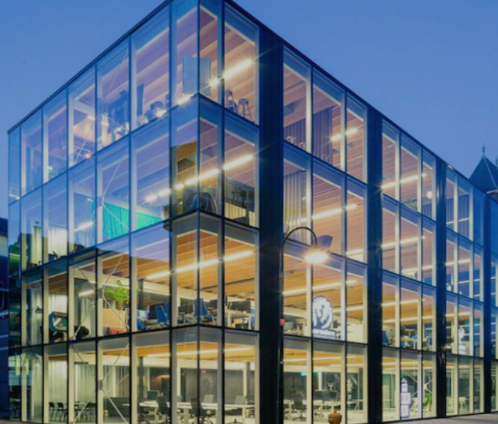
The ultimate “Safe Haven”?
It’s how many see Property as an investment – it’s not true of course, but it does give us a sense of where it stands on the risk spectrum.
Certainly in 2022, for Irish pension funds and investors generally, Irish commercial property has played this role in what has been an abysmal financial market environment.
Most, though not all, Irish property funds are showing small positive returns in 2022 – while stocks are in a bear market and bond yields have surged. Other investments such as so-called Absolute Return funds available in Ireland are also deeply in the red.
Typically an Irish pension fund might hold 5% in commercial property – it’s been higher in the past. Some would hold higher – some none at all. This is in turn allocated to the Office, Retail and Logistics (Industrial) sectors.
Today a confluence of factors sees all three sectors are in the midst of seismic shifts.
Office has always dominated commercial property portfolios and probably accounts for about 60% in a typical fund. Rents today point to the city centre still being sought after with rent levels over twice what’s being charged in any of the suburbs. We continue to see substantial activity here. And while issues such as global and domestic growth always play a role here, we are also facing the impact of new factors such as hybrid working and an institutional drive to sustainability.
Some potential office occupiers are understandably delaying expansion and relocation decisions until we can see greater clarity on what the week in the office will look like.
In other words – do we need the space?
It’s simply too soon to say where the endgame is on hybrid working. There is a lot of flux between employee surveys, corporate intentions and the health environment. Throw the energy crisis into this and any forward looking view on the extent of hybrid working is unsure. Perhaps the most that can be said is that in Ireland today about 31% of the workforce are not in the office five days a week. That number has come down and in all likelihood will fall further even if we’re not sure to where.
Return to office plans have been making headlines since mid 2020. Ultimately the issue will not just be about space. McKinsey say that executives should focus on making the workplace matter and measuring that success. There is a need to design and activate offices that truly foster human connection. It’s a complex issue; McKinsey highlight research which shows that work experience accounts for at least half of the average person’s human capital. That cannot be squandered in remote working.
Owned space can also be repurposed for other activity that can still meet corporate goals. A US insurance company has donated some space to third level education – creating a “triple bottom line” for the company, the local community and society.
The other watchwords sweeping through the Irish office market are sustainability and resilience. Property is pivotal in the race to net zero.
The OECD recently noted that buildings and construction account for nearly 40% of global energy-related CO2 emissions and, in larger cities, sometimes as much as 70%.
Many occupiers and investors have made bold and public commitments around decarbonisation with goals of 2030 or sooner.
This trend is irreversible.
JLL estimate that zero carbon commitments are expected to double over the next two years from 43% to over 80%.
The good news is that huge strides have been made by builders and developers in pursuing this agenda.
IPUT, for example, which is the largest office owner in Dublin, has had ESG factors embedded in its DNA for decades now and its practice and processes reflect standards many still aspire to. Through new builds and refurbs to science-based targets and occupier engagement, a truly holistic approach has been shown to work. It is now working on its first net zero carbon build.
So there will be a supply of best in class office space but also a stock of secondary buildings with poor ESG metrics. The investor will need to choose wisely.
While office dominates portfolios and grabs headlines, other sectors are also undergoing fundamental and unprecedented change.
As regards Industrial, the post covid obsession on supply chains, puts emphasis on “near shoring” and probably higher local inventory levels. Strong demand with little supply has seen rents rise and under-pins further advances. Corporates with a clear ESG mission will insist upon sustainability levels through the supply chain. Investors should do like-wise.
The Pandemic had a huge impact on trends in retail. During lockdowns, on-line sales in Ireland naturally rose to 15-20% of all retail sales based on CSO data. These levels, not surprisingly, fell back on re-opening, but settled at higher than pre-pandemic levels. The issue for investors looking at the Retail property sector is that some, such as consultants Oliver Wyman, see the on-line proportion moving to 25% over the next 5 years. Even for those who don’t avail of on-line, frequency of trips may have reduced.
Transaction activity in the sector is recovering from almost nothing in 2021 but investors need to think long and hard about how consumer habits may have changed for good.
An investor in Irish commercial property needs to consider (as they always have) risk of tightening financial conditions, level of supply, level and breadth of demand, valuations etc. Liquidity and vagaries in pricing are also ever present factors.
Current yields, at around 4%, stack up quite well in European comparisons.
Investors need to consider what sector offers the best risk return profile.
But perhaps today there is an imperative to drill deeper into those sectors and identify the winners and losers in a world of decarbonisation, hybrid working supply chain rebuilding and changed consumer habits.
For the investor, this may present more challenges – but also more opportunities.
 Tradewinds