Every day in stock markets seems to be a tug of war between the medical facts and their implications for further lock-downs, and the sheer scale of fiscal and monetary action being announced, or in the course of being implemented.
We have had the juggernaut move from mid-March when global equity markets bounced by about over 30% from their lows mainly on foot of promised policy support. Now some like Christine Lagarde, the ECB chief, venture to say that we are past the worst in economic terms in Europe.
But in the US the medical facts are deteriorating, and we are seeing a pushback on economic opening, certainly in the sun-belt states. The response from authorities has been closer to lock-down than the surgical and targeted moves that John Hopkins University and others were suggesting, and markets may have been assuming.
And in the US on down days there are many examples of highly recognizable corporate disappointments to enhance the negative narrative. Today it was Harley Davidson and Walgreens.
For the media, it has always been clear at sector level who were the clear losers from the Pandemic. As the virus spread and its economic consequences clarified, airlines, restaurants, leisure, hotels all garnered headlines. Factset have produced interesting analysis on media trends and the medical facts. Tracking media sentiment against confirmed cases in the US shows somewhat of a broad-brush approach in the early days of the pandemic. For example, road and rail gets similar sentiment as hotels and restaurants. But as time goes on, and we get further information on the degree of financial distress in certain sectors, coverage gets more “nuanced”. As cases declined, many of the sectors in the firing line did see an uptick in positive media coverage. However Airlines continue to be covered by the media with a healthy dose of scepticism. Given the likelihood of continued travel restrictions, quarantines etc. that cautious media sentiment seems appropriate. One recent anomaly in the US has been much improved sentiment for Hotels and Restaurants despite only more gradual improvements in restaurant reservations (OpenTable). This may be a reflection of more casual dining as consumers begin to dip a toe in the water.
The sheer size of the fiscal and monetary response is what many look to in order to frame a more constructive outlook for stock markets. The numbers are huge – estimates of £190B in the UK,€750B in Europe and a Washington Post estimate of $6 Trillion in the US when you combine both the Federal Reserve and Congress. The IMF estimate that the fiscal response worldwide is close to $11 Trillion. The actions certainly provided the “shock and awe” that markets needed in March and April.
However as the time frame lengthens, some of the media coverage around these packages is more about when certain supports will be reduced or stopped.
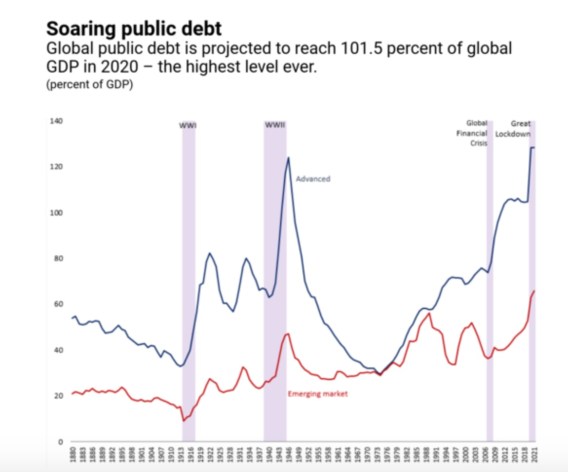
All acknowledge that unprecedented support is required and that debt to GDP ratios globally will balloon. The IMF estimates global public debt will reach 101.5% of global GDP – the highest level in recorded history
Not surprisingly, there is some mention of the fiscal responsibility side of the coin, that somewhere there is a limit to what can be brought to the table without compromising future generations and future growth. As the head of the Irish Central Bank, Gabriel Makhlouf said last week – “There is no money tree”.
However the media is giving much more space to outlining the scale and range of government spending. Indeed media coverage would be more supportive of the view of a former Irish Central Bank chief, Patrick Honohan, who said last week “There must be no loss of nerve in fully deploying the financial resources of the state and its borrowing capacity.”
And certainly for the economy and the markets that would seem to make sense.
 Tradewinds