 Investors need to find a balance between short term and long term factors in making decisions.
Focusing purely on short term factors will likely lead to over-trading, higher costs and leave fundamental investors at the mercy of high frequency strategies. All of which will ultimately haemorrhage returns.
At the same time, investors do need to be dynamic and aware of current market conditions and not simply invest on the basis of what may be extremely long term factors.
One of those key long term calls is that economic growth in the future will not match the run rate we have seen over the past 30 years or so. Irrespective of fiscal and monetary policy interventions around the globe, the trend rate of global economy will shift down a gear.
The drivers of this are well established and include demographics, high debt levels, lower productivity and growing income inequality.
But we know these long term factors aren’t going to impact on the investment case tomorrow any more than they did today. Allowing factors such as the above to dominate a dynamic investment strategy doesn’t make sense. It’s the well established challenge of getting the balance between long term and short term right.
For instance, concerns about record global sovereign debts levels shouldn’t really have a huge bearing on the correct valuation for IBM. Similarly growing global income inequality won’t feature in the medium term investment thesis for Ryanair.
So can we just park these long term factors like income inequality in coming to a market view?
In fact, it may well be that this very factor – growing income inequality (and one particular aspect of it) – has been influencing financial markets more directly in the past 2-3 years.
Growing global income inequality features a lot in the “Key Risks” sections of investment presentations. We’re all familiar with the “elephant curve” chart which shows how the top 1% in income terms have captured 27% of income growth in the past 35 years. It’s usually associated with the risks from rising populism etc.
However there’s another interesting aspect to this and it is one that was deemed sufficiently important to be given a full chapter in the IMF’s Global Outlook in October, and this is the rapid growth in inequality between regions within an individual state.
The picture below shows how the gap between regions within advanced economies has been growing since before 2000. The characteristics of these “lagging” regions include poorer health outcomes, lower labour productivity and reduced resilience in the face of economic shocks.
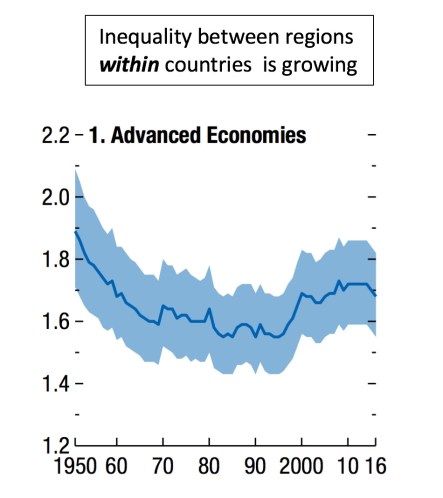
Just how wide is the gap in terms of GDP per capita? Typically in Advanced Economies, those regions in the top 10% are about 70% better off than the regions in the bottom 10%.
In the words of the IMF, this “can fuel discontent and political polarisation, erode social trust and threaten national cohesion”. Somehow sums up the environment today?
Why might this regional disparity matter more than the global aggregates usually quoted?
I think partly because it transposes so directly on to the political map. Many of the key political outcomes in recent years have been driven by clusters of people believing that they were being left behind or losing control. Brexit and Trump grew partly out of this disparity – with all the consequences for financial markets and currencies that we have seen.
For investors, Income inequality and its impact on growth, does fit into that longer term concerns bucket, but also can directly impact financial markets now.
And it’s a trend that’s not reversing anytime soon.
 Tradewinds